OT SOC Staffing Explained: Why the Real 2026 Shortage Is Skills, Not Headcount
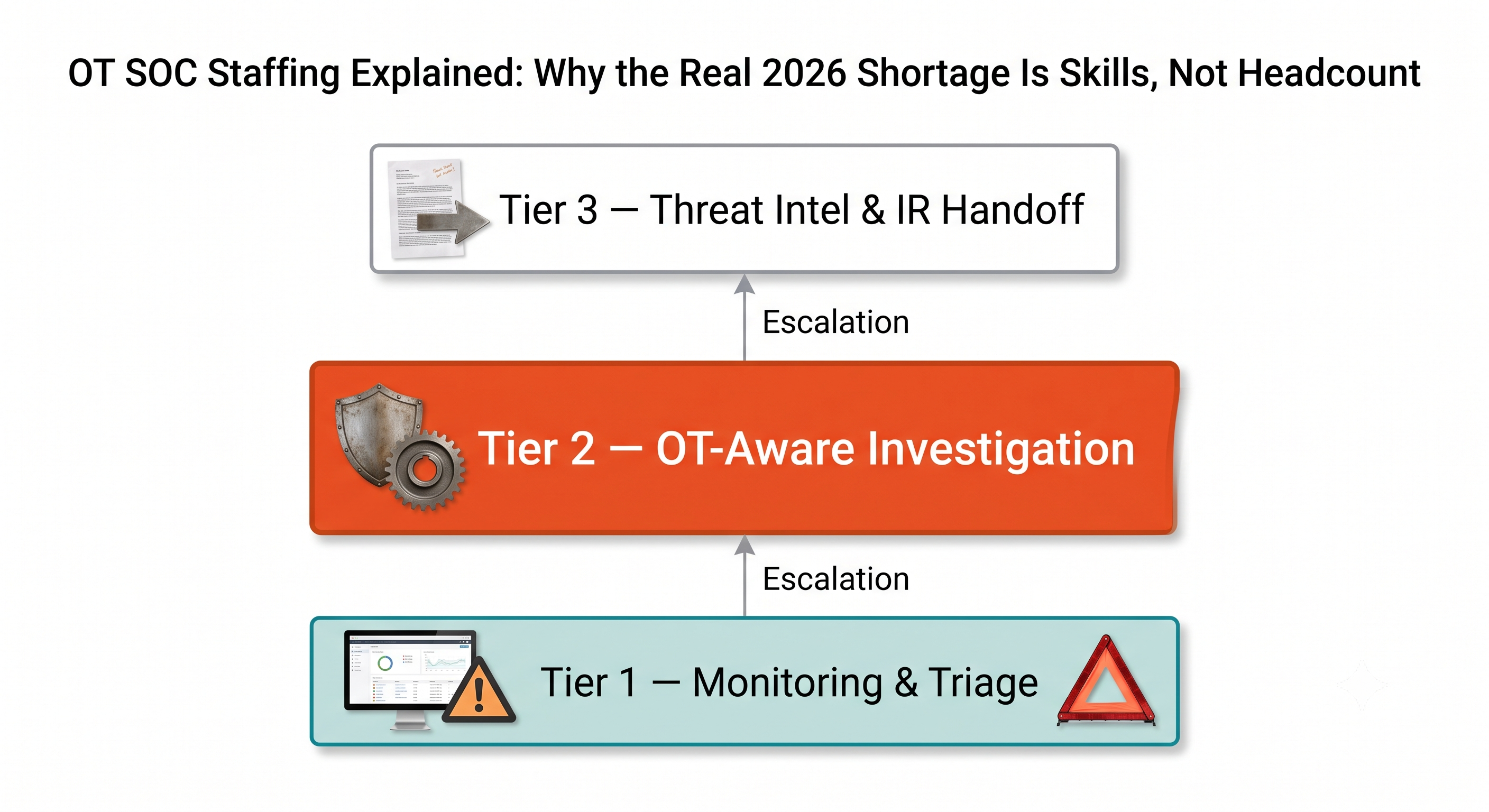
An OT SOC staffing model is the tiered team structure — typically a Tier 1 monitoring/triage layer, a Tier 2 OT-aware investigation layer, and a Tier 3 threat-intelligence/incident-response handoff layer — that industrial organizations build to actually watch an operational-technology network around the clock. The real staffing problem going into 2026 isn't a headcount gap, it's a skills gap: SANS's 2026 Cybersecurity Workforce Research Report found that skills gaps overtook headcount shortages as the top workforce challenge for the first time in the report's three-year history, with 60% of organizations citing skills gaps versus 40% citing staffing shortages — a 20-point gap that had been just 4 points a year earlier. For OT specifically, that skills gap is structural: an OT SOC analyst needs a rare combination of cybersecurity monitoring skill and industrial-process knowledge that almost no hiring pipeline produces in one candidate. This piece lays out the 3-tier staffing model plant security leads actually build, the realistic build-out timeline, and when a managed OT SOC beats building one in-house.
By The Whitepaper Skeptic — OT security architecture reviews and TCB/IR documentation prep
Quick Facts
| Question | Answer |
|---|---|
| What is an OT SOC staffing model? | The tiered team structure (Tier 1 monitoring/triage, Tier 2 OT-aware investigation, Tier 3 threat intel/IR handoff) an organization builds to watch an OT network continuously |
| Is the 2026 OT security workforce problem mainly headcount or skills? | Skills, per SANS's 2026 Cybersecurity Workforce Research Report (947 respondents) — the gap between "we need more people" and "we need people who know both SIEM tools and industrial process" |
| How many tiers does a typical OT SOC staffing model have? | Three — Tier 1 (monitoring/triage), Tier 2 (OT-aware investigation), Tier 3 (threat intel/incident-response handoff) |
| How long does it take to build a Tier 1-2 OT SOC in-house? | Opsio (a managed OT security provider) estimates roughly 12-18 months from an IT security baseline — a single-vendor estimate, not independently corroborated |
| When does a managed OT SOC make more sense than building in-house? | When the organization can't absorb a 12-18 month build-out runway or can't source OT-aware analysts fast enough on its own |
Why the 2026 OT Security Workforce Problem Is Skills, Not Headcount
Most budget conversations about OT security staffing still start from the same assumption: "we need to hire two or three more analysts." The 2026 workforce data — from SANS's Cybersecurity Workforce Research Report (947 respondents across six global regions: 56% North America, 16% Europe, 14% Latin America, 7% Asia-Pacific, 5% Africa, 2% Middle East) — says that assumption is increasingly wrong. For the first time in the report's three-year history, skills gaps overtook headcount shortages as the top-cited workforce challenge: 60% of organizations pointed to skills gaps as the bigger problem versus 40% citing staffing shortages, and that 20-point spread had been just a 4-point spread only a year earlier. Only 19% of organizations consider their security teams fully skilled, 35% report a moderate skills gap (10-29% of required skills missing), 13% report a major gap (more than 30% missing), and 27% report an actual breach tied directly to a workforce capability gap.
That reframe matters more in OT than almost anywhere else in security, because the OT analyst skill set is genuinely rare. A general SOC analyst needs to read SIEM alerts and threat intelligence. An OT SOC analyst needs that plus enough industrial-process literacy to tell the difference between an anomalous Modbus command that's a legitimate maintenance action and one that's an attacker manipulating a setpoint — a distinction a pure-IT hire usually can't make, and a plant engineer without security training usually can't either. Manufacturing remains one of the sectors under the most sustained pressure while this skills gap persists — the sector accounted for 27.7% of all cyberattacks in 2025, the highest share of any industry for the fifth consecutive year (IBM X-Force 2026 Threat Intelligence Index), and ransomware attacks on manufacturers rose 56% year-over-year in 2025 versus a 32% increase in global ransomware overall (Comparitech's 2025 end-of-year ransomware roundup) — which is exactly why staffing the team that has to catch those incidents is a different problem than simply adding names to a roster. See this cluster's manufacturing ransomware case studies spoke for the documented incident patterns behind that pressure.
Why a Siloed IT-Only or OT-Only SOC Structurally Misses the Attack Chain
Headcount alone doesn't fix this because of where OT incidents actually originate. TXOne Networks' 2026 Annual OT/ICS Cybersecurity Report — a Frost & Sullivan survey of 200 C-level OT security decision-makers across six industries and five regions, fielded in November 2025 — found that 96% of OT security incidents originate from IT-level compromises rather than a direct breach of the OT network itself. Dragos's own research describes the same pattern qualitatively, without attaching a specific figure: adversaries consistently gain access through the infrastructure that connects IT and OT rather than "getting into OT" directly. This means a SOC that's staffed entirely by IT-side analysts who don't understand the OT environment, or entirely by OT engineers who don't have security monitoring training, will structurally miss the handoff point where an intrusion crosses from the IT network into the control-system environment — regardless of how many people are on either team. This is the core argument for IT/OT SOC convergence: not a headcount increase on either side, but a staffing model built so at least some analysts can follow an attack chain across the IT/OT boundary instead of losing visibility exactly where it matters most.
The 3-Tier OT SOC Staffing Model
The staffing structure most OT security programs converge on — whether built in-house or delivered through a managed service — breaks into three tiers, each requiring a different blend of skills:
| Tier | Primary function | Typical background | Illustrative build-out timeline* |
|---|---|---|---|
| Tier 1 — Monitoring & triage | Watches SIEM/OT-monitoring platform alerts, performs first-pass triage, escalates anomalies | General SOC analyst background, OT-monitoring-platform-specific training | 3-6 months to reach basic competency on the platform |
| Tier 2 — OT-aware investigation | Investigates escalated alerts with process context — distinguishes a legitimate maintenance action from an actual intrusion | Blend of security analysis and industrial/control-systems background — the rarest hire on this list | 9-18 months to develop reliable process-context judgment |
| Tier 3 — Threat intel & IR handoff | Owns threat-intelligence context, hands off confirmed incidents into the organization's OT incident response plan | Senior security engineer or OT-specialized incident responder, often augmented by a vendor or MSSP retainer | Typically staffed last, frequently outsourced even in otherwise in-house programs |
*These timelines are illustrative, practitioner-informed ranges — not survey data — and will vary by facility complexity and existing staff background.
Tier 2 is where the "skills gap, not headcount gap" reframe from the SANS data above shows up most concretely: an organization can post a Tier 2 requisition and get applicants, but finding someone who can genuinely do both halves of the job — read a SIEM console and understand what a compromised PLC command would actually do to the physical process — is the actual bottleneck, not the number of open seats.
How Long It Actually Takes to Build an OT SOC In-House
Opsio, a managed OT security services provider, estimates a build-out window of roughly 12-18 months to bring a Tier 1-2 OT SOC capability from an IT security baseline to a functioning state — a single-vendor estimate rather than an independently corroborated industry-wide figure. That timeline covers hiring or training Tier 1 analysts on the OT-monitoring platform, developing the Tier 2 investigation skill set described above, and building the playbooks and escalation paths that connect the SOC's output into the organization's incident response process. For a mid-sized industrial organization that doesn't already have security engineering headcount to redirect toward this build-out, 12-18 months is a long runway to sustain without any interim OT visibility — which is the practical reason this timeline pushes many organizations toward a managed or co-managed arrangement instead of building fully in-house from day one.
In-House vs. Managed OT SOC: How to Decide
Neither option is universally correct — the decision comes down to whether the organization has the runway and the ability to source Tier 2 talent described above.
| Factor | Build in-house | Managed / co-managed OT SOC |
|---|---|---|
| Time to functioning Tier 1-2 capability | ~12-18 months (Opsio estimate; single-source, not independently corroborated) | Weeks to a few months — the provider already has the trained staff |
| Where the hardest hire (Tier 2) comes from | Your own recruiting pipeline, competing for a genuinely scarce skill set | The provider's existing bench, shared across multiple client environments |
| Ongoing cost structure | Fixed headcount cost regardless of alert volume | Typically a recurring service fee, often scaled to environment size |
| Institutional/process knowledge retention | Stays in-house, compounds over time as staff learn the specific plant | Depends on the provider's account continuity and how much is documented internally |
| Best fit | Larger organizations with sustained OT security budget and the ability to compete for OT-aware talent | Mid-sized organizations facing the skills-gap bottleneck directly, or those needing OT visibility faster than a 12-18 month build allows |
This is also where staffing decisions intersect directly with vendor selection: several of the platforms this cluster's own OT security vendor comparison spoke covers — Dragos in particular, through offerings like its OT Watch threat-hunting and monitoring service — sell managed or co-managed OT SOC capability specifically to organizations that don't want to run the 12-18 month in-house build-out themselves. Choosing a platform and choosing a staffing model aren't two separate decisions; for a managed arrangement, they're effectively the same decision.
Staffing cost — whether it's in-house headcount or a managed-service line item — is also one of the largest recurring entries in an OT security budget. This cluster's OT cybersecurity budget benchmarks spoke breaks down where OT security spend actually goes once a budget is approved, which is a useful companion read before taking a build-vs-buy staffing decision to leadership.
Where This Fits: Staffing vs. Incident Response
It's worth being explicit about how this spoke differs from this cluster's OT incident response plan spoke, because the two are easy to conflate. That piece is the playbook — the documented, engineering-informed set of steps a team follows once an incident is declared: who to call, what to isolate, what not to touch. This piece is the organizational structure and staffing that has to exist before an incident is even detected in the first place. An IR plan is worthless if there's no one watching the sensors to trigger it — the staffing model covered here is what makes sure someone actually is. The two pieces are meant to be read together: staffing determines whether an incident gets caught at all, and the IR plan determines what happens once it is.
FAQ
Q: What is an OT SOC staffing model?
A: It's the tiered team structure an industrial organization builds to monitor an operational-technology network continuously — typically a Tier 1 monitoring/triage layer, a Tier 2 layer that investigates alerts with industrial-process context, and a Tier 3 layer that owns threat intelligence and hands confirmed incidents off to the incident response process.
Q: How long does it take to build an OT SOC?
A: Opsio, a managed OT security provider, estimates roughly 12-18 months to bring a Tier 1-2 capability from an IT security baseline to functioning — a single-vendor estimate, not independently corroborated across multiple sources. That timeline is the main practical reason many mid-sized industrial organizations choose a managed or co-managed OT SOC instead of building fully in-house.
Q: Should we build an OT SOC in-house or use a managed OT SOC?
A: It depends on whether the organization can sustain a 12-18 month build-out and can realistically compete for the scarce Tier 2 "OT-aware analyst" skill set. Organizations with sustained budget and recruiting reach often build in-house over time; organizations that need OT visibility faster, or that keep losing the recruiting race for Tier 2 talent, typically lean toward a managed or co-managed arrangement.
Q: What skills does an OT SOC analyst need?
A: It varies by tier. Tier 1 analysts need general SOC monitoring/triage skills plus platform-specific training on the OT-monitoring tool in use. Tier 2 analysts need the much rarer combination of security investigation skill and enough industrial-process knowledge to tell a legitimate maintenance action apart from an actual intrusion — this is the specific bottleneck the 2026 skills-gap data points to.
Q: Is the OT security staffing shortage really about not having enough people?
A: According to SANS's 2026 Cybersecurity Workforce Research Report, no — for the first time in the report's three-year history, organizations cited skills gaps (60%) over headcount shortages (40%) as the bigger workforce challenge, a gap that widened sharply from the prior year. The practical implication for OT specifically is that adding headcount without addressing the Tier 2 skills bottleneck doesn't solve the underlying problem.
Sources
- SANS Research: The Cybersecurity Talent Shortage Narrative Is Wrong. The Real Crisis Is What Your Team Doesn't Know, Starting with AI — SANS Institute (official press announcement for the 2026 Cybersecurity Workforce Research Report)
- Cybersecurity Skills Gap Is Now the Top CISO Concern, SANS 2026 Workforce Report Finds — Cybersecurity Insiders
- Skills Gap Top CISO Concern, Says New SANS Survey — BankInfoSecurity
- Unifying the IT/OT SOC with Intelligence-Driven Cybersecurity — Dragos
- 2026 Annual OT/ICS Cybersecurity Report — TXOne Networks (Frost & Sullivan survey of 200 OT security decision-makers)
- What Is an OT SOC? OT Security Operations Center Explained — Opsio
- Threat Hunting & Security Monitoring (OT Watch) — Dragos
- Manufacturing saw the most cyberattacks of any industry in 2025: IBM X-Force — Manufacturing Dive
- Worldwide Ransomware Roundup: 2025 End-of-Year Report — Comparitech
Author Bio
The Whitepaper Skeptic has direct experience with OT cybersecurity in industrial and smart-factory environments, including customer-facing security architecture reviews where the recurring finding wasn't a missing monitoring tool but a staffing gap — plants that had a SIEM or OT-monitoring platform deployed but no analyst on the roster who could read both the console and the process it was watching — and TCB/IR-preparation work assembling the kind of structured, stakeholder-reviewed documentation that only functions if someone is actually staffed to watch the sensors it depends on.
Related Posts
- OT Cybersecurity 101: Why Smart Factories Need a Different Security Model Than IT
- OT Incident Response Plan Explained: The SANS Five Critical Controls Model for Building an ICS-Specific IR Playbook
- OT Security Vendor Comparison 2026: Dragos vs. Claroty vs. Nozomi Networks for Industrial Environments
- OT Cybersecurity Budget Benchmarks 2026: What Manufacturers Actually Spend on IT vs. OT Security
- Manufacturing Ransomware Case Studies: What OT/IT Segmentation Failures Actually Cost


Comments
Post a Comment