OT Security Vendor Comparison 2026: Dragos vs. Claroty vs. Nozomi Networks for Industrial Environments
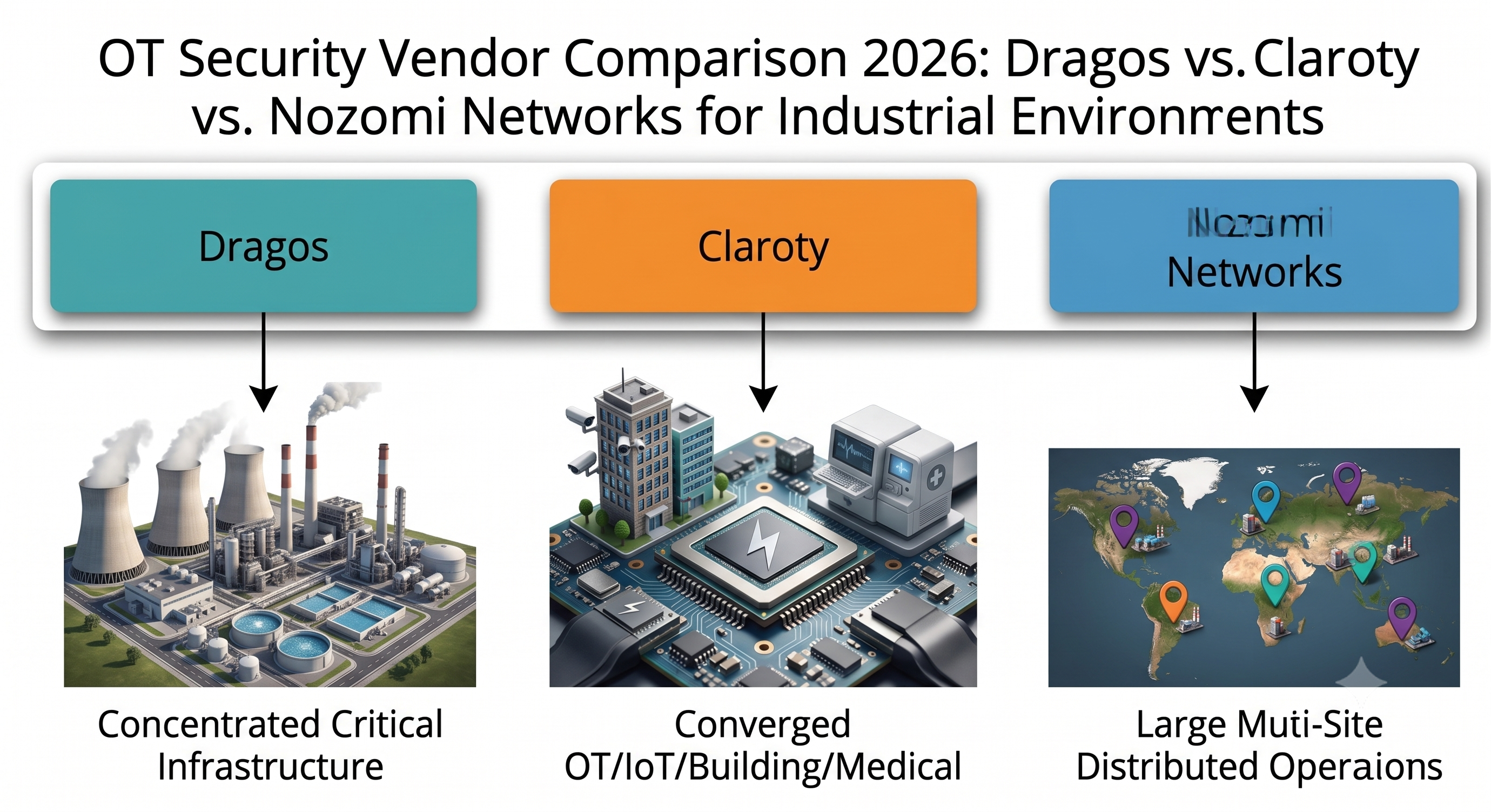
Dragos, Claroty, and Nozomi Networks were all named Leaders in the 2026 Gartner Magic Quadrant for CPS Protection Platforms — so "which one is best" isn't the right question, because Gartner didn't rank a single winner among them. The real decision driver is environment fit: Dragos leans strongest on ICS-specific threat intelligence and managed detection for concentrated, high-criticality sites; Claroty covers the broadest scope across OT, IoT, building systems, and medical devices; and Nozomi Networks offers the most flexible deployment options for large, multi-site, geographically distributed operations. This guide builds a vendor-neutral decision matrix around those differences instead of repeating any vendor's self-reported ranking.
Quick Facts
| Question | Answer |
|---|---|
| Are all three Gartner Leaders? | Yes — Dragos, Claroty, and Nozomi Networks were three of only four vendors named Leaders in the 2026 Gartner Magic Quadrant for CPS Protection Platforms, out of 13 vendors evaluated total; the fourth Leader was Armis |
| Does Gartner name a single "#1"? | No — a Magic Quadrant places vendors in a quadrant, it does not rank a single top vendor; any "highest-ranked" claim should be traced to the primary report, not a vendor press release |
| Dragos strongest fit | Single-site or concentrated critical-infrastructure environments (especially energy) needing deep ICS threat intelligence and managed detection/response |
| Claroty strongest fit | Converged environments spanning OT, IoT, building management, and medical devices under one platform (its "XIoT" scope) |
| Nozomi Networks strongest fit | Large, multi-site, geographically distributed deployments needing flexible sensor form factors (hardware, software, virtual, cloud) |
Why "Which One Is #1" Is the Wrong Question
Every one of these three vendors put out its own 2026 Gartner Magic Quadrant press release, and read side by side, the claims don't agree with each other — each vendor's PR highlights the specific axis (Ability to Execute, Completeness of Vision, or some combination) where its own placement looks strongest. That's not unusual behavior for enterprise security marketing, but it means none of the three press releases is a neutral source for "who's actually best." A Magic Quadrant places vendors into quadrants (Leaders, Challengers, Visionaries, Niche Players) based on Gartner's own methodology — it does not publish a single numeric #1 ranking that vendors can legitimately claim outright. All three companies landing in the Leaders quadrant — alongside Armis, the fourth Leader in a field of 13 evaluated vendors — tells you they all cleared a high bar, not which one fits your specific plant floor.
That's the frame this article uses: instead of trying to crown a winner, it maps each vendor's reported strengths against the kind of environment where that strength actually matters. If you've already worked through what assets you need visibility into and how you'd structure zones and conduits around them, you're in a much better position to score a vendor demo against real requirements instead of a generic feature checklist.
What Buyers Should Already Have Before Evaluating Vendors
Vendor selection isn't the first step in an OT security program — it's closer to the last step before implementation. Two inputs matter most:
- An asset inventory, even a partial one. You can't meaningfully evaluate a platform's asset-discovery claims if you don't already know roughly how many devices, what protocols, and what network topology you're working with. Walking into a vendor demo without this means you're evaluating marketing claims instead of fit.
- A zone and conduit design, even a draft one. IEC 62443's zone/conduit model defines what security levels and segmentation boundaries a platform actually needs to support. A platform that's excellent at flat-network monitoring but weak at multi-zone policy enforcement is a mismatch for a site that's already committed to a segmented architecture — and you won't catch that mismatch without having done the zone design first.
Skipping straight to vendor comparison without these inputs is how organizations end up buying a capable platform that doesn't fit their actual network.
Dragos vs. Claroty vs. Nozomi Networks: Decision Matrix
| Dimension | Dragos | Claroty | Nozomi Networks |
|---|---|---|---|
| Primary positioning | ICS-specific threat intelligence and managed detection/response | Broadest converged scope — OT, IoT, building systems, and medical devices ("XIoT") | Deployment flexibility for large, distributed multi-site environments |
| Deployment model | On-prem sensors with threat-intel platform | On-prem (Continuous Threat Detection / CTD) and cloud-native (xDome) | Hardware sensors, software sensors, virtual appliances, and cloud-native SaaS via Nozomi Vantage |
| Notable differentiator | Neighborhood Keeper — a free collective-defense threat-sharing community open to any Dragos Platform customer, spanning oil & gas, electric, water, manufacturing, and other critical-infrastructure sectors, with notable energy-sector partnerships (the U.S. Department of Energy as a Trusted Advisor, NERC's E-ISAC) | Medigate healthcare-device acquisition extends coverage into medical/clinical OT | Sensor form-factor breadth is the most frequently cited differentiator across independent comparisons |
| Best-fit environment | Single-site or concentrated critical infrastructure, especially energy, with heavy threat-intel needs | Organizations converging OT security with IoT, building automation, and/or medical-device security under one program | Large, multi-site, geographically distributed industrial footprints |
| Reported Gartner MQ 2026 status | Named a Leader | Named a Leader | Named a Leader |
| Pricing model | Quote-based, undisclosed | Quote-based, undisclosed | Quote-based, undisclosed |
None of the three vendors publishes list pricing for enterprise OT deployments — expect a scoping call and a quote tied to site count, sensor count, and services, not a published price sheet.
Claroty vs. Nozomi Networks: The Closer Head-to-Head
Dragos is the clearest outlier of the three on scope — it stays tightly focused on ICS/OT threat detection and intelligence rather than expanding into adjacent device categories. Claroty and Nozomi Networks are the more directly comparable pair, since both compete on breadth of asset visibility across converged environments. The reported difference is less about detection quality and more about where each company has invested its platform architecture: Claroty's expansion has gone toward device-category breadth (healthcare, building systems, IoT alongside OT), while Nozomi's expansion has gone toward deployment-form-factor breadth (letting the same visibility platform run as a hardware appliance in one plant and a cloud-native sensor in another). A converged-security program spanning multiple device categories under one roof tends to point toward Claroty; a program spanning many physically distributed sites with varying infrastructure maturity tends to point toward Nozomi.
How Environment Fit Should Actually Drive the Decision
- Single-site or concentrated critical infrastructure (especially energy) with a need for deep ICS threat intelligence and incident response support → Dragos's reported strengths line up most closely here.
- Converged security programs spanning OT plus IoT, building management, and/or medical devices → Claroty's XIoT scope is the most directly relevant reported fit.
- Large, multi-site, geographically distributed operations with mixed infrastructure maturity across sites → Nozomi Networks's deployment flexibility is the most frequently cited fit in independent comparisons.
These are directional starting points based on how each vendor is generally positioned in current third-party comparisons, not a substitute for a scoped proof-of-concept against your own network. Any serious shortlist should still include a hands-on pilot before a contract is signed — self-reported and third-party comparisons will get you to a shortlist of two, not a signed decision.
What This Comparison Deliberately Leaves Out
This article does not attempt a pricing comparison. OT security platform pricing across all three vendors is quote-based and not publicly disclosed — any article claiming specific per-sensor costs, license tiers, or contract minimums for these platforms is estimating, not reporting. Get actual quotes scoped to your asset count and site footprint before budgeting.
FAQ
Q: Which is better, Dragos, Claroty, or Nozomi Networks?
A: There's no single "better" — all three were named Leaders in the 2026 Gartner Magic Quadrant for CPS Protection Platforms, and each vendor's own press release naturally emphasizes the angle where it looks strongest. The right choice depends on your environment: Dragos for concentrated critical-infrastructure sites with heavy threat-intel needs, Claroty for converged OT/IoT/medical/building-systems programs, and Nozomi Networks for large multi-site distributed deployments.
Q: Were Dragos, Claroty, and Nozomi Networks all named Leaders in the same 2026 Gartner Magic Quadrant?
A: Yes — all three, along with Armis, were the four vendors named Leaders (out of 13 evaluated) in the 2026 Gartner Magic Quadrant for CPS Protection Platforms. A Magic Quadrant doesn't declare one overall winner, so being a co-Leader doesn't resolve which platform fits a specific buyer.
Q: What's the difference between Claroty and Nozomi Networks for asset visibility?
A: They're the closer comparison of the three, since Dragos stays more narrowly focused on OT/ICS. Claroty has generally expanded breadth by device category (OT plus IoT, building systems, and medical devices via its Medigate acquisition), while Nozomi Networks has generally expanded breadth by deployment form factor (hardware, software, virtual, and cloud-native sensors under one platform), which tends to suit organizations with many distributed sites.
Q: How much do Dragos, Claroty, and Nozomi Networks cost?
A: None of the three publishes list pricing — OT security platform pricing for all three is quote-based and scoped to factors like site count and sensor count. Any figure you see cited elsewhere as a specific price should be treated skeptically unless it's tied to a named, dated quote.
Q: What should I do before comparing OT security vendors?
A: Build at least a partial asset inventory and a draft IEC 62443 zone/conduit design first. Without those inputs, a vendor demo is really just a marketing presentation — you need to know roughly what you're protecting and how you plan to segment it before a platform's specific capabilities become meaningfully comparable.
Sources
- Gartner, "Magic Quadrant for CPS Protection Platforms" (2026) — primary source for Leaders-quadrant placement; use the Gartner landing/reprint page rather than any single vendor's press release for positioning claims
- Nozomi Networks, 2026 Gartner Magic Quadrant announcement (vendor-sourced, cited here only for Nozomi's own claims, not as a neutral ranking)
- Claroty, 2026 Gartner Magic Quadrant announcement (vendor-sourced, cited here only for Claroty's own claims, not as a neutral ranking)
- Dragos, 2026 Gartner Magic Quadrant press release (vendor-sourced, cited here only for Dragos's own claims, not as a neutral ranking)
- Elisity, "7 Top OT Security Vendors for 2026 [Compared]"
- IoT & AI Security Institute, "Navigating the OT Security Landscape: A Comparison of Claroty, Nozomi Networks, and Dragos"
Author Bio
The Whitepaper Skeptic has direct experience with OT cybersecurity in industrial and smart-factory environments, including customer-facing security architecture reviews covering network segmentation, asset inventory gaps, and legacy-equipment risk on live production networks — the same practical requirements (what needs visibility, how zones and conduits are structured) that determine which OT security platform actually fits a given environment, rather than a personal deployment history with any specific named vendor.
Related Posts
- OT Cybersecurity 101: Why Smart Factories Need a Different Security Model Than IT
- OT Asset Management: How to Build an Industrial Asset Inventory When You Don't Know What's on the Network
- IEC 62443 Zones and Conduits Explained: How to Actually Segment an OT Network in 2026
- Manufacturing Ransomware Case Studies: What OT/IT Segmentation Failures Actually Cost
- OT Cybersecurity Budget Benchmarks 2026: What Manufacturers Actually Spend on IT vs. OT Security


Comments
Post a Comment