Korea Research Institute Spin-Off Companies Explained: How KAIST and ETRI Turn Patents Into Equity Startups in 2026
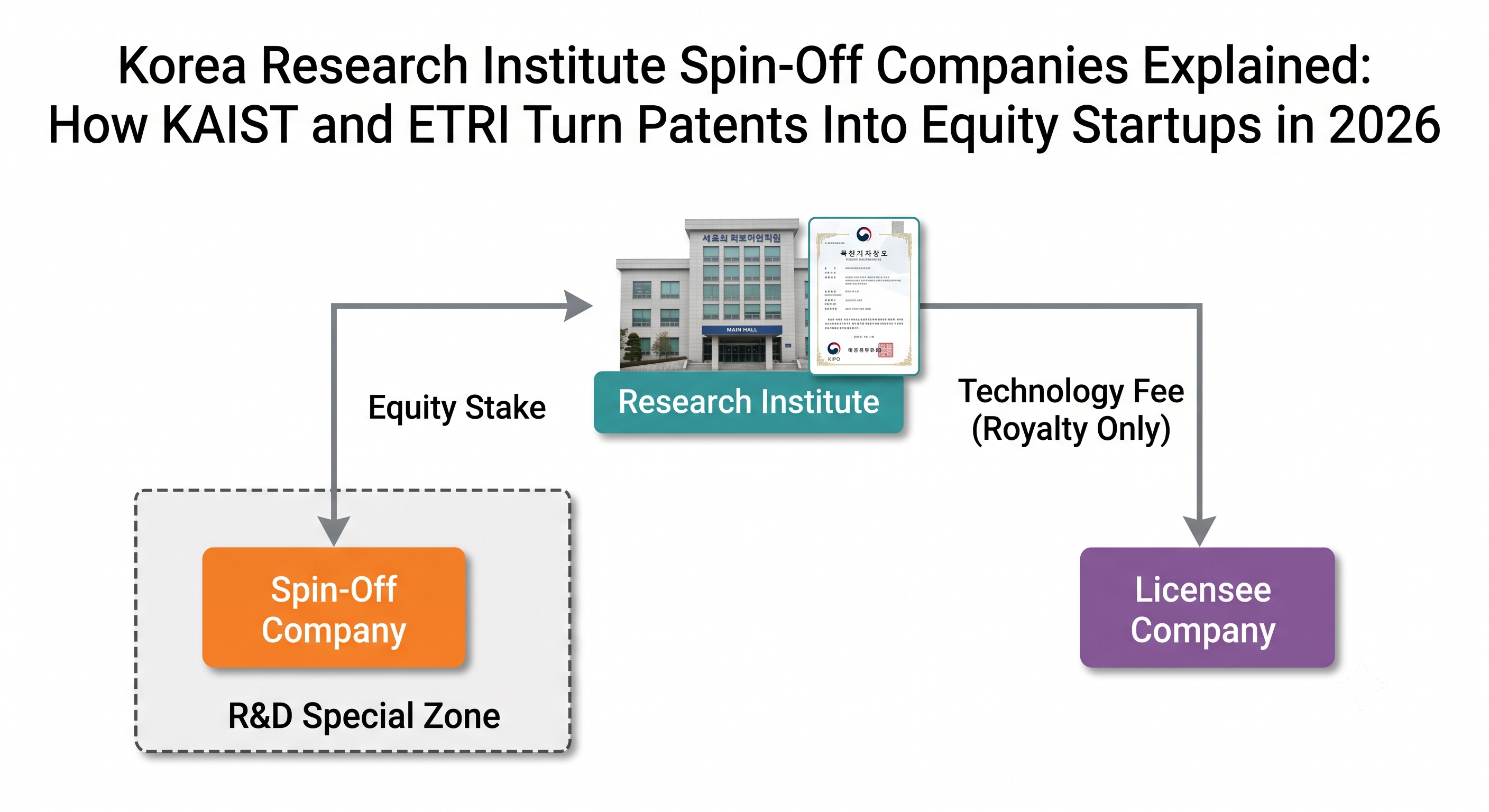
A 연구소기업 (research institute spin-off company) is a legally defined Korean vehicle in which a public research institute — a university, government-funded research institute, or research hospital — takes a direct equity stake in a newly incorporated company to commercialize its own patented technology, and the company must be established inside one of Korea's designated R&D special zones. In exchange, the company receives a multi-year corporate tax exemption tied to that zone residency. This is structurally different from a university simply licensing a patent for a royalty, and it's also different from a generic "KAIST-founded startup" — a company whose founder happens to be a KAIST alumnus but where the institute itself holds no equity and no formal registration exists.
By The Whitepaper Skeptic — negotiated IP-ownership and technology-fee terms in Korean R&D grants
Quick Facts
| Question | Answer |
|---|---|
| What is a 연구소기업? | A legally defined Korean vehicle where a public research institute takes a direct equity stake — currently a minimum of 10% of capital, per the enacted 2021 amendment to the 연구개발특구법 시행령 — in a new company to commercialize its own patented technology |
| Where must the company be based? | Inside one of Korea's designated R&D special zones. The list has expanded well beyond the original five (Daedeok/Daejeon, Jeonbuk, Gwangju, Daegu, Busan) — Gangwon was added as a sixth major zone, and INNOPOLIS has designated 13 additional "Gangso" (강소) specialized zones in rounds since 2019 (including Seoul Hongneung, Ansan, Pohang, and Gumi), bringing the 2026 total to 19 designated zones nationwide |
| What tax break does it get? | Under 조세특례제한법 제12조의2, a 100% corporate/income tax exemption for the first 3 years of income, stepping down to 50% for the following 2 years (5 years total) |
| How is this different from IP licensing? | The institute takes equity in the new company itself — it isn't collecting a royalty from a licensee, which is a separate mechanism (기술료, the technology fee) |
| Is Point2 Technology a registered 연구소기업? | Unconfirmed, and unlikely as a formally registered entity in the strict sense — it's a KAIST-linked founder's startup headquartered in San Jose, with its Seoul office in Gangnam-gu (Sinsa-dong), which is not one of the designated R&D special zones. Formal 연구소기업 registration requires special-zone residency in Korea and should not be assumed from "KAIST-linked" press coverage alone |
What Is a Korean Research Institute Spin-Off Company (연구소기업), Exactly?
The term gets used loosely in English-language coverage — "KAIST spinoff," "ETRI-linked startup," "research institute spin-off" all get applied to companies that range from formally registered vehicles to startups that simply have a professor or grad student as founder. The legal version is narrower and more specific.
A 연구소기업 is a company in which a "public research institute" — defined under Korea's Special Act on the Promotion of Research and Development Special Zones (연구개발특구법) to include universities, government-funded research institutes (GRIs) like ETRI or KIST, and research hospitals — takes a direct equity stake in a newly incorporated entity formed specifically to commercialize a patent or other IP the institute already owns. The institute isn't licensing the technology out to a founder who then builds a company around it on their own; the institute itself becomes a shareholder in the company from formation, contributing the patent as (part of) its equity consideration.
That structure is what separates a real 연구소기업 from the two things it's most often confused with in casual reporting: a "professor spinoff" where a faculty member starts a company using knowledge gained at the university but the university holds no formal equity, and a straight IP license where a startup pays a royalty to use a patent but the institute never sits on the cap table. Our companion piece on who owns the IP from a Korean government R&D grant covers that second mechanism — the 기술료 (technology fee) a grant recipient pays back to the government only upon successful commercialization. That's a fundamentally different flow of value than what happens in a 연구소기업, where the institute converts a patent it already owns directly into a founding equity position rather than collecting a royalty later.
The Equity Stake: How Much Does the Institute Actually Take?
For a foreign co-founder or lead investor, the equity question is the one that actually determines how a cap table looks from day one.
Under the current framework, a public research institute registering a 연구소기업 is required to hold a minimum equity stake of 10% of the company's capital in exchange for contributing its patented technology. That flat 10% floor isn't a pending proposal — it was enacted via an amendment to the 연구개발특구법 시행령 that passed the 국무회의 (Cabinet meeting) and took effect June 23, 2021, replacing an older tiered structure that had required 20% for companies with capital under ₩1 billion, 15% for ₩1-5 billion, and 10% for companies above ₩5 billion. The same 2021 amendment went further for later-stage companies: if a 연구소기업 raises outside investment that increases its capital base after formation, the institute's required stake can drop to as low as 5%, so the founding-stage 10% isn't necessarily the floor for the life of the company.
For a foreign lead investor evaluating a Series A or later round in a formally registered 연구소기업, the practical implication is straightforward: the institute's equity stake is baked into the cap table from incorporation, not negotiated away later, and it doesn't dilute the same way a later financing round does — it's a founding-stage allocation, not a new issuance a fundraise has to price around. That's a materially different governance starting point than a company where the "KAIST connection" is purely reputational.
Where It Must Be Located: The Special Zone Residency Requirement
A 연구소기업 doesn't just need an equity relationship with a public research institute — it has to be physically established inside one of Korea's designated R&D special zones (연구개발특구). The original five major zones were Daedeok (Daejeon), Jeonbuk, Gwangju, Daegu, and Busan; Gangwon was later added as a sixth major/broad zone. Layered on top of those, the government designated a separate tier of smaller "Gangso" (강소) specialized zones in rounds starting in 2019 (including Ansan, Pohang, and Gumi) and continuing through a 2022 round that added Seoul Hongneung, Ulsan Ulju, Jeonnam Naju, Jeonbuk Gunsan, and Chungnam Cheonan-Asan, among others. As of 2026, INNOPOLIS counts 13 Gangso zones alongside the 6 major zones — 19 designated R&D special zones nationwide in total.
This residency requirement is the detail that matters most for evaluating press coverage of any specific "KAIST spinoff" or "ETRI spinoff" story: a company headquartered outside Korea entirely — in the U.S., for example — cannot simultaneously be a formally registered 연구소기업 in the legal sense, because the zone-residency condition isn't optional. A company can absolutely have a KAIST-affiliated founder, KAIST-originated IP, and even a formal licensing relationship with KAIST, without meeting the residency and equity conditions that make it a 연구소기업 under Korean law.
The Tax Incentive
The trade the institute and the founding team make for that equity stake and zone residency is a corporate tax exemption. Under 조세특례제한법 (Restriction of Special Taxation Act) 제12조의2, a qualifying company inside a designated R&D special zone — including a registered 연구소기업 — receives a 100% corporate/income tax exemption for the first three years of income, stepping down to a 50% exemption for the following two years (five years total), layered on top of other special-zone R&D incentives available inside the same zones.
INNOPOLIS by the Numbers: How Big Is This System, Really?
INNOPOLIS first publicized crossing 1,001 cumulative research-based spin-off companies as of August 2020 — starting from the program's first registered company, Kolmar BNH, founded in 2006. As of that 2019-2020 snapshot, INNOPOLIS reported these companies had generated a combined ₩739.4 billion in sales and roughly 3,910 jobs, a 75.0% five-year survival rate against a 28.5% general Korean startup average, and an average of 7.6 years from founding to IPO. The program has grown substantially since: INNOPOLIS's own registered-company ledger showed 1,334 active 연구소기업 as of December 31, 2024, and 1,345 as of June 30, 2025 — roughly a third more than the 2020 milestone count. INNOPOLIS has not republished an updated combined sales, jobs, or survival-rate figure alongside those more recent registry snapshots, so the 2019-2020 performance figures above should be read as the last full performance breakdown made public, not as a current 2026 statistic — treat them as illustrative of program-wide track record rather than a present-day scale metric.
The 2026 News Hook: KAIST, GIST, DGIST, UNIST Launch Startup Arms
What made this mechanism newly relevant in August 2026 is a coordinated push from Korea's four leading science and technology institutes — KAIST, GIST, DGIST, and UNIST — each launching a dedicated in-house "startup arm" specifically to move more of their patented research toward this commercialization track, according to Seoul Economic Daily's coverage. Separately, the same four institutes jointly ran a "2026 Emerging Tech Global Launchpad" program earlier in the year, targeting 50 companies total — 20 in a "Go-To-Global" track (companies already preparing for or partially entered overseas markets) and 30 in a "Born-To-Global" track (companies building overseas-expansion capability from an earlier stage) — with a June 19, 2026 application deadline, per Seoul Economic Daily's coverage of the program launch.
The specific company tying this policy push to a concrete funding headline is Point2 Technology — a KAIST-linked interconnect startup that closed a $136 million Series B in August 2026, with NVIDIA and Arm both participating as investors, according to SDxCentral's coverage. That's a genuinely notable round for a Korea-linked deep tech company. What it is not — at least not confirmed — is proof that Point2 Technology is itself a formally registered 연구소기업 under the mechanism this article describes.
Available reporting describes Point2 Technology as a company founded in 2016 out of a KAIST research lab by Professor Hyeon-Min Bae (now Dean of the KAIST Startup Institute) and headquartered in San Jose, California since founding — a location that would be structurally inconsistent with the special-zone residency requirement described above unless the company separately maintains a zone-resident Korean entity that holds a formal registration. No source reviewed for this article — Korean or English trade coverage — describes Point2 explicitly as a registered 연구소기업; coverage consistently uses looser framing like "KAIST-linked," "KAIST deep tech startup," or "KAIST spinout." That pattern is suggestive but not conclusive, so this article treats Point2's formal 연구소기업 status as unconfirmed rather than assuming it either way.
How This Differs From Licensing IP or Being a Founder-Affiliated Startup
Because "KAIST spinoff" gets applied loosely to at least three structurally different arrangements, a direct comparison is more useful than prose alone:
| Feature | Research institute spin-off (연구소기업) | IP licensing (grant-funded IP) | Founder-affiliated startup |
|---|---|---|---|
| What the institute gets | Direct equity stake (minimum 10% of capital, per the enacted 2021 시행령 amendment) in the new company | A 기술료 (technology fee/royalty) only if the licensed tech is commercialized | Nothing formal — no equity, no fee, no legal link to the institute |
| Governing structure | Registered under 연구개발특구법, special-zone residency required | Governed by the underlying R&D grant's research agreement | No special registration; ordinary Korean corporate law only |
| Tax treatment | 100% corporate tax exemption for 3 years, 50% for 2 more years (5 years total), per 조세특례제한법 제12조의2 | Standard corporate tax; the technology fee is a separate obligation, not a tax break | Standard corporate tax, no special exemption |
| What press coverage often calls it | "Research institute spin-off," "KAIST spinoff" (correctly, if formally registered) | Rarely described this way in press coverage | Also frequently called a "KAIST spinoff" (loosely, and often inaccurately) |
The middle column — IP licensing under a government R&D grant — is covered in full in our companion piece on Korean government R&D grant IP ownership and the technology fee. The distinction worth internalizing: a 연구소기업 is about an institute converting IP it already owns into a founding equity stake, while the technology fee mechanism is about a grant recipient (often the startup itself) owing money back to the government only if a government-funded project it already controls the IP for gets commercialized. They can both apply to the same company at different stages of its life, but they are not the same transaction.
What This Means for Foreign Investors and Co-Founders
For a foreign investor doing pre-deal diligence on a Korean deep-tech target, or a foreign researcher scoping how to commercialize IP developed at a Korean institute, the practical questions this mechanism raises are worth asking explicitly rather than assuming from a company's press narrative:
- Is the institute actually on the cap table? A "KAIST-linked" or "ETRI-linked" description in press coverage does not, by itself, confirm formal 연구소기업 registration. Ask for the actual shareholder registry.
- What governance rights come with the institute's equity? A public research institute holding at least 10% of a company's capital is a different governance dynamic than a passive financial investor holding the same percentage — board representation, veto rights over certain corporate actions, and reporting obligations back to the institute can all attach to that stake depending on the registration terms.
- Does the special-zone residency requirement affect where the company can eventually headquarter or redomicile? A formally registered 연구소기업's tax-exempt status is tied to physical presence inside a designated zone — worth understanding before assuming a later international relocation is straightforward.
- How does this interact with the company's broader funding history? Our guide to Korea's deep tech VC ecosystem and our piece on how foreign investors do due diligence on Korean deep tech startups both cover adjacent diligence angles — TCB certification status, government grant history, and now, where relevant, formal spin-off equity structure — that a complete cap-table review should account for together, not in isolation.
For a foreign founder considering building on IP licensed or spun out from a Korean institute directly, the visa and residency side of that decision is a separate but related question, covered in our guide to Korea's D-8-4 tech startup visa. And once a spin-off or licensed-IP company reaches the stage of negotiating actual investor term sheets, the equity-instrument mechanics — RCPS structures in particular are common in Korean venture rounds — are worth understanding on their own terms in our RCPS vs. SAFE breakdown.
None of this is a reason to avoid the mechanism — a formally registered 연구소기업 comes with a real tax benefit and a credibility signal (an institute doesn't stake its own equity lightly). It's a reason to ask the registration and governance questions directly rather than inferring them from a funding-round headline.
FAQ
Q: What is a 연구소기업 in South Korea?
A: A 연구소기업 (research institute spin-off company) is a legally defined Korean vehicle in which a public research institute — a university, government-funded research institute, or research hospital — takes a direct equity stake in a new company formed to commercialize IP the institute already owns, and the company must be located inside one of Korea's designated R&D special zones.
Q: How much equity does a Korean research institute take in a spin-off company?
A: A public research institute is currently required to hold a minimum of 10% of the new company's capital in exchange for contributing its patented technology, a flat floor enacted via a 2021 amendment to the 연구개발특구법 시행령 that replaced an older tiered structure requiring up to 20% for smaller-capital companies. That required stake can later drop to as low as 5% if the company raises outside investment that increases its capital base.
Q: What's the difference between a research institute spin-off company and simply licensing IP from a Korean university?
A: In a 연구소기업, the institute takes direct equity in the new company from formation. In a straight IP license (including the technology-fee arrangement common under Korean government R&D grants), the institute or funding agency collects a royalty-style payment only if and when the licensed or grant-funded technology is successfully commercialized — the institute doesn't hold shares in the company either way.
Q: Is Point2 Technology a formally registered Korean research institute spin-off company?
A: This is unconfirmed. Point2 Technology is widely described as KAIST-linked following its $136 million Series B in August 2026 with NVIDIA and Arm as investors, but it is headquartered in San Jose, California — which would be structurally inconsistent with the special-zone residency requirement unless a separate Korean entity holds the formal registration. Treat "KAIST-linked" as a founder-affiliation claim, not confirmation of formal 연구소기업 status, until the company's own registration is verified.
Q: What tax benefits does a Korean research institute spin-off company get?
A: Under 조세특례제한법 제12조의2, a qualifying company gets a 100% corporate/income tax exemption for its first three years of income and a 50% exemption for the following two years (five years total), tied to the company's location inside a designated R&D special zone.
Sources
- INNOPOLIS (연구개발특구진흥재단) — "Ministry of Science and ICT, broke through 1000 INNOPOLIS Research-based Spin-off Companies!" (official English release) — 2019-2020 cumulative milestone, sales, jobs, and survival-rate figures
- 연구소기업/창업 제도소개 — KISTI 성과활용가이드시스템 — primary Korean-language regulatory summary of the equity requirement and special-zone list
- 국가법령정보센터 — 조세특례제한법 제12조의2 (연구개발특구에 입주하는 첨단기술기업 등에 대한 법인세 등의 감면) — official statutory text of the 3-year 100% / 2-year 50% corporate tax exemption schedule
- 전자신문 — "연구개발특구 입주기업 규제 완화... 특구법 시행령 개정" (2021) — confirms the 20%→10% equity-floor amendment passed 국무회의 and took effect June 23, 2021, plus the further easing to 5% on later capital increases
- 아주경제 — "[규제혁신①] 연구소기업 설립 주체 최소지분율 20→10% 인하 추진" (2021) — detail on the prior tiered 10-20% structure the 2021 amendment replaced
- INNOPOLIS (연구개발특구진흥재단) — 연구개발특구 연구소기업 등록 및 등록취소 현황 (기준일: 2025.6.30, 등록기업 총 1,345개) — most recent publicly available registered-company count
- Seoul Economic Daily — "Four Korean Science Institutes Launch Startup Arms as KAIST Firm Draws Nvidia and Arm" — KAIST/GIST/DGIST/UNIST startup-arm launch, August 2026
- Seoul Economic Daily — "Korea's Top 4 Science Institutes Launch Global Push for Deep Tech Startups" — "2026 Emerging Tech Global Launchpad" program details
- Seoul Economic Daily — "Daedeok Innopolis Accelerates Tech Entrepreneurship Push for Researchers" — context on the Daedeok special zone's researcher-commercialization push
- SDxCentral — "Nvidia AI interconnect darling bags $136M funding from Arm, others" — Point2 Technology's $136M Series B, NVIDIA and Arm participation
- How South Korea Funds Deep Tech Startups: TCB Certification & Government R&D Grants Explained — our own pillar article, background on the broader Korean government funding system this mechanism sits alongside
Author Bio
The Whitepaper Skeptic has directly negotiated IP-ownership and technology-fee terms embedded in Korean government R&D grant agreements, and prepared TCB certification documentation for deep tech startups where a research institute's equity position needed to be explained cleanly to outside investors and co-founders.
Related Posts
- How South Korea Funds Deep Tech Startups: TCB Certification & Government R&D Grants Explained (pillar)
- Who Owns the IP From a Korean Government R&D Grant? Ownership Rules and the Technology Fee Explained
- Korea's Deep Tech VC Ecosystem: Who's Funding Semiconductors, Robotics, and Advanced Materials Startups in 2026
- How Foreign Investors Do Due Diligence on Korean Deep Tech Startups
- Korea's D-8-4 Tech Startup Visa Explained: How the OASIS Points System Replaces the ₩100M Capital Requirement in 2026
- RCPS vs SAFE: How Korean Startup Equity Financing Actually Works in 2026
Tags
Korea research institute spinoff, INNOPOLIS, KAIST startup, Korea R&D special zone, tech transfer Korea


Comments
Post a Comment