Foldable Display Durability Testing Explained: How 200,000-Fold Ratings Actually Get Measured
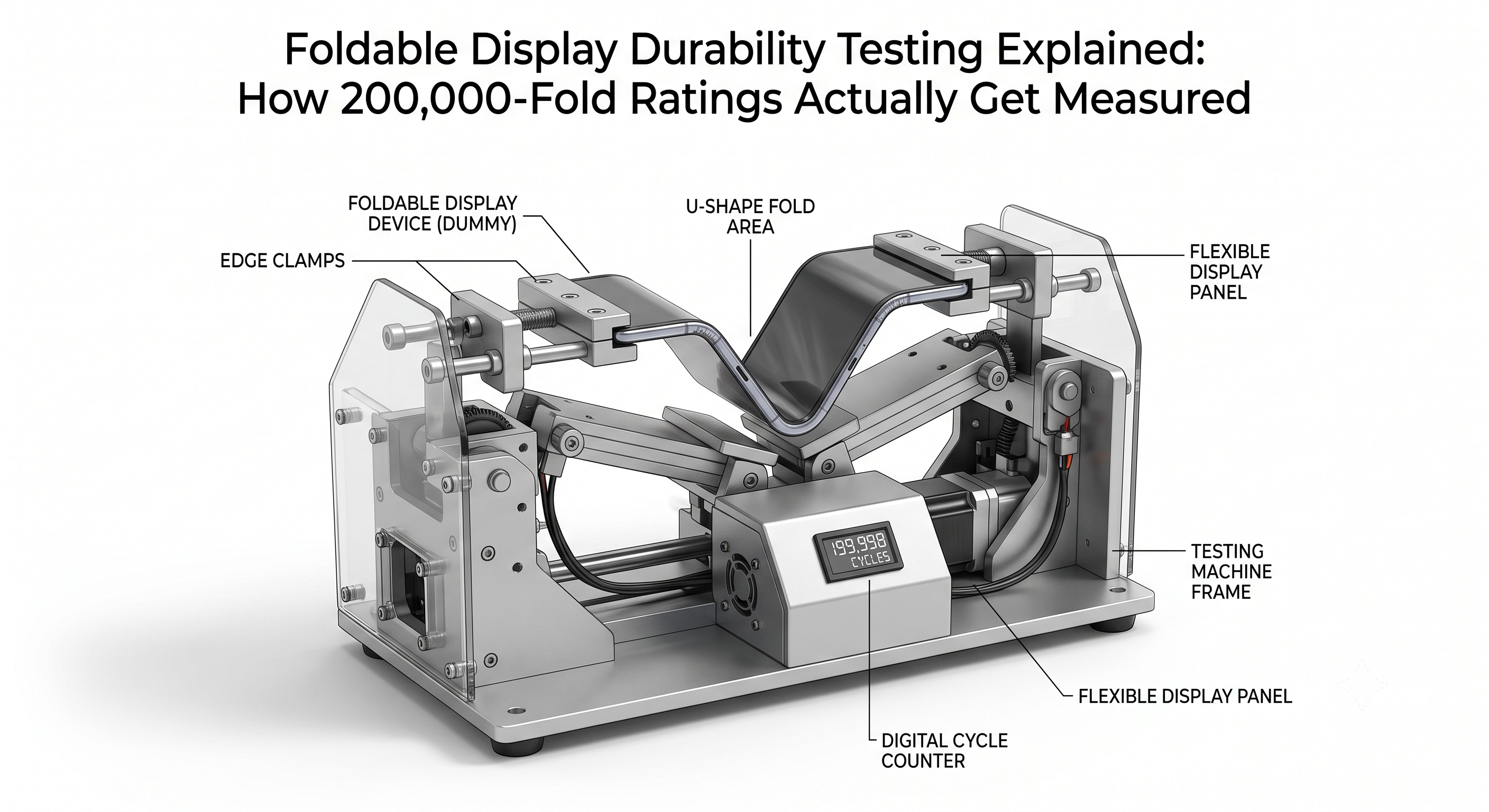
Foldable-display durability testing measures three separate things — fold-cycle fatigue, crease depth, and impact resistance — using standardized lab rigs, not a simulation of real-world abuse. A shipping foldable's advertised fold-cycle number, commonly cited in the 200,000–400,000 range industry-wide in 2026, comes from a cyclic bend tester run to IEC 62715-6-1 under fixed temperature, fold angle, and speed, with no dust, drops, sweat, or grit involved. That's exactly why an independent torture test can show a hinge creaking at a fraction of its rated cycle count without the original lab rating being false: the number on the spec sheet is a controlled materials-qualification result, not a warranty promise about how the device behaves in a pocket for two years.
Quick Facts
| Question | Answer |
|---|---|
| What standard governs foldable bend-cycle testing? | IEC 62715-6-1 — a fold/bend test method for flexible display devices, implemented via cyclic U-shape bend testers |
| What standard governs crease measurement? | IEC 62715-6-22:2023 — a crease-and-waviness measurement methodology, typically executed with 3D-profilometer scanning |
| What fold-cycle rating do most 2026 foldables carry? | Commonly 200,000–500,000 folds depending on generation and test temperature. Samsung's current-generation Galaxy Z Fold8 (unveiled July 22, 2026; on sale August 5, 2026) carries an officially reported 500,000-fold hinge rating, per Samsung and multiple outlets (SamMobile, July 26, 2026) — a device-level figure distinct from the panel's fold-cycle rating, which Samsung has not disclosed for this generation |
| What did independent testing show on the Galaxy Z TriFold? | Hinge creaking reported around ~61,000 and ~121,000 folds, elasticity degradation around ~144,000 folds, against a stated 200,000-fold rating (SamMobile, 9to5Google, Digital Trends, December 2025) |
| Does a lab fold-cycle rating predict real-world failure? | No — lab testing holds temperature, angle, speed, and cleanliness constant, which real-world use never does, so the rating functions as a qualification spec rather than a guarantee |
Why a "Durability Rating" Isn't One Number
Every foldable-phone durability headline compresses three physically different failure modes into a single figure, and that compression is where most of the public confusion starts. A fold-cycle rating measures fatigue in the hinge mechanism and the flexible panel stack under repeated bending. A crease measurement measures how visible and how permanent the fold line becomes over time. An impact or drop rating measures how much point-load stress the cover layer can absorb before cracking. These are not the same test, they don't use the same rig, and a strong number on one doesn't guarantee a strong number on another.
There's a second, quieter source of confusion: device-level versus panel-level claims, and it plays out differently across generations. The table below breaks out exactly what each commonly-cited number actually refers to:
| Generation | What's Rated | Fold-Cycle Number | Test Condition |
|---|---|---|---|
| Galaxy Z Fold6 (2024) | Hinge mechanism (device-level) | 200,000 folds | Not disclosed |
| Galaxy Z Fold7 (July 2025) | Foldable OLED panel, Bureau Veritas-verified | 500,000 folds | Fixed 25°C |
| Galaxy Z Fold7 (July 2025) | Same panel, temperature-derated | 300,000 folds | 60°C |
| Galaxy Z Fold7 (July 2025) | Same panel, temperature-derated | 60,000 folds | -20°C |
| Galaxy Z Fold8 (unveiled July 22, 2026) | Hinge mechanism (device-level) | 500,000 folds | Panel figure not disclosed this generation |
So the 200,000/300,000/500,000 spread that shows up in a search isn't one inconsistent number — it's three different things: an older generation's hinge rating (Z Fold6), a temperature-derated panel figure for the prior generation (Z Fold7 panel at 60°C), and the current generation's device-level hinge rating (Z Fold8), with tech coverage in 2026 not always making clear which one it's citing. The Z Fold7's 500,000-fold panel claim was already sourced and cited in this blog's companion article on OLED thin-film encapsulation.
What every credible lab rating shares, regardless of the exact number, is that it's measured under controlled variables: fixed temperature, fixed fold angle, fixed folding speed, and a clean test environment with no contaminants. That's the same logic as a materials qualification test in any manufacturing context — you hold everything constant except the variable you're measuring, so the result is repeatable and comparable across runs. It is explicitly not a simulation of a phone riding in a pocket with pocket lint, temperature swings, and inconsistent folding force from a real hand. That gap between lab-controlled and real-world-uncontrolled is the single most useful thing to understand before treating any fold-cycle number as a warranty promise.
Inside the Bend-Test Rig: How IEC 62715-6-1 Testing Actually Works
IEC 62715-6-1 is the fold/bend test method standard for flexible display devices, and the physical apparatus used to run it is more mundane than the marketing language around "hundreds of thousands of folds" suggests. Test-equipment makers such as Yuasa System build cyclic U-shape folding machines explicitly marketed as compliant with IEC 62715-6-1 — the panel or device under test is clamped at both edges, and a motor-driven mechanism folds it through a defined angle (typically to a U-shape, mimicking an inward book-style fold) at a fixed speed, over and over, while a counter tracks completed cycles.
The test runs until either a target cycle count is reached (the number the manufacturer wants to validate, such as 200,000 or 300,000 cycles) or a defined failure condition occurs — visible cracking, delamination, a functional failure of the display, or a mechanical failure in the hinge if the whole device rather than a standalone panel is under test. What the rig deliberately does not vary is everything else: ambient temperature is held constant, the fold angle and radius are fixed by the test fixture, and there's no dust, moisture, or off-axis folding force introduced. That controlled repetition is what makes the resulting number scientifically comparable between two different manufacturers' claims — assuming both actually tested to the same IEC method, which not every marketing claim discloses.
Measuring the Crease: IEC 62715-6-22 and the Permanent-Set Problem
Fold-cycle count measures whether a hinge and panel survive repeated bending. It says nothing about how visible the fold crease becomes, which is a separate and, for a lot of buyers, more immediately noticeable durability question. IEC 62715-6-22:2023 standardizes crease-and-waviness measurement methodology specifically to close that gap — the test typically uses 3D-profilometer scanning to map the physical depth and shape of the crease line after folding, rather than relying on a human eye judging "is this crease bad."
The underlying material behavior being measured is a form of polymer creep — the cover layer and internal film stack don't fully spring back to flat after repeated folding, and some deformation becomes permanent, or "set," over the display's life. Patent-literature summaries describe permanent-set retention in a rough 3–5% range as an illustrative figure for this kind of deformation. This research could not trace that figure to a peer-reviewed materials-engineering study or a standards-body source — it comes from a patent-aggregator (Patsnap) summary of cover-window patent claims, and searches for an independent academic source (bending-fatigue studies on colorless polyimide and OLED cover-window stacks) turned up qualitative descriptions of creep and permanent deformation but no matching quantitative figure. Readers should treat 3–5% as a rough, secondary-sourced illustration of the phenomenon rather than a confirmed, citable industry spec.
The measurement side of this is still actively evolving as device geometry gets more complex. Samsung Display led a revision to the multi-fold crease-measurement standard that was published in June 2026, using numerical differentiation to map multiple peaks and valleys across a single panel — aimed squarely at multi-fold devices like tri-fold phones, where a single-crease measurement approach designed for one fold line doesn't cleanly apply to a panel with two or more fold points. Samsung Display engineer Lee Seung-min presented the work at the 2026 Display International Standards Forum, held August 18 at BEXCO in Busan alongside the ICDM Busan International Conference. This is independently corroborated by Korean business-tech press (Sisajournal-e, August 2026) in addition to Sammy Fans (August 18, 2026) coverage of the same forum.
Three Different Failure Modes, Not One "Durability" Score
It's worth stating plainly what each rig actually tests, because a single "durability" number on a spec sheet or in a review headline tends to flatten three distinct engineering questions into one:
- Bend-fatigue rig (IEC 62715-6-1): How many open/close cycles the hinge mechanism and flexible panel stack survive before a defined failure condition — the source of the "200,000-fold" style rating.
- Crease-recovery rig (IEC 62715-6-22:2023): How deep and how permanent the visible fold line becomes over the display's life, measured with 3D-profilometer scanning rather than a fold-cycle counter.
- Drop/impact rig: How much point-load stress the cover layer can absorb before cracking — a completely different mechanical failure mode from fold fatigue. At MWC 2026, Samsung Display's own booth materials describe a golf putting station where a foldable smartphone serves as the "hole," repeatedly struck by golf balls to demonstrate the panel's ability to withstand impact (Samsung Display Newsroom, global.samsungdisplay.com/31431) — a repeated point-impact test on the cover layer, not a fold-fatigue test. It follows an earlier CES 2026 demonstration in which a robotic arm launched basketballs at a backboard built from mounted foldable phones.
A device can score well on one of these and mediocre on another — a hinge that survives 300,000 open/close cycles without mechanical failure can still develop a visibly deep crease well before that count, because crease depth and hinge fatigue are governed by different parts of the stack. Treating "durability" as one number obscures that a buyer evaluating a foldable is really asking about three semi-independent engineering properties at once.
What Independent Torture Tests Actually Show: The Galaxy Z TriFold Case
In December 2025, independent torture-test coverage of the Galaxy Z TriFold reported hinge wear appearing well before the device's stated 200,000-fold rating: creaking noise from the first hinge was reported starting around 61,000 folds, creaking from the second hinge around 121,000 folds, and a measurable degradation in hinge elasticity around 144,000 folds. These figures were reported consistently across multiple outlets — SamMobile, 9to5Google, PhoneArena, and Digital Trends all covered the same test results, which trace back to an automated eight-day fold marathon run by the YouTube channel OMG_electronics, per PhoneArena's coverage.
It's tempting to read that as proof the 200,000-fold rating was inflated marketing, but that's not the most likely explanation, for two reasons that matter to anyone weighing a fold-cycle spec against a torture-test headline. First, hinge creaking is a symptom of wear onset, not a failure condition — a fatigue-life rating is typically defined against an actual functional or structural failure threshold, not against the first audible noise a component makes as it breaks in. A hinge can creak and keep functioning for tens of thousands of additional cycles. Second, an independent torture test's fold cycle, speed, angle, and environment are very unlikely to exactly replicate the certified lab conditions the original rating was measured under — a faster fold cadence, a slightly different fold angle, or ambient conditions outside the lab's controlled range can all shift when wear symptoms first appear without changing the underlying qualification number. The torture-test numbers are real and worth knowing before buying a tri-fold device, but they document when wear becomes noticeable under one specific test protocol, not proof that the manufacturer's rated cycle count was false.
Where the Standards Are Headed: Rollable Displays and Multi-Fold Panels
Foldable-display standards work is not finished — it's actively expanding to keep pace with new form factors. IEC published its first global standard for rollable-display "flattening force" — the mechanical force required to unroll and flatten a rollable panel — in June 2026. This is corroborated independently by Korean business-tech press (Sisajournal-e, August 2026), which also reports that a China-based project leader directed that specific standardization effort within IEC. This article was not able to independently verify the standard's exact publication number against IEC's own webstore catalog — a direct search of webstore.iec.ch turned up the IEC 62715-6 series through 62715-6-23:2024 but did not surface a confirmable listing for the newer rollable-flattening-force document, so no specific standard number is asserted here pending that confirmation.
Taken together with Samsung Display's multi-fold crease-measurement standard revision discussed above, the direction is clear: as tri-fold phones and rollable displays move from concept to shipping product, the existing bend-cycle and crease-measurement standards built for a single fold line are being extended and, in some cases, rewritten to handle geometry the original IEC 62715 series wasn't written for.
FAQ
Q: How are foldable phone fold-cycle ratings measured?
A: They're measured on a cyclic bend-test rig — commonly a U-shape folding machine built to IEC 62715-6-1 — that clamps the panel or device and folds it through a fixed angle at a fixed speed and temperature, counting cycles until a target count is reached or a defined failure condition occurs. The controlled conditions (no dust, no temperature swings, consistent fold force) are what make the number a repeatable lab spec rather than a real-world guarantee.
Q: What is IEC 62715 for foldable displays?
A: IEC 62715 is a series of standards covering flexible display devices. Within it, IEC 62715-6-1 covers the fold/bend test method used to generate fold-cycle ratings, and IEC 62715-6-22:2023 covers crease-and-waviness measurement — a separate methodology for quantifying how visible and permanent a fold line becomes, typically using 3D-profilometer scanning.
Q: Why did my foldable's hinge start creaking before the rated fold count?
A: Creaking is generally a symptom of wear onset, not the failure threshold a fold-cycle rating is defined against — a hinge can creak and keep functioning for many more cycles. It can also appear earlier than a lab rating if your actual fold speed, angle, or environment differs from the controlled lab conditions the rating was tested under; independent torture tests on devices like the Galaxy Z TriFold have documented exactly this pattern.
Q: What is a crease-recovery test?
A: A crease-recovery or crease-and-waviness test measures how deep and how permanent a fold line becomes after repeated folding, using standards like IEC 62715-6-22:2023 and typically 3D-profilometer scanning. It's a separate test from fold-cycle fatigue testing — a display can pass a high fold-cycle count while still developing a visibly deep, permanent crease line, because crease depth is governed by polymer creep in the cover layer rather than hinge mechanical fatigue.
Q: Does the Galaxy Z Fold really last 200,000 folds?
A: It depends on which generation and which layer you mean. The current Galaxy Z Fold8 (August 2026) carries an officially reported 500,000-fold hinge rating; the prior Z Fold7 had a Bureau Veritas-verified 500,000-fold panel rating at 25°C that fell to 300,000 folds at 60°C; and the older Z Fold6 was rated at 200,000 folds. So 200,000 describes an older generation, not the current one — but whatever the exact rated number for a given model, it describes performance under controlled lab conditions (fixed temperature, angle, and speed, no contaminants), not a guarantee against real-world wear appearing sooner.
Sources
- IEC — IEC 62715-6-1:2018, "Flexible display devices - Part 6-1: Mechanical test methods - Deformation tests" and IEC 62715-6-22:2023, "Flexible display devices - Part 6-22: Crease and waviness measurement methods" (titles and scope verified directly against IEC's own webstore catalog)
- Yuasa System Co., Ltd. — bending test machine product page, as a concrete example of an actual IEC-62715-6-1-oriented display fold-test rig
- Samsung Display — "Samsung Display's Foldable OLED Panel Proves Exceptional Durability with 500,000-Fold Test," July 22, 2025 (Bureau Veritas-verified panel-level durability claim for the Galaxy Z Fold7 panel, tested at 25°C; already cited and verified in this blog's OLED thin-film encapsulation article)
- Samsung Display — "Samsung Display Showcases AI-Optimized OLED Technologies at MWC26" (primary source confirming the golf-ball impact demonstration and CES 2026 basketball demonstration)
- SamMobile — Galaxy Z Fold8 durability coverage, July 26, 2026 (Galaxy Z Fold8 hinge fold-cycle rating, device-level vs. panel-level distinction)
- Independent Galaxy Z TriFold torture-test coverage, December 2025 (cross-corroborated hinge-wear figures, OMG_electronics test attribution per PhoneArena): SamMobile, 9to5Google, PhoneArena, Digital Trends
- Android Central — MWC 2026 Samsung golf-ball durability simulator coverage
- Sisajournal-e, August 2026 (Korean business-tech coverage of Samsung Display's Busan standards-forum presentation and the IEC rollable flattening-force standard)
- Sammy Fans, August 18, 2026 (corroborating coverage of the same Busan forum presentation)
- Society for Information Display (SID) — general reference/terminology backup
- Patsnap (patent-aggregator summary of cover-window/foldable-panel patent claims) — source of the ~3–5% permanent-set retention figure cited in the crease-measurement section; flagged in-text as a secondary, non-peer-reviewed source that could not be independently corroborated against a standards body or academic study
Author Bio
The Whitepaper Skeptic has direct project experience working with a global materials supplier on a display-related manufacturing project, including reviewing mechanical durability and reliability test specifications as part of a broader materials qualification process — the same lens applied here to separating a lab-controlled fold-cycle rating from a real-world durability guarantee.
Related Posts
- How Are OLED and LCD Displays Manufactured? A Guide to Panel Fabrication and Inspection — the pillar guide covering the full display fabrication and inspection process this article's durability-testing deep dive builds on
- OLED Thin-Film Encapsulation Explained: How Barrier Films Keep Flexible Displays From Dying in Days — the barrier-film materials and structure that a fold-cycle test is, in part, stress-testing at the crease line
- Machine Vision for Display Defect Inspection: How AOI and Deep Learning Catch Sub-Pixel Defects — a companion look at how display defects get detected in production, versus how durability is validated before a panel ever reaches the line
Tags
foldable display durability, IEC 62715, fold cycle testing, crease measurement, display reliability testing


Comments
Post a Comment