GICSP vs. ISA/IEC 62443 Certification: Which OT Security Credential Should You Get in 2026?
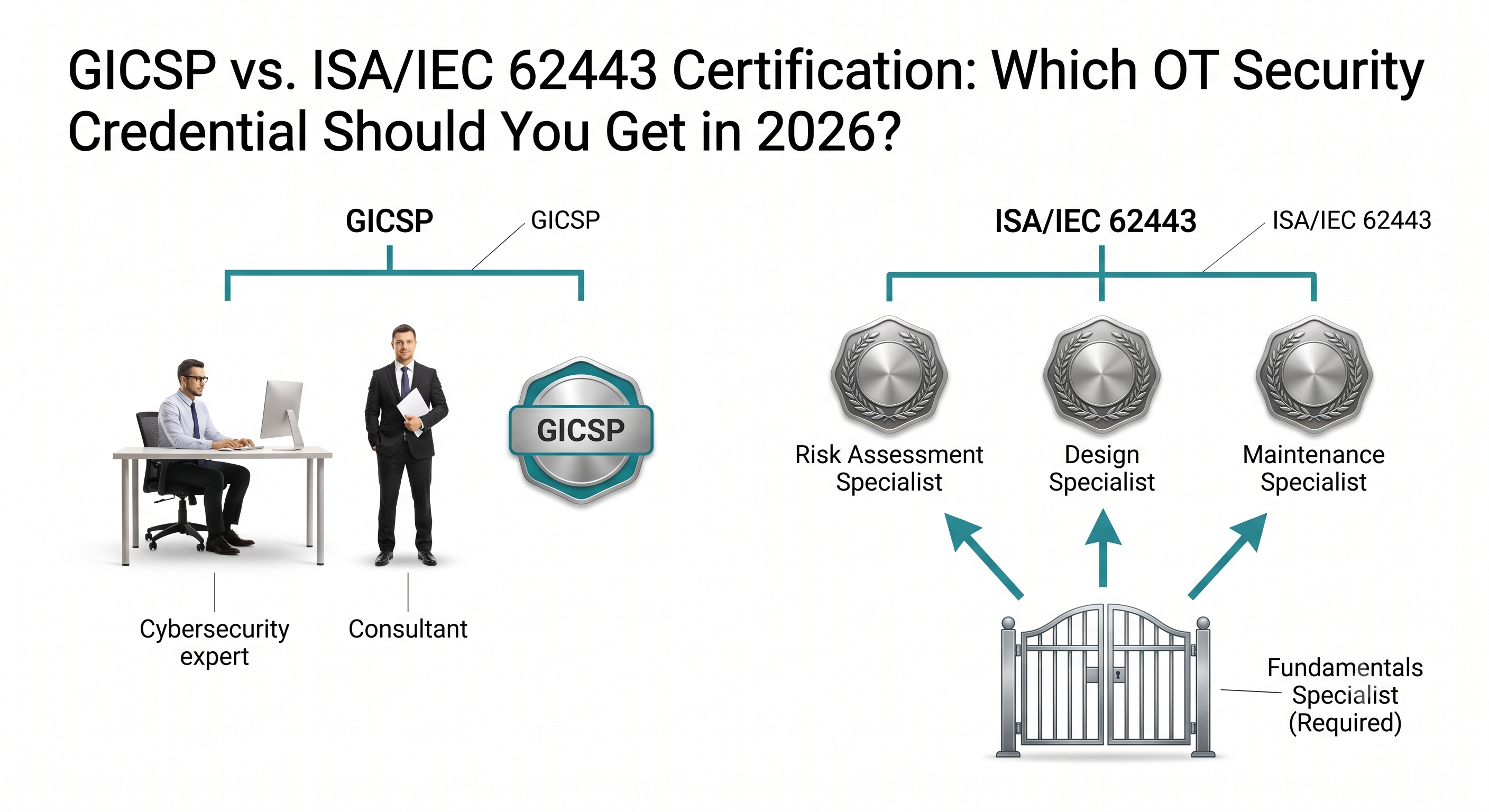
GICSP is the better fit if you're coming from an IT/cybersecurity background and moving into hands-on OT defense work, especially in government- or defense-adjacent environments — it's a single proctored exam. ISA/IEC 62443 certificates are the better fit if you're a control-systems engineer, or you do design, governance, or compliance work — it's a four-tier certificate program with a mandatory prerequisite, not one exam. The two credentials test different things and target different job functions, so "which one" mostly comes down to what your job title already is, not which one is "harder" or "more respected."
By The Whitepaper Skeptic — OT security architecture reviews and TCB/IR documentation prep
Quick Facts
| Question | Answer |
|---|---|
| What is GICSP? | A single proctored-exam credential from GIAC/SANS (82-115 questions, 3 hours, 71% pass bar), valid 4 years |
| What is ISA/IEC 62443 certification? | A four-tier certificate program (Fundamentals → Risk Assessment → Design → Maintenance Specialist), with Fundamentals as a mandatory prerequisite for the other three |
| Who is GICSP built for? | IT-background engineers moving into hands-on OT defense, and government/defense-adjacent roles |
| Who is ISA/IEC 62443 built for? | Control-systems engineers and anyone doing OT security design, risk-assessment, or compliance/governance work |
| Roughly what does each cost? | GICSP: ~$999 exam-only, or ~$8,780 bundled with SANS ICS410 training. ISA/IEC 62443: roughly $2,000 per certificate non-member (~$1,600 ISA member) — stacking all four runs into the same range as the GICSP+training bundle |
Two Different Things Being Compared
The first source of confusion in this comparison is structural: GICSP and "ISA/IEC 62443 certification" aren't the same kind of credential, so comparing them head-to-head like two competing exams is slightly misleading.
GICSP (Global Industrial Cyber Security Professional) is a single credential earned by passing one proctored exam. It's administered by GIAC, the certification arm of SANS, and it's built around hands-on defense of industrial control systems — the assumption is that you're the person actually watching, hardening, or responding on an OT network.
"ISA/IEC 62443 certification" isn't one exam — it's a four-certificate program run by ISA (International Society of Automation), built around the IEC 62443 series of standards themselves:
- Cybersecurity Fundamentals Specialist — the mandatory entry point. You can't sit for the other three without it.
- Risk Assessment Specialist
- Design Specialist
- Maintenance Specialist
That prerequisite structure is the detail most listicle-style comparisons of "top OT security certifications" skip over, and it's the single most useful thing to understand before you pay for anything: a control-systems engineer who wants the Design Specialist certificate has to pass Fundamentals first, whether or not they ever plan to use the Fundamentals credential on its own.
GICSP: Cost, Format, and Renewal
GICSP is priced two ways. You can sit the exam standalone for roughly $999, or you can take it bundled with SANS's ICS410: ICS/SCADA Security Essentials course, which runs roughly $8,780 for the training-plus-exam package. The standalone exam-only path is the one to compare against ISA/IEC 62443's per-certificate pricing below; the training bundle is really a separate purchase decision (do you need the training, or do you already have the OT background and just need to prove it on an exam).
The exam itself runs 82-115 questions over a 3-hour window, with a 71% passing score. GICSP certifications are valid for 4 years, after which you renew either by earning 36 Continuing Professional Experience (CPE) credits or by retaking the exam, plus a renewal fee (reported at roughly $499 in current GIAC pricing — confirm the exact current figure on GIAC's own renewal policy page before budgeting, since certification body fees change).
ISA/IEC 62443 Certificate Program: Cost, Format, and the Prerequisite Gate
Each of the four ISA/IEC 62443 certificates is its own course-plus-exam bundle, priced at roughly $2,000 for non-ISA-members and roughly $1,600 for ISA members. Unlike GICSP, there's no single "exam" you can point to — the format, question count, and time limit vary by which of the four certificates you're sitting.
The structural point worth repeating: Fundamentals Specialist is a mandatory gate, not just a recommended starting point. You cannot earn Risk Assessment, Design, or Maintenance Specialist without first holding Fundamentals. In practice this means the real decision isn't "should I get 62443 certified" — it's "how many of the three specialist tiers past Fundamentals do I actually need for my job."
Unlike GICSP, ISA's own renewal page confirms this is a one-time credential: ISA does not require holders to renew ISA/IEC 62443 Cybersecurity Certificate Program certificates, and ISA's certificate-program FAQ states plainly that "you do not need to renew your certificate." That's because ISA classifies these as certificates (proof you completed a course-plus-exam), not certifications in the CAP/CCST sense — ISA's own CAP and CCST certifications do sit on a mandatory three-year renewal cycle, but the four ISA/IEC 62443 certificates don't. There's no published CPE/continuing-education requirement or renewal fee for them, because there's no renewal event to attach one to. If your employer or a client contract requires proof the credential is "current," that's a policy question for them, not an ISA renewal deadline — confirm directly on ISA's renewal page if your situation is non-standard.
GICSP vs. ISA/IEC 62443 at a Glance
| Aspect | GICSP | ISA/IEC 62443 Certificate Program |
|---|---|---|
| Structure | Single proctored exam | Four-tier certificate program (Fundamentals mandatory gate + 3 specialist tiers) |
| Issuing body | GIAC (SANS) | ISA (International Society of Automation) |
| Cost (entry point) | ~$999 exam-only, or ~$8,780 with ICS410 training bundle | ~$2,000/certificate non-member, ~$1,600 ISA member |
| Exam format | 82-115 questions, 3 hours, 71% passing score | Varies by certificate; each is its own course-plus-exam |
| Validity | 4 years, then 36 CPEs or retake + renewal fee | No renewal required — ISA classifies these as certificates, not renewal-cycle certifications like its own CAP/CCST |
| Best suited for | IT-background engineers moving into hands-on OT defense; government/defense-adjacent roles | Control-systems engineers; design, risk-assessment, and compliance/governance roles |
| Regulatory tie-in | Discussed alongside DoD 8140/8570 workforce alignment in some sources — treat as unconfirmed until checked against an official DoD 8140 credential list | Increasingly referenced as a due-diligence baseline in NIS2-driven vendor/procurement conversations (NIS2 does not name 62443 certification by title as a legal mandate) |
Which One Should You Get? A Decision Table by Job Title
None of the existing "top 5 OT security certifications" roundups walk through this as a decision tree tied to what you actually do all day — they treat it as a ranked list. In practice, the choice tracks your job function much more cleanly than any ranking would:
| If your current role is... | The better starting point is... |
|---|---|
| IT security analyst/engineer moving into OT defense | GICSP |
| Control-systems or instrumentation engineer | ISA/IEC 62443 Fundamentals Specialist, then Design Specialist |
| OT security consultant doing architecture/design work | ISA/IEC 62443 (Fundamentals, then Design Specialist) |
| GRC, compliance, or audit role tied to vendor qualification or regulatory alignment (e.g., NIS2) | ISA/IEC 62443 (Fundamentals, then Risk Assessment Specialist) |
| Government or defense-adjacent OT defense role | GICSP — some sources describe it as helping meet DoD 8140/8570 workforce-qualification categories, though this should be verified against the current official DoD 8140 baseline for your specific role before you rely on it |
The row I'd push back on is my own — the consultant doing architecture and design work. When I've reviewed a client team's zone/conduit design, checking who held which credential was genuinely the first thing I did, and it turned out to predict much less than I expected: a Fundamentals Specialist certificate on the wall told me far less about the design in front of me than whether anyone had actually run the 62443-3-2 risk assessment that SL-T assignment depends on. The mandatory Fundamentals gate is worth paying for because it forces you through that material. It isn't worth reading, on either side of the table, as evidence the work got done.
If your job genuinely spans both — you defend live OT networks and you're expected to weigh in on segmentation and risk-assessment design — stacking GICSP with ISA/IEC 62443 Fundamentals (not the full four-certificate stack) is a reasonable middle path rather than an either/or choice.
Cost Over 4 Years: GICSP Renewal vs. Stacking Multiple 62443 Certificates
Run the numbers over a comparable window and the two paths land closer together than the sticker prices suggest:
- GICSP, exam-only path: ~$999 to earn, plus a ~$499 renewal at year 4 if you choose the fee route instead of 36 CPEs — call it roughly $1,500 total across 4 years.
- GICSP, with ICS410 training bundle: ~$8,780 up front, same ~$499 renewal at year 4.
- ISA/IEC 62443, Fundamentals only: ~$2,000 non-member (~$1,600 member), one time — cheapest single entry point of the two programs, but it only covers the fundamentals-level content.
- ISA/IEC 62443, all four certificates: roughly $8,000 non-member (~$6,400 member) to hold the full stack — landing in the same range as the GICSP-plus-training bundle, once you account for the fact that most roles don't actually require all four tiers.
The practical takeaway: don't budget for "GICSP" or "ISA/IEC 62443" as if either is a single fixed number. Budget for the specific tier or exam-only path your job function actually needs, using the decision table above as the starting filter.
Job Demand and Salary Data (2026)
Job-board data from ZipRecruiter's July 2026 snapshot puts GICSP-related salaries in the U.S. in a roughly $86,000-$121,000 range, clustering around a national average near $104,852, across ICS security analyst, engineer, and consultant listings. Treat this as a job-board aggregation, not a formal wage survey — it reflects self-reported and aggregated postings rather than BLS-grade methodology, and it will move with the listings ZipRecruiter is indexing at any given moment.
There is no published salary survey tied specifically to holding an ISA/IEC 62443 certificate — no site publishes a "62443-certified salary" figure the way ZipRecruiter does for GICSP. What does exist is job-posting demand data: ZipRecruiter's job-listing aggregation for postings mentioning "IEC 62443" as a required or preferred skill has shown roughly $72,000-$170,000 depending on the snapshot date, with most listings clustering in the $80,000-$130,000 range for industrial-cybersecurity engineer, compliance, and design-adjacent roles. Treat that figure as unstable and directional at best — it reflects demand for the standard as a listed skill across many job titles, not a wage survey of certificate holders, and the range shifts noticeably from one monthly snapshot to the next. If you need a defensible number for a specific negotiation, check ZipRecruiter's live "IEC 62443" job listings yourself rather than relying on this or any other secondhand summary.
Where This Fits: A Career Decision, Not a Technical Deep-Dive
This piece is about which credential to pay for and sit, as an individual engineer choosing between two career paths. It's a different angle from this cluster's IEC 62443 zones and conduits piece, which explains what the standard's segmentation architecture actually says and how to design it — that piece is about the standard's technical content, not about how to get certified in it. If you already know you need to design zone/conduit boundaries and want the underlying technical grounding, start there; come back here once you're deciding whether to also hold the credential.
It's also worth distinguishing this from this cluster's Zero Trust OT industrial networks piece, which is an architecture strategy question (how to apply zero-trust principles inside an OT network), not a personnel-credentialing question. And it's a lighter, related read next to The Air Gap Myth — that piece argues "isolated" OT networks usually aren't, which is exactly the kind of gap a GICSP-holder is trained to find on the defense side and a 62443 Design Specialist is trained to prevent architecturally in the first place.
The regulatory push behind this decision is real but often overstated: NIS2 is increasingly cited alongside IEC 62443 alignment in vendor-qualification and procurement conversations, but NIS2 does not name ISA/IEC 62443 certification by title as a hard legal requirement — it references risk-management measures and standards alignment more broadly. If your certification decision is being driven by a compliance deadline, verify the actual scope of what your organization (or your customer) is requiring before assuming a specific certificate is mandatory.
FAQ
Q: Is GICSP or ISA/IEC 62443 better for OT security?
A: Neither is universally "better" — they test different things. GICSP suits IT-background engineers doing hands-on OT defense work. ISA/IEC 62443 certificates suit control-systems engineers and design/risk-assessment/compliance roles. Match the credential to your job function using the decision table above rather than picking based on reputation alone.
Q: How much does the GICSP exam cost in 2026?
A: Roughly $999 for the exam standalone, or roughly $8,780 if you take it bundled with SANS's ICS410 training course. Confirm current pricing directly on GIAC's official GICSP page before budgeting, since certification fees change.
Q: Do I need to pass ISA/IEC 62443 Cybersecurity Fundamentals Specialist before the other certificates?
A: Yes. Fundamentals Specialist is a mandatory prerequisite for Risk Assessment Specialist, Design Specialist, and Maintenance Specialist — you cannot sit for those three without holding Fundamentals first.
Q: What's the average GICSP salary in 2026?
A: Job-board data (ZipRecruiter, July 2026 snapshot) shows a roughly $86,000-$121,000 range for GICSP-related roles in the U.S., clustering near a $104,852 national average. This is aggregated job-listing data, not a formal wage survey, so treat it as directional rather than precise.
Q: Can I get both GICSP and ISA/IEC 62443 certifications?
A: Yes, and it's a reasonable path if your job spans both hands-on defense and design/risk-assessment work. A common combination is GICSP plus ISA/IEC 62443 Fundamentals Specialist, without necessarily completing the full four-certificate 62443 stack.
Sources
- GIAC, official Global Industrial Cyber Security Professional (GICSP) certification page (exam objectives, fee, renewal policy)
- GIAC, official renewal/recertification policy page (4-year validity, 36 CPE or retake, renewal fee schedule)
- ISA, official ISA/IEC 62443 Cybersecurity Certificate Program page (tier structure, prerequisites, current pricing)
- ISA, official "Renew an ISA Certificate" page (confirms ISA/IEC 62443 certificates are not subject to a renewal requirement, unlike ISA's CAP/CCST certifications)
- ISA, Certificate Programs Frequently Asked Questions (confirms "you do not need to renew your certificate")
- SANS, ICS410: ICS/SCADA Security Essentials course page (training bundle pricing tied to GICSP)
- ZipRecruiter, GICSP salary listings (job-board aggregation, July 2026 snapshot)
- ZipRecruiter, "IEC 62443" job listings aggregation (job-posting demand/salary range for postings requiring the standard as a skill, not a certificate-holder-specific wage survey; checked August 2026)
Author Bio
The Whitepaper Skeptic has direct experience with OT cybersecurity in industrial and smart-factory environments, including customer-facing security architecture reviews where a client team's certification mix — or the lack of one — was often the first thing checked before trusting their zone/conduit design decisions, plus TCB/IR-preparation work that depended on the same kind of structured, standards-literate documentation that ISA/IEC 62443's Design and Risk Assessment tiers are built to produce.
Related Posts
- OT Cybersecurity 101: Why Smart Factories Need a Different Security Model Than IT
- IEC 62443 Zones and Conduits Explained: How to Actually Segment an OT Network in 2026
- Zero Trust OT Industrial Networks: How to Apply CISA's 2026 Framework Without Breaking Production
- NIS2 and OT Security: What Manufacturers Must Do Before the 2026 Compliance Deadline
- The Air Gap Myth: Why "Isolated" OT Networks Aren't Actually Isolated
Tags
GICSP certification, ISA IEC 62443 certification, OT security certification, OT cybersecurity career, ICS security credentials


Comments
Post a Comment