Korea R&D Tax Credit for Startups Explained: Up to 50% Rates and the 2026 Eligibility Changes
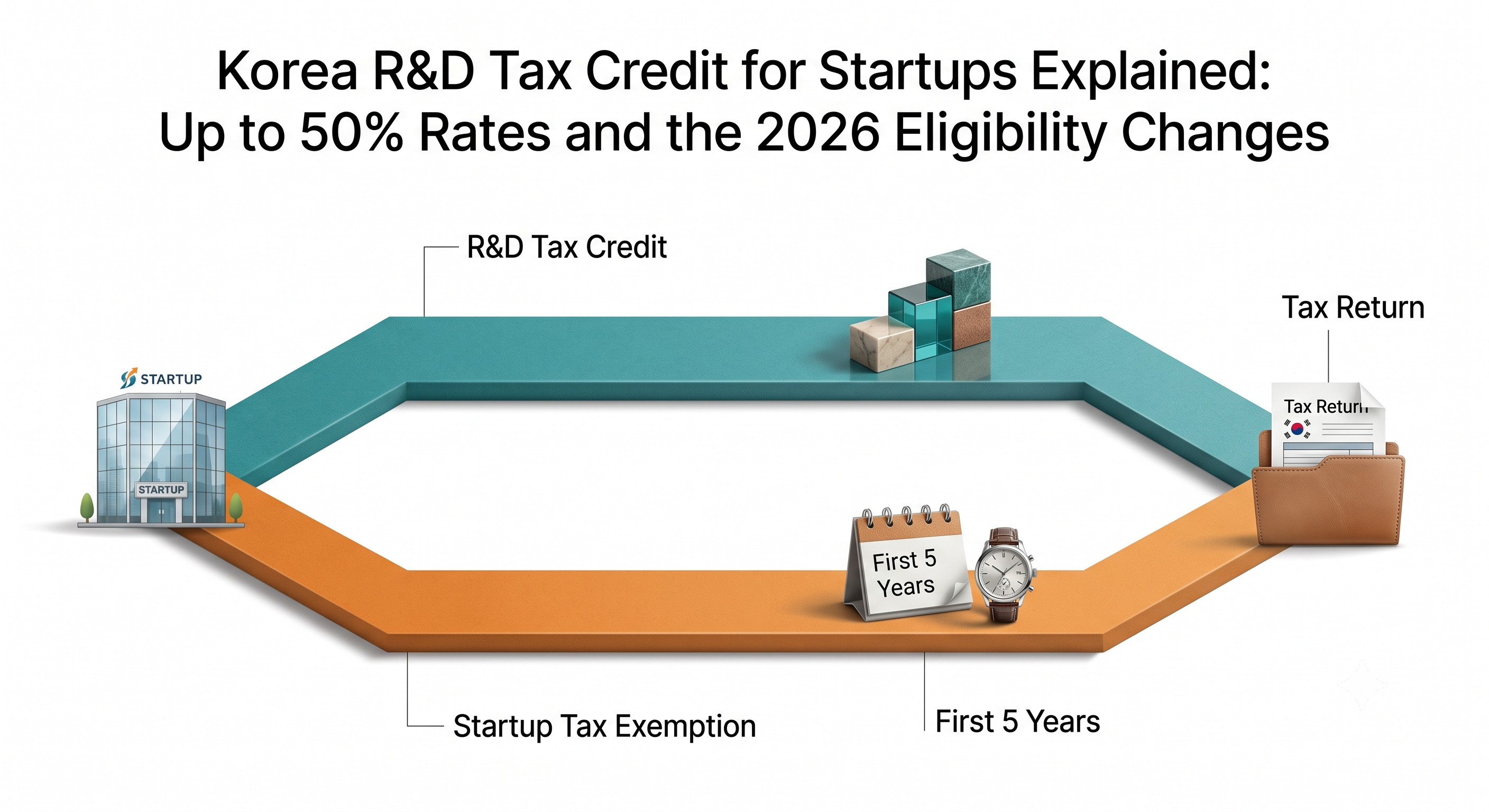
Korea's R&D tax credit (연구·인력개발비 세액공제, 조세특례제한법 Article 10) lets startups claim 25% of current-year qualifying R&D spend — or up to 50% of the increase over their 4-year average — against their tax bill, with rates climbing to 40-50% for national strategic technologies like semiconductors, batteries, and AI. It is a completely separate benefit from Korea's startup tax exemption (Article 6), which was restructured into regional tiers effective January 1, 2026 — a distinction most search results and even some professional summaries get wrong. This guide walks through both what the R&D credit is actually worth and where it stops being the benefit you're looking for.
By The Whitepaper Skeptic — prepared TCB certification and government R&D grant applications firsthand
Quick Facts
| Question | Answer |
|---|---|
| What's the base SME R&D tax credit rate? | 25% of current-year qualifying R&D spend, or up to 50% on the increase over your 4-year average spend |
| Which law governs it? | 조세특례제한법 (Restriction of Special Taxation Act) Article 10 — a credit against R&D expenses, not a general tax exemption |
| What's the top rate available? | Up to 40–50% for SMEs in national strategic technology fields (semiconductors, batteries, AI, biopharma, displays, hydrogen, vaccines) |
| What newly qualifies (2025)? | Software lease/purchase and cloud computing service costs, added effective February 28, 2025 |
| How long can unused credit carry forward? | 10 years |
What Korea's R&D Tax Credit Actually Covers
The R&D tax credit reduces a company's corporate tax liability based on how much it actually spent on qualifying research and personnel development in a given year — it's a credit against expenses, not a blanket reduction of income or corporate tax like some other Korean startup incentives. The legal basis is Article 10 of the 조세특례제한법 (Restriction of Special Taxation Act), and it runs on three separate tiers, each with its own rate structure and eligible technology scope.
For an SME, the general tier gives a choice between two calculation methods: 25% of the current year's qualifying R&D expenses, or up to 50% of the increase in R&D spending over the company's trailing 4-year average, whichever produces the better result. That incremental-basis option matters most for startups scaling R&D spend quickly year over year, since the 50% rate applies only to the growth, not the full base.
The Three Tiers and What They're Actually Worth
Rates step up sharply as the underlying technology moves from general R&D into government-designated growth categories:
| Tier | SME | KOSDAQ / Mid-Size | Large Enterprise | In Effect Through |
|---|---|---|---|---|
| General R&D expenses | 25% (current-year) or up to 50% (incremental) | 8% (current-year) or 40% (incremental) | 0–2% (current-year, scaled to revenue) or 25% (incremental) | No fixed sunset — baseline tier |
| New growth & source technology (신성장·원천기술) | 30%+α | 25%+α | 20%+α | Through December 31, 2029 |
| National strategic technology (국가전략기술) | 40–50% | 30–40% | 30–40% | Semiconductor track through December 31, 2031 |
The "new growth/source technology" tier and the "national strategic technology" tier both cover pre-designated lists of technology categories — the strategic tier currently spans semiconductors, secondary batteries, AI, biopharmaceuticals, displays, hydrogen, and vaccines, though these lists get revised in Korea's annual tax law amendments, so it's worth reconfirming your specific technology still qualifies before filing. A startup only accesses the higher rates if its R&D activity is formally classified under one of these designated categories — general-tier rates apply by default otherwise.
What Expenses Actually Qualify
Qualifying R&D expenses generally include personnel costs for staff dedicated to R&D activity, materials and equipment consumed in R&D work, and outsourced R&D contracted to qualifying institutions. As of February 28, 2025, the qualifying expense list was expanded to include software lease/purchase costs and cloud computing service costs — a meaningful update for software-heavy hardware and AI startups that previously couldn't count cloud compute spend toward their credit base.
R&D Tax Credit vs. the Startup Tax Exemption: Two Different Benefits
This is the disambiguation that most existing English-language coverage either skips or conflates, and it's worth being precise about because a startup can potentially claim both:
| Aspect | R&D Tax Credit (Article 10) | Startup Tax Exemption (Article 6) |
|---|---|---|
| Korean name | 연구·인력개발비 세액공제 | 창업중소기업 등에 대한 세액감면 |
| What it reduces | A credit sized to qualifying R&D expenses | Income/corporate tax itself, for the company's early years |
| How long it applies | Ongoing, year by year, tied to how much qualifying R&D spend a company has | First 5 years after founding |
| 2026 change | No direct rate change from this update | Restructured into regional tiers (100%/75%/50%) replacing the old 수도권과밀억제권역 vs. non-과밀 split, effective for companies founded on or after January 1, 2026 |
| Can a startup claim both? | Yes — the two apply to different parts of the same tax return | Yes — see left column |
The Article 6 exemption reduces the tax owed on a company's income for its first five years, scaled by region under the new 2026 tiers. The Article 10 credit covered in this article instead offsets tax based on documented R&D spend, with no founding-date cutoff and no regional tier structure. Confusing the two leads founders to either overestimate their total tax relief (assuming one benefit covers what the other actually does) or miss a credit they're eligible for because they assumed the exemption already "covered R&D."
How to Apply: The Advance Review (사전심사) System
Korea runs an optional advance-review system (사전심사) that lets a company pre-clear which specific expenses qualify for the R&D tax credit before filing, rather than claiming the credit and finding out at audit time that some of the claimed expenses don't hold up. This matters more than it might sound: the National Tax Service has been publicly ramping up post-filing verification of R&D tax credit claims — clawing back roughly 27 billion KRW from 864 companies in 2024, about ten times the 2021 figure — and disputes between taxpayers and tax authorities over what counts as qualifying R&D activity or expense scope are a recurring theme in that enforcement, since "qualifying R&D" has enough definitional edge cases (contract R&D scope, personnel time allocation, cloud cost apportionment) that documentation quality drives real outcomes. For startups without in-house tax expertise, the point where the advance-review filing gets discussed is usually also the point where it makes sense to bring in a Korean tax advisor or CPA rather than self-file.
The habit that actually protects a claim here is one I picked up on the grant side, not the tax side. Government R&D grant reporting already forces monthly R&D personnel time allocation and a project-level split of materials and outsourced work — which is close to exactly the evidence an 사전심사 filing or a post-filing check wants, and exactly what a company reconstructing its year from memory in March cannot produce. I used to log that grant paperwork as pure compliance overhead on the project budget. Set against 864 companies handing back roughly ₩27 billion in 2024, it reads more like a free audit file you were already required to build.
Where This Fits in Korea's Funding Stack
The R&D tax credit sits alongside — and is frequently confused with — several other pieces of Korea's deep tech funding and incentive landscape. It is not the same as a government R&D grant, which funds product development directly rather than crediting expenses already incurred, and it is not the same as the TIPS matching-grant program, which combines private investment with non-dilutive government funds rather than adjusting a tax bill. It is also unrelated to who owns the IP from a government R&D grant — that question turns on grant terms and the 기술료 technology fee, not on tax law at all. On the equity side, it has nothing to do with how a founder should sequence grant funding against venture capital or which Korean conglomerate CVC to approach — those are financing-source decisions, while the R&D tax credit is a tax-return line item available regardless of how a company is funded.
If you're building out a broader picture of how a Korean deep tech startup's tax and equity position actually fits together, this credit is worth reading alongside Korea's deep tech VC ecosystem for the investor-facing side, and — once published — the employee-side stock option tax exemption and RCPS vs. SAFE equity-structuring pieces, both of which sit on the same cap table but touch entirely different parts of the tax code than this R&D expense credit does.
Foreign-Owned Subsidiaries: What Actually Qualifies
The eligibility question splits on how the entity is structured in Korea, not on who owns it. Article 10 limits the credit to "내국인" — resident individuals and 내국법인 (domestic corporations) — and Korean corporate tax law defines "domestic corporation" by where a company's head office or place of effective management sits, not by shareholder nationality. A Korea-incorporated subsidiary of a foreign parent (외국인투자기업/외투법인) is a 내국법인 under that test, which means it qualifies for the R&D tax credit on the same tiered terms as any other Korean company of its size, provided it clears the same substantive requirements (e.g., a certified in-house R&D center, 기업부설연구소). This isn't just a theoretical reading of the statute: the National Tax Service runs a priority fast-track for R&D tax credit advance-review (사전심사) applications from foreign-invested companies that grew investment or headcount by 10%+ year over year, which only makes sense if FDI subsidiaries are already active claimants under this same credit.
What the R&D credit does not clearly cover is an unincorporated Korea branch office of a foreign company (외국법인의 국내지점) rather than a separately incorporated subsidiary — a branch is taxed as a foreign corporation on Korea-source income, and Article 10's "내국인"-only scope doesn't extend to that structure. Founders should still confirm current guidance with a Korean tax advisor before filing, but the incorporated-subsidiary-vs-branch distinction is the actual fork in the road, not foreign ownership itself.
FAQ
Q: What is Korea's R&D tax credit rate for startups?
A: For general R&D expenses, SMEs can claim 25% on a current-year basis or up to 50% on an incremental basis (when current-year R&D spend exceeds the company's 4-year average). Rates rise to 30%+α for new growth/source technology and 40-50% for national strategic technologies like semiconductors and AI.
Q: Is Korea's R&D tax credit the same as the startup tax exemption?
A: No. The R&D tax credit (Article 10) credits qualifying R&D expenses. The startup tax exemption (Article 6) separately reduces income/corporate tax for a company's first 5 years, restructured into regional tiers (100%/75%/50%) for companies founded on or after January 1, 2026. A startup can potentially claim both, since they apply to different parts of the same tax return.
Q: What expenses qualify for Korea's R&D tax credit?
A: Personnel costs for dedicated R&D staff, R&D materials and equipment, and outsourced R&D to qualifying institutions all generally qualify. As of February 28, 2025, software lease/purchase costs and cloud computing service costs were added to the qualifying expense list.
Q: Can foreign-owned Korean subsidiaries claim the R&D tax credit?
A: Yes, if the entity is incorporated in Korea. Eligibility turns on legal structure, not ownership — a Korea-incorporated subsidiary of a foreign parent is a domestic corporation (내국법인) under Korean tax law and can claim the credit on the same tiered terms as any other Korean company its size, provided it meets the same substantive requirements. An unincorporated branch office of a foreign company is a separate case and generally falls outside this credit's "내국인"-only scope — founders should confirm current details with a Korean tax advisor.
Q: How do I apply for Korea's R&D tax credit advance review?
A: Korea's optional 사전심사 (advance review) system lets a company pre-clear which specific R&D expenses qualify before filing, reducing the risk of a claimed expense being disallowed later at audit. Most startups engage a Korean tax advisor or CPA at this stage rather than filing the advance review request themselves.
Sources
- 조세특례제한법 (Restriction of Special Taxation Act), Article 10 — 연구·인력개발비에 대한 세액공제 — 국가법령정보센터 (Korea Ministry of Government Legislation, official statute text)
- 조세특례제한법, Article 6 — 창업중소기업 등에 대한 세액감면 — 국가법령정보센터, primary source for the disambiguation section
- Korea, Republic of - Corporate - Tax credits and incentives — PwC Tax Summaries
- 신성장·원천기술 및 국가전략기술 세액공제 시스템 — KIAT (한국산업기술진흥협회)
- 법인세 공제·감면사항 — 국세청 (National Tax Service), confirms Article 10 eligible-taxpayer scope as 내국인(거주자+내국법인)
- "투자·고용 늘린 외국계기업, 세무검증 면제한다" — 한국세정신문 (Korea Tax Times), on NTS's priority-review track for FDI subsidiaries filing R&D tax credit advance-review applications
- "국세청, R&D 세액공제 사후관리 강화…허위 연구소·불법 컨설팅 검증" — 일간NTN, 2025-11-28, on NTS post-filing verification and clawback trends for R&D tax credit claims
Author Bio
The Whitepaper Skeptic has direct experience preparing TCB certification materials and government R&D grant applications as part of Series A investment and IPO roadmap work — the same detailed R&D expense tracking and reporting that later gets reused to substantiate an R&D tax credit claim, which most generic tax-advisory content treats as an unrelated process.
Related Posts
- How South Korea Funds Deep Tech Startups: TCB Certification & Government R&D Grants Explained
- Government Grant or Venture Capital First? A Funding Sequence Framework for Deep Tech Hardware Startups
- Which Korean Conglomerate CVC Should Deep Tech Hardware Startups Target? Samsung, SK, and LG Compared
- Who Owns the IP From a Korean Government R&D Grant? Ownership Rules and the Technology Fee Explained
- TIPS Program Explained: How Korea's Matching R&D Grant Works for Deep Tech Founders
Tags
Korea R&D tax credit, 조세특례제한법, Korea startup taxes, Korea deep tech funding


Comments
Post a Comment