NIS2 OT Security Compliance: What Manufacturers Must Do in 2026
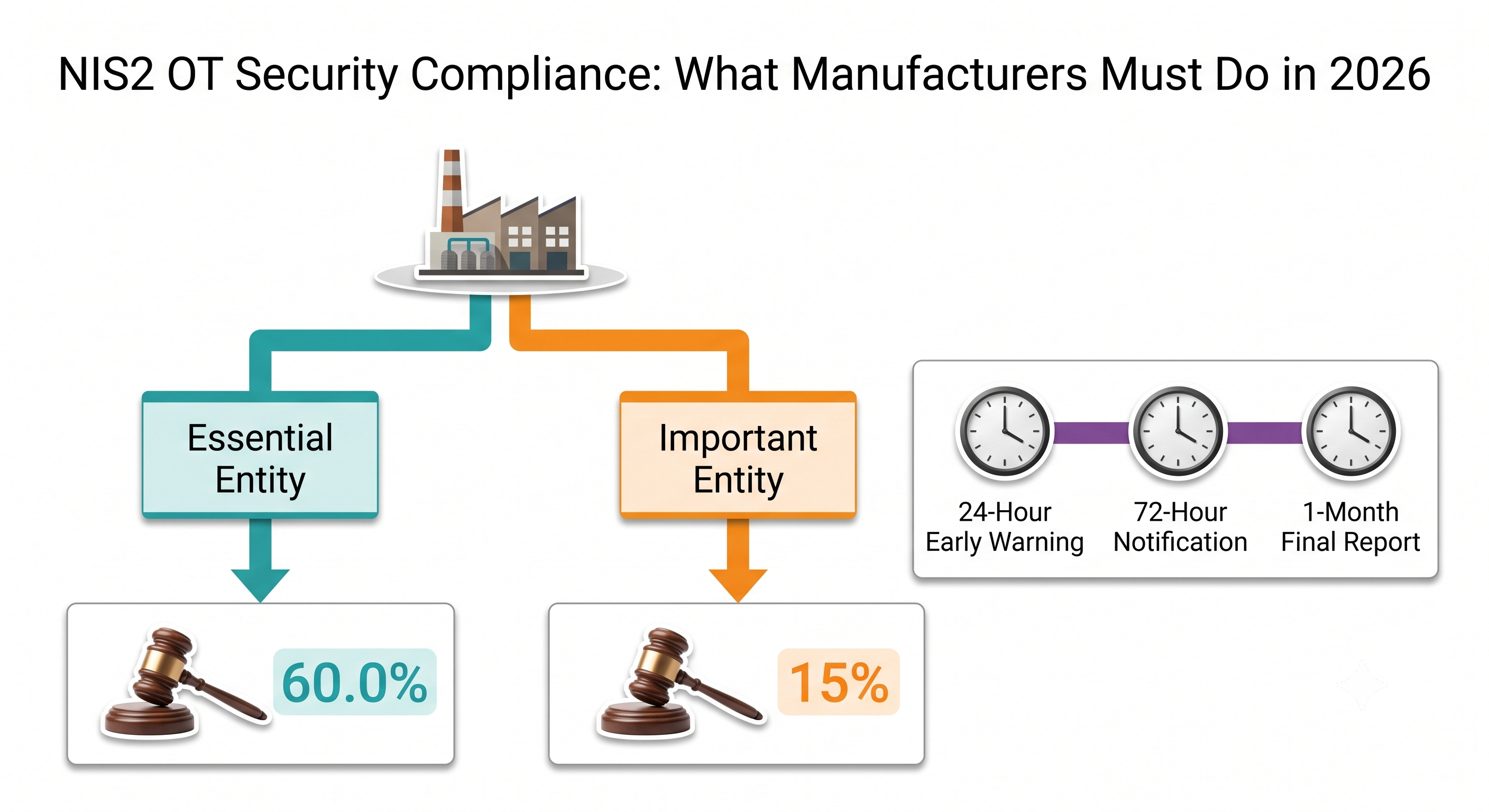
NIS2 (Directive (EU) 2022/2555) requires most EU manufacturers to implement Article 21 risk-management measures and report major cyber incidents within 24 hours of detection — but the exact obligations depend on a classification decision most compliance content glosses over. Most manufacturers (medical devices, electronics/optical products, electrical equipment, machinery, motor vehicles — Annex II) are classified as "important entities," facing fines up to €7 million or 1.4% of global annual turnover, not the €10 million/2% cap that's usually quoted and that actually applies only to "essential entities" in Annex I. This article maps what the directive's text requires onto the OT security controls a plant actually has to build, and explains why "NIS2 compliance" isn't one EU-wide deadline but 27 separate national clocks.
By The Whitepaper Skeptic — translated compliance frameworks into plant-floor OT controls in architecture reviews
Quick Facts
| Question | Answer |
|---|---|
| What is NIS2? | Directive (EU) 2022/2555 — an EU-wide cybersecurity law; Member State transposition deadline was 17 October 2024 (Article 41) |
| Am I "essential" or "important"? | Most manufacturers (Annex II: medical devices, electronics/optical, electrical equipment, machinery, motor vehicles) are classified as important entities |
| What's the maximum fine? | Essential entities: up to €10M or 2% of global turnover; important entities: up to €7M or 1.4% of global turnover, whichever is higher (Article 34) |
| What's the incident-reporting deadline? | 24-hour early warning, 72-hour incident notification, 1-month final report (Article 23) |
| Is there one EU-wide compliance deadline? | No — supervisory and audit mechanics are set by each Member State's national transposing law, not by the directive itself |
NIS2 in Plain English: What the Directive Actually Requires
NIS2 replaced the original 2016 NIS Directive and significantly widened its scope — from a handful of critical-infrastructure sectors to a much longer list of "essential" and "important" entities, including large parts of manufacturing for the first time. At its core, the directive requires in-scope organizations to do two things: implement a defined set of cybersecurity risk-management measures (Article 21), and report significant incidents to their national authority on a strict timeline (Article 23).
The directive itself set a transposition deadline of 17 October 2024 for EU Member States to turn it into national law (Article 41). Progress has been slow and uneven: only 6 of the 27 Member States had transposed the directive as of January 2025, and by July 2026 the European Commission had referred four persistent laggards — Ireland, Spain, France, and the Netherlands — to the Court of Justice of the European Union, seeking lump-sum and daily financial penalties for being more than 20 months late. Most other Member States had enacted at least a first version of their national transposing legislation by mid-2026, but completeness and enforcement maturity still vary sharply by country — check the ECSO transposition tracker for the current country-by-country status before assuming any one country's law is finalized. That gap matters for manufacturers operating across multiple EU countries: "NIS2 compliance" is not a single clock, it's a different national implementing law — with its own registration process, evidence requirements, and supervisory timeline — in every country you operate in.
Essential vs Important Entity: The Distinction Most Compliance Guides Flatten
This is the single most consequential classification decision in the whole directive, and it's the part most "NIS2 for manufacturers" content gets sloppy about. A flat "up to 2% of global revenue" penalty figure gets quoted constantly — but that 2%/€10M cap applies specifically to essential entities. Most manufacturers sit in Annex II and are classified as important entities instead, with a lower — but still commercially significant — maximum exposure.
| Aspect | Essential entity | Important entity |
|---|---|---|
| Sector list | Annex I (11 sectors of "high criticality") — energy, transport, banking, financial market infrastructure, health, drinking water, waste water, digital infrastructure, ICT service management (B2B), public administration, space, plus large entities in a handful of Annex II sectors specifically designated critical | Annex II — postal/courier, waste management, chemicals, food, manufacturing (medical devices, computers/electronics/optical products, electrical equipment, machinery, motor vehicles/trailers/semi-trailers, other transport equipment), digital providers, research organizations |
| Typical size threshold to be in scope | Article 2(1) sets the line at "medium-sized enterprise or larger" under the EU's standard SME definition (Commission Recommendation 2003/361/EC) — in practice, an entity is in scope once it crosses out of "small" size: roughly 50+ staff, or annual turnover above €10M, or an annual balance-sheet total above €10M. (Certain entity types are in scope regardless of size — see Article 2(2)-(6) — e.g., sole providers of a service in a Member State or entities whose disruption would have significant public-safety impact.) | Same general medium-sized-enterprise-or-larger threshold, applied within Annex II sectors |
| Maximum fine (Article 34) | Up to €10,000,000 or 2% of total global annual turnover, whichever is higher | Up to €7,000,000 or 1.4% of total global annual turnover, whichever is higher |
| Where most manufacturers land | Only if large and operating in an Annex I sector, or specifically designated as critical regardless of size | Most Annex II manufacturing sub-sectors — this is where the majority of manufacturers actually sit |
The practical takeaway: before you plan your compliance program around a "2% of revenue" worst case, confirm which annex and which entity classification actually applies to your business. For most manufacturers, the real number is 1.4% and €7M — still large enough to be a board-level risk figure, just not the number that gets repeated in generic compliance-vendor marketing.
Article 21: Mapping the Law to Actual OT Security Controls
Article 21(2) lists ten categories of risk-management measures that in-scope entities must implement — but the directive's text stays at the level of a legal bullet list (risk analysis, incident handling, business continuity, supply-chain security, access control, cryptography, and so on) without ever specifying what an OT or plant-security engineer actually configures. That gap is where most generic NIS2 explainers (written for IT/legal/GRC audiences) stop. Here's how the two most operationally relevant categories translate to a factory floor.
Article 21(2)(a) — risk analysis and network and information systems security policies. For a manufacturer, this is where OT network segmentation does the actual work: grouping assets by criticality, assigning them a target security level, and controlling every communication path between zones. The detailed design sequence — asset inventory, criticality assessment, security-level assignment, zone boundaries, conduit placement — is covered step by step in IEC 62443 Zones and Conduits Explained, which is the closest thing to a technical answer key for satisfying this requirement on the plant floor.
Article 21(2)(d) — supply-chain security. NIS2 requires entities to address security risks in their relationships with direct suppliers and service providers. In OT terms, this starts with knowing what's actually connected to your network in the first place — vendor-supplied PLCs, remote-access tools for equipment maintenance contracts, third-party historian integrations. You cannot secure, or even report on, an asset you don't know exists; that's exactly the gap OT Asset Management: How to Build an Industrial Asset Inventory walks through.
Of the ten categories, (d) is the one I've seen turn up at a review with nobody's name against it. Risk analysis and incident handling had owners, because someone on the plant network was already doing that work and could be pointed at. The supplier and service-provider relationships lived in procurement, in contracts that had never been mapped against what was physically connected — so the first real deliverable ended up being a reconciliation between a vendor list and an asset list, which is not what anyone thought they were commissioning when they asked for help with Article 21.
The remaining Article 21(2) categories — incident handling, business continuity and disaster recovery, security in system acquisition/development/maintenance, policies to assess the effectiveness of risk-management measures, basic cyber hygiene and security training, cryptography and encryption policies, human-resources security/access control/asset management, and the use of multi-factor authentication and secured communications — largely map to standard OT/IT security program components rather than requiring a novel translation, but they still need to be documented and evidenced, not just implemented informally.
Article 23: The Incident-Reporting Clock You Can't Miss
NIS2's incident-reporting cascade under Article 23 runs on three deadlines from the moment a significant incident is detected:
- 24 hours — an early warning to the national competent authority or CSIRT, indicating whether the incident is suspected to be caused by unlawful or malicious action and whether it could have cross-border impact.
- 72 hours — a fuller incident notification, updating the initial assessment, its severity and impact, and any indicators of compromise where available.
- 1 month — a final report, including a detailed description of the incident, the root cause, mitigation measures applied, and (where relevant) the cross-border impact.
That 24-hour window is aggressive for an OT environment, where the first priority during an active incident is often physical safety and production continuity, not paperwork. The real-world timelines described in Manufacturing Ransomware Case Studies — how fast ransomware actually spreads across a flat OT network once it's inside, and how long incident response and recovery realistically take — are a useful gut check against Article 23's clock: if your organization can't tell within 24 hours whether an incident is malicious or accidental and whether it might have cross-border impact, the reporting obligation is exposing a detection gap, not just a compliance gap.
One Directive, 27 National Clocks
Because NIS2 is a directive rather than a regulation, it doesn't take direct legal effect — each of the 27 EU Member States has to pass its own national implementing law, and each of those laws sets its own registration process, evidence-of-compliance timeline, and supervisory/audit mechanics. A frequently repeated claim across compliance-vendor content is a "first audit by 30 June 2026" deadline, presented as if it applies EU-wide — it does not. That date does not trace back to Directive (EU) 2022/2555 itself, nor to any ENISA or European Commission primary source; at the directive level, audit and supervisory mechanics are left entirely to each Member State's competent authorities. The 30 June 2026 date is real, but it is Hungary-specific: under Hungary's amended Act LXIX of 2024 (in force from 31 May 2025), in-scope essential entities had to contract a cybersecurity auditor registered with the national authority (SZTFH) by 31 August 2025 and complete their first mandatory audit by 30 June 2026. Treat any "first audit by 30 June 2026" claim you see elsewhere as a Hungarian national deadline, not an EU-wide one, unless the source specifies otherwise.
Germany is a second concrete worked example available as of 2026. Its NIS2UmsuCG-based implementing law (which amends the BSI Act, the BSIG) took immediate effect on 6 December 2025, with a registration deadline of 6 March 2026 for in-scope entities. Supervisory intensity is also tiered by entity type under the amended BSIG: "particularly important" entities (Germany's equivalent of essential entities) face proactive BSI audit powers from the outset, while some of the BSI's broader compliance-evidence powers over non-KRITIS particularly important entities phase in later, roughly three years after the law's entry into force — detail worth confirming against current BSI guidance before treating any specific date as final, since German secondary commentary on this point is not fully consistent. The lesson for manufacturers operating in multiple EU countries isn't "wait for a single deadline" — it's that your actual compliance timeline depends entirely on which national implementing law(s) apply to your operations, and those timelines are staggered, nationally specific, and still being finalized across the bloc.
Does NIS2 Apply to Non-EU Manufacturers Selling Into the EU?
This depends on where the entity actually provides services or carries out its activities, not simply on where it's headquartered — Article 2(1) applies NIS2 to in-scope entities "provid[ing] their services or carry[ing] out their activities within the Union," so a non-EU manufacturer with an EU subsidiary or EU-based operations in an in-scope Annex I/II sector can fall within NIS2's territorial scope even if its parent company is outside the EU. Jurisdiction — which Member State actually supervises the entity — is then assigned under Article 26: entities established in the Union fall under the jurisdiction of their Member State of establishment. Article 26 also contains a mandatory EU-representative requirement for non-EU-established entities, but that specific mechanism is narrower than it's often described: it applies only to the digital-infrastructure and digital-service entity types named in Article 26(1)(b) — DNS/TLD/domain-registration providers, cloud computing, data centre, and CDN providers, managed service and managed security service providers, and providers of online marketplaces, search engines, or social networking platforms — not to general Annex I/II manufacturers. For a non-EU manufacturer with no EU subsidiary or EU-based operations, Article 26 does not supply an equivalent representative-appointment mechanism, which leaves jurisdiction and enforcement genuinely less defined at the directive level; in practice this is governed by the national implementing law of whichever Member State(s) the company's activities touch, so it should be assessed with counsel on a country-by-country basis rather than assumed either way.
FAQ
Q: Is my company in scope for NIS2 if I'm a manufacturer?
A: If your business falls under Annex II's manufacturing sub-sectors (medical devices, computers/electronics/optical products, electrical equipment, machinery, motor vehicles/trailers/semi-trailers, or other transport equipment) and meets the medium-sized-enterprise size threshold, you're very likely in scope as an important entity. Confirm your exact classification and the applicable national implementing law before assuming either way.
Q: What's the difference between a NIS2 essential entity and an important entity?
A: Essential entities (mostly Annex I sectors like energy, transport, banking, and health) face a maximum fine of €10 million or 2% of global turnover and are subject to proactive supervision. Important entities (mostly Annex II sectors, including most manufacturing) face a lower maximum fine of €7 million or 1.4% of global turnover. Most manufacturers are classified as important entities, not essential entities.
Q: What happens if I miss the NIS2 24-hour incident reporting deadline?
A: The directive doesn't specify a fixed penalty tied solely to a missed reporting deadline — enforcement is handled by each Member State's competent authority as part of its broader supervisory powers, and can factor into the overall fines described under Article 34. The more immediate operational risk is that a missed or incomplete early warning delays the coordinated response the reporting cascade is designed to enable, particularly for incidents with cross-border impact.
Q: Does NIS2 apply to non-EU manufacturers selling into the EU?
A: It can, depending on where the entity provides services or operates its network and information systems, not simply where it's headquartered. A non-EU manufacturer with EU-based operations, an EU subsidiary, or EU-based network infrastructure in an in-scope sector may fall within scope; export-only relationships without EU-based infrastructure are a less clear-cut case that should be assessed against the applicable national implementing laws.
Q: When do I actually need to be NIS2-compliant?
A: There isn't one EU-wide date — the directive set a 17 October 2024 transposition deadline for Member States to pass their own national laws, but registration deadlines, evidence-of-compliance timelines, and audit mechanics are set individually by each country. Germany's law, for example, took effect 6 December 2025 with a registration deadline of 6 March 2026. Check the specific national implementing law for every country where your company operates rather than assuming a single deadline applies.
Sources
- Directive (EU) 2022/2555 of the European Parliament and of the Council (NIS2), full text — EUR-Lex (primary legal source: transposition deadline Article 41, entity classification and size thresholds Article 2/3, penalty figures Article 34, Annex I/II sector lists, Article 21 risk-management measures, Article 23 incident-reporting timelines, Article 26 jurisdiction/territoriality)
- ECSO, NIS2 Directive Transposition Tracker (Member State transposition status — a moving figure, check current status at read time)
- The Record (Recorded Future News), "EU takes member states to court over unimplemented cybersecurity law" (July 2026 European Commission referral of Ireland, Spain, France, and the Netherlands to the CJEU over NIS2 transposition; January 2025 6-of-27 transposition snapshot)
- Reed Smith, "Germany Implements NIS2 With Immediate Effect, Broad Scope, Near-Term Registration" (Germany worked example: 6 December 2025 effective date, 6 March 2026 registration deadline)
- Morrison Foerster, "Flipping the NIS2 Switch: What Germany's Implementation Means for 2026 Compliance" (Germany implementation detail: immediate-effect obligations, registration timeline)
- RSM Hungary, "NIS2: Modified cybersecurity deadlines!" (Hungary-specific NIS2 audit deadlines: auditor contract by 31 August 2025, first audit by 30 June 2026 — national timeline, not EU-wide)
- nis2directive.eu, "NIS2 Fines and Penalties" (secondary cross-check on the essential/important penalty-tier figures against the primary Directive text above)
Author Bio
The Whitepaper Skeptic has run OT security architecture reviews for manufacturing environments where the entire point of the engagement was translating an abstract compliance framework's risk-management requirements into actual network segmentation, asset inventory, and incident-response procedures on the plant floor — the same legal-text-to-control-room mapping this article walks through for NIS2 Article 21 and Article 23.
Related Posts
- OT Cybersecurity 101: Why Smart Factories Need a Different Security Model Than IT
- IEC 62443 Zones and Conduits Explained: How to Actually Segment an OT Network in 2026
- Manufacturing Ransomware Case Studies: What OT/IT Segmentation Failures Actually Cost
- OT Asset Management: How to Build an Industrial Asset Inventory When You Don't Know What's on the Network
Tags
NIS2, OT security, EU cybersecurity compliance, NIS2 penalties, manufacturing cybersecurity


Comments
Post a Comment