AMR Fleet Charging Strategy Explained: Opportunity Charging vs. Battery Swap vs. Scheduled Charging in 2026
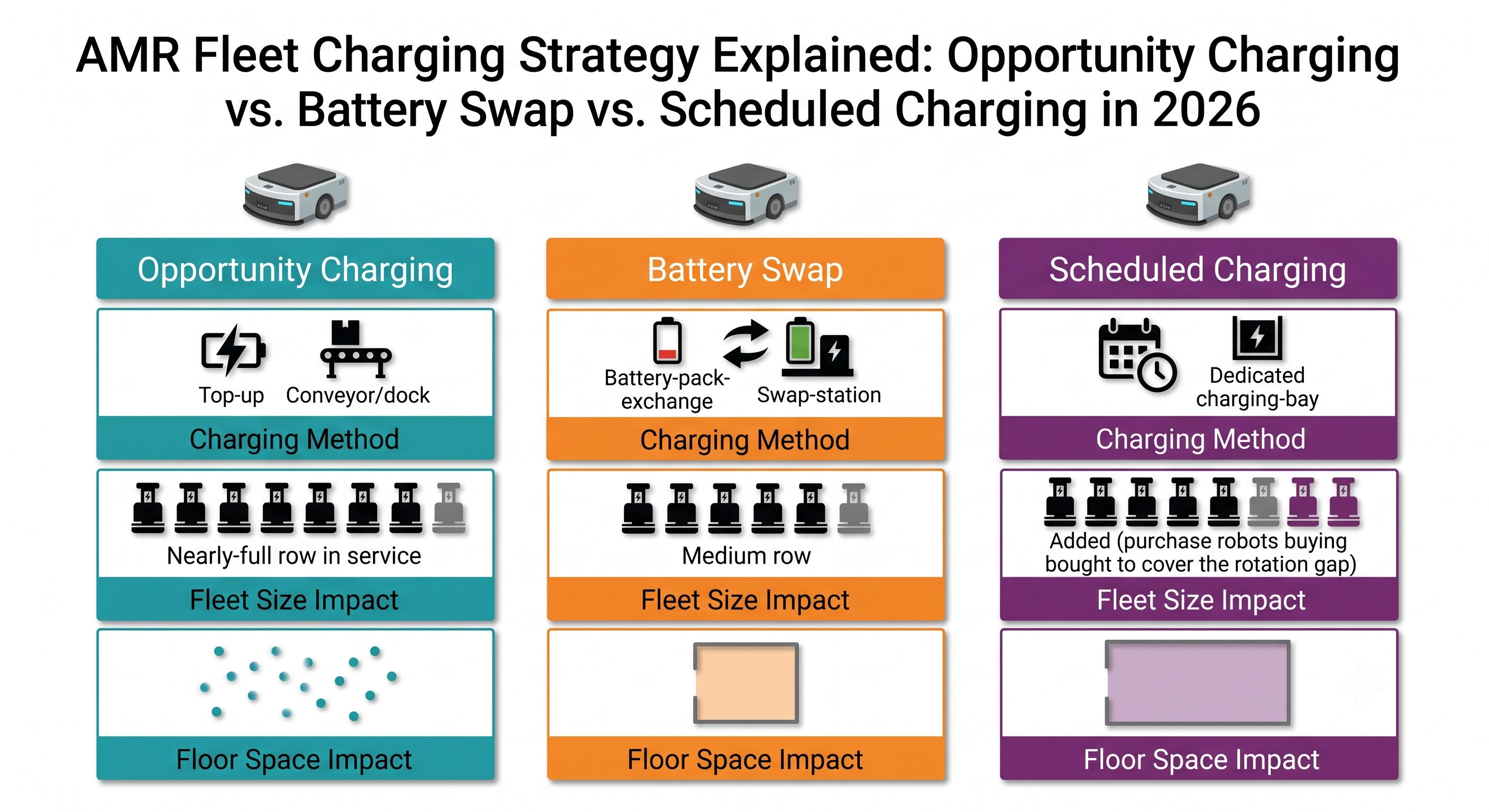
There are three AMR fleet charging strategies: opportunity charging (short top-ups during natural work gaps), scheduled charging (robots taken out of rotation for dedicated charge windows), and battery swapping (a depleted pack physically swapped for a charged one in minutes). Which one fits your operation depends less on battery chemistry than on your shift pattern and peak-hour robot demand — a charging model sized to your average daily workload will look fine on paper and fail on your busiest shift. Lithium iron phosphate (LFP) has become the default chemistry for opportunity charging specifically because it tolerates the frequent partial charging that strategy demands. Get the strategy wrong and the fix is usually buying more robots than you actually need.
Quick Facts
| Question | Answer |
|---|---|
| How many core AMR charging strategies are there? | Three — opportunity charging, scheduled charging, and battery swapping — each with different tradeoffs on fleet size, uptime, and floor space |
| Why do "average day" charging models fail? | Peak-hour charging demand, not average daily demand, determines whether enough robots stay in rotation — a model built on averages looks fine on paper and fails on the busiest shift (RoboticsTomorrow, Aug 2026) |
| What battery chemistry dominates opportunity charging? | Lithium iron phosphate (LFP) — reported at roughly 68% of global AGV/AMR battery sales in 2025, per a QYResearch market estimate (market-research-sourced, not government/standards data) |
| Does battery swapping improve fleet-wide uptime the way the swap-time number suggests? | Not automatically — under-two-minute swap time is a per-swap capability claim from swap-station vendors; fleet-wide uptime gain depends separately on how many swap stations you have and how much queueing happens at peak |
| Is scheduled charging ever the right call? | Yes, for fleets where dedicated charge windows fit naturally into existing shift breaks — but it usually means buying extra robots to cover the rotation gap |
The Three AMR Charging Strategies, Explained
Every AMR charging plan reduces to one of three underlying strategies, and most fleet operators default into one without formally comparing it against the other two:
- Opportunity charging. Robots take short top-ups during natural gaps in their work — waiting at a pick station, queued at a conveyor, idle between tasks — so they rarely leave service for a dedicated charge. This is the strategy that most closely hides charging time inside work time, but it depends on a battery chemistry that can tolerate frequent partial charge cycles without degrading quickly.
- Scheduled charging. Robots are pulled out of rotation for a dedicated charging window, the way a forklift driver swaps to a charged unit at shift change. It's the simplest strategy to plan around on paper, but it takes units out of rotation during the charge window and usually means buying more robots to cover the resulting capacity gap during peak hours.
- Battery swapping. A depleted battery pack is physically removed and replaced with a charged one, typically in under two minutes per swap. This minimizes per-robot downtime, but it adds cost and complexity elsewhere in the system — spare battery packs, dedicated swap stations, and the labor (human or automated) to run the swap process.
None of these is universally "best" — each one moves the cost and the risk to a different part of the operation: opportunity charging pushes complexity into battery chemistry and dwell-time scheduling, scheduled charging pushes it into fleet sizing, and battery swapping pushes it into capital equipment and spare-parts inventory.
Opportunity Charging vs. Battery Swap vs. Scheduled Charging: Head-to-Head
| Factor | Opportunity Charging | Battery Swap | Scheduled Charging |
|---|---|---|---|
| How it works | Short top-ups during natural work gaps; robot rarely leaves the workflow | Depleted pack physically swapped for a charged one, typically under two minutes per swap | Robot taken out of rotation for a dedicated charge window |
| Battery chemistry fit | Requires a chemistry that tolerates frequent partial charging — LFP is the current default for this reason | Chemistry-agnostic in principle; pack design and swap-station compatibility matter more than chemistry | Works with most chemistries, including lead-acid, since charge cycles are full and infrequent |
| Added capital cost | Low — no swap stations or spare packs required; cost shows up in charger placement across the floor | Higher — spare battery packs (often a second full pack per robot) plus dedicated swap stations | Low equipment cost, but usually offset by buying extra robots to cover the rotation gap |
| Added labor | Minimal — charging is largely passive within existing workflow | Requires labor or automation to run the swap process itself | Minimal beyond routing robots to charge stations on schedule |
| Floor space impact | Chargers distributed near natural dwell points across the facility | Dedicated swap-station footprint plus staging area for spare packs | Dedicated charging bay area, sized for peak simultaneous demand |
| Fleet-size impact | Lowest — robots stay in rotation almost continuously | Low — swap time is short, but total uptime gain depends on swap-station count and queueing at peak | Highest — robots are unavailable during scheduled windows, which peak-hour math usually has to cover with extra units |
| Best-fit scenario | Continuous multi-shift operations with frequent natural dwell time and LFP-compatible robots | High-utilization fleets where per-robot downtime must be minimized and capex for spare packs/stations is available | Single- or two-shift operations with natural breaks that already leave charging windows open |
Why "Average Day" Charging Models Fail
The most common charging-planning mistake isn't picking the wrong strategy — it's sizing whichever strategy you pick to the wrong demand curve. As trade press covering AMR deployments put it directly in August 2026: "a charging model built on average utilization will look fine on paper and fail in practice." The reason is straightforward — peak-hour charging demand, not average daily demand, is what actually determines whether a fleet has enough robots in rotation at the moment it needs them most.
A fleet that averages, say, 60% utilization across a 24-hour day can still fall short during a two-hour peak-shipping window if charging capacity was sized to the daily average instead of that peak window. This is the same modeling mistake that shows up in warehouse staffing and dock-door planning — averages smooth out exactly the spikes that determine whether operations hold up when it matters. Buyers building an AMR fleet charging plan should model peak-hour robot demand first, then work backward to how much charging capacity (chargers, swap stations, or spare packs) that peak actually requires — not the other way around.
LFP vs. Lead-Acid: Why Battery Chemistry Decides Which Strategy You Can Run
Battery chemistry isn't an independent decision from charging strategy — it's what determines which strategies are even viable. Lithium iron phosphate (LFP) has become the default recommendation for opportunity charging specifically because it tolerates the frequent partial charging that strategy demands, without the sulfation degradation that shortens lead-acid battery life under the same partial-charge pattern. Lead-acid batteries, by contrast, generally need full, infrequent charge cycles to avoid accelerated wear — which pushes lead-acid fleets naturally toward scheduled charging rather than opportunity charging.
Market research from QYResearch puts LFP at roughly 68% of global AGV/AMR battery sales in 2025, with the AGV/AMR lithium battery market projected to grow at an 11.8% CAGR from 2026 to 2032 — figures confirmed directly against QYResearch's published report (this is a market-research estimate, not standards-body or government data, and should be read as such). That shift matters for fleet planning because it changes the economics of opportunity charging: as LFP becomes the standard chemistry rather than a premium option, the chemistry constraint that used to push fleets toward scheduled charging is becoming less binding.
One planning heuristic worth treating as guidance rather than a hard engineering constant: batteries generally lose their first ten to twenty percent of usable capacity relatively quickly after being put into service, according to industry fleet-planning coverage. This isn't a chemistry-specific or vendor-specific spec — it's a rule of thumb for sizing charging capacity with some margin rather than against a battery's rated, day-one capacity.
On cost: battery-vendor content and industry blogs (e.g., material-handling battery suppliers publishing TCO calculators and case comparisons) commonly cite a total-cost-of-ownership advantage of roughly 20–40% for lithium chemistries (including LFP) over lead-acid — typically shown across a 3-to-5-year fleet-ownership window, with some vendors claiming the gap widens further over a full 8-to-10-year battery lifetime. This is a vendor/industry-blog claim, not an independent third-party study, and horizons vary by source — treat the specific percentage as an industry claim to sanity-check against your own fleet's actual battery replacement and downtime costs, not as a settled, independently verified number.
Sizing Charging Infrastructure for Your Fleet: A Decision Framework
Having built total-cost-of-ownership models across AMR vendor evaluations, the charging-strategy question is one of the most consistently under-modeled line items in a fleet plan — vendors quote robot pricing and throughput specs in detail, but charging infrastructure (charger count, floor space, spare packs, swap-station capex) is frequently left for the buyer to work out after the sale rather than priced into the initial proposal.
| Your operating profile | Charging strategy that tends to fit | Why |
|---|---|---|
| Continuous multi-shift operation with frequent natural dwell time (queuing, staging, pick-station waits) | Opportunity charging (LFP) | Dwell time absorbs charging almost invisibly; LFP tolerates the partial-cycle pattern this creates |
| High-utilization fleet where every minute of per-robot downtime is costly, and capex is available | Battery swap | Swap time is short and predictable, but only pays off if swap-station count is sized to peak-hour demand — not average demand |
| Single- or two-shift operation with existing scheduled breaks (shift change, lunch, overnight) | Scheduled charging | Charging windows already exist in the shift pattern; the extra-robot cost of taking units out of rotation is smaller when breaks are already built in |
| Mixed fleet with both continuous zones and shift-based zones | Hybrid — opportunity charging in continuous areas, scheduled charging in shift-based areas | Matches strategy to the actual demand curve of each zone rather than forcing one strategy across the whole facility |
This decision sits upstream of — and directly feeds — the payback-period math in our warehouse AMR ROI guide: a battery-swap strategy that requires buying a second full battery pack per robot changes the upfront capital figure that ROI calculation starts from, and that per-robot spare-pack cost is exactly the kind of line item generic AMR pricing content tends to leave out.
Charging Strategy and RaaS Contracts: What Gets Bundled, What Doesn't
If you're evaluating a robotics-as-a-service (RaaS) contract rather than an outright purchase, charging strategy is one of the places buy-vs-lease-vs-RaaS math diverges in ways that aren't always obvious from the sales deck. Some RaaS contracts bundle charging infrastructure — chargers, docking hardware, sometimes even swap-station equipment — into the monthly rate; others price the robot hardware and software separately from any charging infrastructure, leaving the buyer to source and install chargers or swap stations independently. Our AMR RaaS pricing guide covers the broader contract-terms checklist, but the charging-specific question worth asking any RaaS vendor directly is: does the quoted monthly rate include charging infrastructure, or is that a separate line item — and if you're evaluating battery swapping specifically, does the vendor's rate include the spare packs and swap-station hardware, or just the robots themselves?
FAQ
Q: What is the best AMR fleet charging strategy?
A: There isn't a single best strategy — it depends on your shift pattern and peak-hour robot demand. Opportunity charging (paired with LFP batteries) tends to fit continuous multi-shift operations with natural dwell time; scheduled charging fits single- or two-shift operations with existing breaks; battery swapping fits high-utilization fleets where per-robot downtime is costly and capex for spare packs and swap stations is available.
Q: Why do AMR charging plans built on average daily demand fail?
A: Because peak-hour charging demand, not average daily demand, determines whether a fleet has enough robots in rotation when it actually needs them. A charging model sized to the average day can look adequate on paper and still leave the fleet short during the busiest shift or peak-shipping window.
Q: What battery chemistry is best for AMR opportunity charging?
A: Lithium iron phosphate (LFP) is the current default recommendation because it tolerates the frequent partial charging that opportunity charging requires, without the sulfation degradation that shortens lead-acid battery life under the same pattern. Lead-acid batteries generally need full, infrequent charge cycles, which pushes lead-acid fleets toward scheduled charging instead.
Q: Does battery swapping actually save more fleet uptime than opportunity charging?
A: Not automatically. The under-two-minute swap time you'll see quoted is a per-swap capability claim from swap-station vendors — actual fleet-wide uptime improvement depends on how many swap stations you have relative to your fleet size and how much queueing happens during peak demand. A fleet with too few swap stations can still bottleneck even with fast individual swaps.
Q: How much does AMR charging infrastructure add to total fleet cost?
A: It varies by strategy and isn't consistently itemized in vendor quotes. Battery swapping typically requires a second full battery pack per robot plus dedicated swap-station equipment; scheduled charging often requires buying extra robots to cover rotation gaps; opportunity charging generally adds the least direct infrastructure cost but depends on LFP-compatible robots. Model this as an explicit line item against your own fleet size and peak-hour demand rather than assuming any single strategy is automatically cheapest — see our warehouse AMR ROI guide for how charging strategy feeds into payback-period math.
Sources
- RoboticsTomorrow, "Charging Is the AMR Decision Nobody Models Until It's Too Late: How to Get Fleet Charging Right Before It Costs You" (Aug 2026)
- ONEPOINTECH, "Opportunity Charging For AGV And AMR Fleets Explained"
- Large Battery, "Fast Charging and Swappable Batteries for Autonomous Mobile Robots (AMRs)"
- Qviro Blog, "Mobile Robot Battery: Swappable vs. Fast-Charge"
- ST Electronics, "AGV & AMR Charging: Complete Guide to Warehouse Robot Chargers"
- QYResearch, "AGV/AMR Lithium Battery Market Research: 11.8% CAGR 2026–2032" — cited for LFP market-share (68% in 2025) and CAGR (11.8%, 2026–2032) estimates; figures confirmed directly against the published report
- Our own pillar: AMR vs AGV: What's the Real Difference in Warehouse and Outdoor Robotics?
- Our own cluster mate: Warehouse AMR ROI: How to Calculate Payback Period Before You Buy
- Our own cluster mate: AMR RaaS Pricing Explained: How Robotics-as-a-Service Contracts Really Cost $2K–$8K a Month in 2026
Author Bio
The Whitepaper Skeptic led AMR vendor evaluation and total-cost-of-ownership modeling at The Won, where charging infrastructure — spare battery packs, charger and swap-station count, floor space for charging bays — was consistently the line item vendor quotes left for the buyer to work out after the sale, not before it. This article is built on the same peak-demand-first modeling approach used in that evaluation work.
Related Posts
- AMR vs AGV: What's the Real Difference in Warehouse and Outdoor Robotics?
- Warehouse AMR ROI: How to Calculate Payback Period Before You Buy
- AMR RaaS Pricing Explained: How Robotics-as-a-Service Contracts Really Cost $2K–$8K a Month in 2026
- VDA 5050 Explained: How Multi-Vendor AMR Fleets Actually Talk to Each Other
- AMR Fleet Management Software Compared: What to Look for Beyond VDA 5050 Support
Tags
AMR fleet charging strategy, opportunity charging vs battery swap, AMR charging infrastructure planning, LFP AMR battery, warehouse robot charging downtime


Comments
Post a Comment