VDA 5050 Explained: How Multi-Vendor AMR Fleets Actually Talk to Each Other (2026 v3.0 Update)
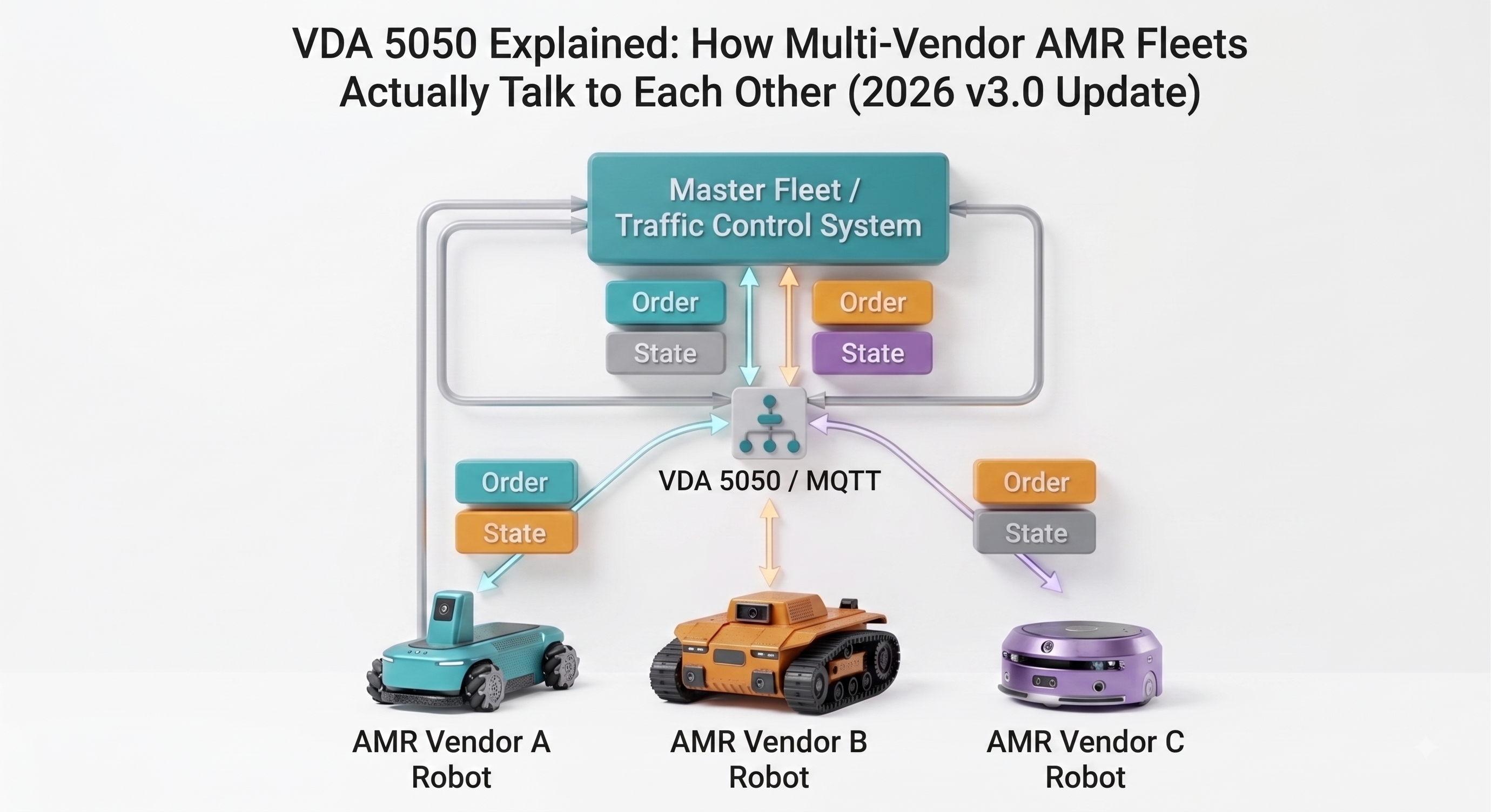
VDA 5050 is the MQTT/JSON-based interface standard — jointly maintained by Germany's VDA and VDMA industry associations — that lets one central fleet/traffic-control layer send transport orders to, and receive state updates from, AMRs and AGVs built by different manufacturers. It is a communication protocol, not a fleet "brain": it standardizes the message format, not the route planning, cross-vendor traffic-conflict resolution, or job assignment logic, which still lives in whichever master fleet-management software a buyer chooses. The standard's current major version, v3.0.0, shipped in 2026, adding native support for freely-navigating robots, a zone concept for traffic rules, and new error-severity levels. VDA 5050 compliance is increasingly written into AMR RFPs as a baseline checkbox — but compliance alone doesn't guarantee real interoperability, and that gap is what this article actually works through.
Quick Facts
| Question | Answer |
|---|---|
| What is VDA 5050? | An MQTT/JSON interface standard (jointly maintained by VDA and VDMA) that lets a central fleet/traffic-control system issue orders to and receive state from AMRs/AGVs across different vendors |
| Current major version | v3.0.0 — went through a public-review pre-release in March 2025, was formally adopted by VDA/VDMA on 2026-02-17, published as a tagged release on the VDA5050 GitHub org on 2026-03-18, and was announced via VDA's official press release on 2026-04-20/21 |
| What it standardizes | The wire protocol only — order/state/instantActions/connection/visualization message topics over MQTT |
| What it does NOT do | Route planning, cross-vendor traffic-conflict resolution, or job assignment — that intelligence still lives in the master fleet-management layer. It is also not a safety standard; physical safety requirements (e.g., ISO 3691-4, ANSI/RIA R15.08) are a separate, unrelated body of standards |
| Known vendor adopters | MiR (VDA 5050 Adapter, announced March 2025) and OTTO Motors (VDA 5050 certifications across its OTTO 100/600/1200/1500 lines) are both documented adopters via their own vendor press releases. Other vendors are sometimes named as VDA 5050 adopters in secondary coverage, but those claims aren't repeated here until confirmed against a vendor's own primary documentation |
What Problem Does VDA 5050 Actually Solve?
Before a shared interface standard, running AMRs or AGVs from more than one vendor in the same facility meant one of two things: keep each vendor's fleet running in its own silo (no shared traffic awareness between them, which gets dangerous and inefficient fast once fleets share aisles), or pay for custom point-to-point integration between each vendor's proprietary API and your master control system — expensive, fragile, and something you'd have to redo every time you swapped or added a vendor.
VDA 5050 standardizes the message schema instead. Each vendor implements an "adapter" that translates its robot's native control protocol into VDA 5050's order/state format. A single master fleet or traffic-control system — whether that's a dedicated third-party fleet orchestrator or one vendor's fleet manager acting as the master — can then talk to robots from multiple manufacturers using one consistent interface, instead of maintaining a separate custom integration per vendor.
How VDA 5050 Works: Orders, State, and MQTT Topics
VDA 5050 runs over MQTT, a lightweight publish/subscribe messaging protocol, with JSON-formatted payloads. The topic structure is organized per robot (by manufacturer and serial number), with a small set of standard topics carrying the traffic between the master system and each vehicle:
- order — the master system publishes a transport order: a sequence of nodes (waypoints) and edges (paths between them), plus any actions the robot should perform along the way (pick, drop, charge, and so on).
- state — the robot publishes its current status back: position, battery level, current node/edge, active errors, and load status. This is also where the robot's own localization output — however it derives that position, whether from LiDAR SLAM indoors or a fused GPS/IMU/LiDAR stack outdoors — gets reported upstream; see our AMR sensor fusion for GPS-denied environments piece for how that localization layer actually works underneath the state message.
- instantActions — commands that should execute immediately, outside the current order sequence (e.g., an emergency stop or a request to pause).
- connection and visualization — connectivity/heartbeat status and optional live-position broadcast for monitoring dashboards.
The master system decides where each robot should go and resolves conflicts between robots sharing the same space; the robot itself is responsible for safely executing the order and reporting back what actually happened. VDA 5050 defines the shape of that conversation — it doesn't decide who wins when two robots want the same aisle at the same time. That decision is made by whatever traffic-control logic sits above the protocol.
What's New in VDA 5050 v3.0 (2026)
Version 3.0.0 followed a reported 243-plus pull requests from the VDA 5050 working group, reflecting several years of field-driven refinements rather than a ground-up redesign. The headline changes commonly cited for this release include:
- Native support for freely-navigating robots sharing planned and intermediate paths, rather than assuming line-following-style fixed routes — a change that matters more for facilities mixing older AGV-style vehicles with genuinely dynamic AMRs.
- A zone concept for defining traffic rules and shared-space coordination between robots from different vendors.
- New CRITICAL and URGENT error-severity levels, giving the master system a clearer signal for how urgently to respond to a reported fault.
- A power-saving mode action, plus a new
batteryCurrentfield and a timestamp-precision change (reportedly from 1/100 second to 1/1000 second) for tighter state-reporting resolution.
Those specific technical items are best verified directly against the VDA 5050 GitHub organization's release notes rather than taken on secondary-source summary alone, since exact field names and behavior can shift between draft and final release text.
On the release timeline itself, there isn't actually a conflict once the stages are laid out — it just looks like one if you only see one date in isolation. VDA 5050 v3.0.0 first circulated as a public-review pre-release in March 2025 (that's the source of the "2025-03"-dated spec PDF that still turns up in some links — it's a working draft, not the final spec). VDMA and VDA formally adopted the finalized 3.0.0 spec on February 17, 2026, the tagged release was published to the VDA5050 GitHub organization on March 18, 2026, and VDA's own press release publicly announcing the release followed on April 20-21, 2026. If you're citing a release date for VDA 5050 v3.0.0 elsewhere, the GitHub tag date (March 18, 2026) is the most defensible one to point to as "when the finalized spec shipped" — the April date marks the press announcement, not the spec's publication.
VDA 5050 vs Proprietary AMR Fleet Management Software
VDA 5050 isn't a competitor to a fleet-management platform — it's a layer underneath one. But buyers evaluating "standardize on VDA 5050" against "just run one vendor's proprietary stack end-to-end" are making a real strategic tradeoff, and it's worth laying out plainly:
| Factor | VDA 5050 (multi-vendor, standardized interface) | Single-vendor proprietary stack |
|---|---|---|
| Interoperability across brands | Yes, in principle — any VDA 5050-compliant robot can talk to a VDA 5050-compliant master system | No — locked to one vendor's robots and fleet software |
| Integration effort per new robot vendor added | Lower than a fully custom integration, but not zero — adapter quality and spec-version alignment still require real integration testing | High if adding a second vendor later; low if you never add one |
| Feature completeness out of the box | Covers order/state/traffic-relevant messaging only — advanced fleet-orchestration features are still whatever your master system provides | Often more feature-complete for that vendor's own robots, since nothing is filtered through a shared minimal schema |
| Vendor lock-in risk | Lower in principle — you can theoretically swap or add hardware vendors without rebuilding the integration layer | Higher — switching vendors later usually means a new integration project |
| Maturity/support | Actively maintained open working-group spec (VDA/VDMA), broad and growing adoption, public GitHub changelog | Vendor-specific documentation and support, no cross-vendor community |
The practical read: VDA 5050 reduces integration friction and lock-in risk on paper, but it doesn't eliminate the work of validating that two vendors' implementations actually interoperate cleanly in your facility — that validation step is exactly what the next section covers.
Does VDA 5050 Compliance Actually Protect You From Vendor Lock-In?
This is the question that matters more than the protocol mechanics for anyone writing an AMR RFP, and the honest answer is: it depends on what you're actually trying to protect against.
Standardizing on VDA 5050 genuinely helps when you're planning a multi-site rollout where different sites may end up buying from different vendors, when you want to preserve real price competition by keeping a second vendor's hardware realistically substitutable later, or when you're running (or expect to run) a mixed fleet across zones with a third-party fleet orchestrator sitting above both vendors' native software. In those cases, a VDA 5050 requirement in the RFP is a legitimate hedge against being stuck with one vendor's pricing and roadmap indefinitely.
It's a weaker argument when the deployment is small, single-site, and unlikely to expand into a second vendor relationship any time soon — in that case, a single vendor's proprietary fleet software is often simpler to integrate, support, and troubleshoot, and the lock-in risk you'd be paying integration overhead to avoid may never actually materialize.
The nuance that gets lost in RFP boilerplate: "both vendors support VDA 5050" does not mean swapping or adding a vendor is free. Two implementations can both be nominally compliant while still requiring real integration engineering — validating spec-version alignment, testing instantActions and error-handling behavior, and confirming the master traffic-control layer actually resolves conflicts correctly between the two vendors' robots in your specific facility layout. That integration effort is a real cost line, and it belongs in the same TCO conversation as every other AMR cost line most vendor ROI pitches understate — see our warehouse AMR ROI guide for the fuller breakdown of integration-engineering costs that vendor payback-period claims routinely leave out. A multi-vendor, VDA 5050-based lock-in-avoidance strategy should be priced as an integration cost item, not assumed to be free just because a checkbox says "VDA 5050 compliant."
How to Check If a Vendor's VDA 5050 Support Is Real
VDA 5050 compliance has become close to boilerplate language in AMR RFPs, an observation the practitioner-focused site mesengineer.com has made directly in its coverage of the standard's adoption — worth treating as a reasonable industry read rather than an independently verified market-penetration statistic, but consistent with how often the phrase shows up in vendor spec sheets today. Given how easy it is to claim, a few due-diligence questions are worth asking before taking "VDA 5050 compliant" at face value:
- Which spec version, specifically? VDA 5050 v2.x and v3.0 aren't identical — a vendor's 2024-era "VDA 5050 support" claim may not include the v3.0 zone concept or freely-navigating-robot support.
- Which topics does the implementation actually cover? Order and state are the minimum; ask whether instantActions, connection, and visualization are also implemented, since some adapters cover only the bare minimum needed for basic order execution.
- Has it actually been tested against a different vendor's fleet manager? A vendor's own internal testing against its own software doesn't confirm real cross-vendor interoperability — ask for evidence of a genuine multi-vendor interoperability test, not just spec conformance in isolation.
- Who owns the master traffic-control layer in your deployment? If one vendor's fleet manager is also acting as the master system for other vendors' robots, ask how conflicts and priority rules are handled for non-native robots — the "brain" is still proprietary even when the wire protocol is standard.
FAQ
Q: What is VDA 5050?
A: VDA 5050 is an MQTT/JSON-based interface standard, jointly maintained by Germany's VDA and VDMA industry associations, that lets a central fleet or traffic-control system send transport orders to and receive state updates from AMRs and AGVs built by different manufacturers.
Q: How does VDA 5050 work?
A: Robots and a master control system exchange JSON messages over MQTT topics — the master publishes "order" messages (waypoints and actions), and each robot publishes "state" messages back (position, battery, errors, load status), plus supporting topics for instant actions, connection status, and optional visualization data.
Q: What changed in VDA 5050 3.0?
A: Version 3.0.0 added native support for freely-navigating (non-line-following) robots sharing planned paths, a zone concept for traffic rules, new CRITICAL/URGENT error-severity levels, a power-saving mode action, and other field-driven refinements after 243-plus working-group pull requests. VDMA and VDA formally adopted the finalized spec on February 17, 2026, the tagged release was published on GitHub on March 18, 2026, and VDA's public press release announcing it followed on April 20-21, 2026 — a March 2025 pre-release draft that circulated earlier is a separate, non-final document.
Q: Does my AMR vendor support VDA 5050?
A: Check the vendor's own documentation for the specific spec version they support (v2.x support is not the same as v3.0 support), which message topics their adapter actually implements, and whether they can point to real cross-vendor interoperability testing rather than just internal conformance testing.
Q: Is VDA 5050 better than a proprietary AMR fleet management system?
A: It depends on your deployment plans. VDA 5050 lowers integration friction and vendor lock-in risk if you're likely to run or add a second vendor's robots, especially across multiple sites. For a small, single-site deployment unlikely to add a second vendor, a single vendor's proprietary fleet software is often simpler to integrate and support, and the lock-in risk you'd be avoiding may not be worth the integration overhead.
Sources
- VDA (Verband der Automobilindustrie), "Version 3.0 of VDA 5050 released" (official press release, Berlin dateline April 20, 2026)
- VDA5050 GitHub organization, Releases page — canonical changelog and tagged-release dates for specific technical changes; shows v3.0.0 tagged March 18, 2026
- VDA 5050 spec PDF hosted by VDA — filename indicates this is the March 2025 public-review pre-release draft rather than the finalized spec; cross-check against the GitHub release above for the current text
- Idealworks, "VDA 5050 3.0.0 Release" — source for the February 17, 2026 formal VDMA/VDA adoption date
- The Robot Report, "VDMA: VDA 5050 V3 will help mobile robot fleets scale"
- Fabrico, "What Is VDA 5050? The Standard Interface for Mixed AGV and AMR Fleets" — plain-language protocol mechanics reference
- mesengineer.com, "VDA 5050 and Multi-Vendor AMR Fleets: A Practitioner's Guide" — source for the "close to RFP boilerplate" adoption observation, attributed by name rather than treated as an independently verified statistic
- Mobile Industrial Robots (MiR), "MiR Supports Interoperability with New VDA5050 Adapter" — vendor primary source for MiR's VDA 5050 Adapter, announced March 2025
- OTTO Motors (by Rockwell Automation), "OTTO Adds VDA 5050 Certifications to Support Mixed-Fleet Deployments" — vendor primary source for OTTO's VDA 5050 certifications
- Our own pillar: AMR vs AGV: What's the Real Difference in Warehouse and Outdoor Robotics?
- Our own cluster mate: Warehouse AMR ROI: How to Calculate Payback Period Before You Buy
Author Bio
The Whitepaper Skeptic evaluated multi-vendor AMR fleet options and vendor lock-in risk as part of AMR strategy and vendor-evaluation work at The Won, including the practical question of which vendors' interface and interoperability commitments held up under real integration testing versus which were checkbox marketing.
Related Posts
- AMR vs AGV: What's the Real Difference in Warehouse and Outdoor Robotics?
- Warehouse AMR ROI: How to Calculate Payback Period Before You Buy
- AMR Sensor Fusion for GPS-Denied Environments: How Outdoor Robots Stay on Track Without a Clean Signal
Tags
VDA 5050, AMR fleet management, AGV interoperability, multi-vendor robotics, warehouse automation standards


Comments
Post a Comment