AI Robot Fleet Hacking Explained: Why Cloud-Connected Controllers Are the New OT Attack Surface in 2026
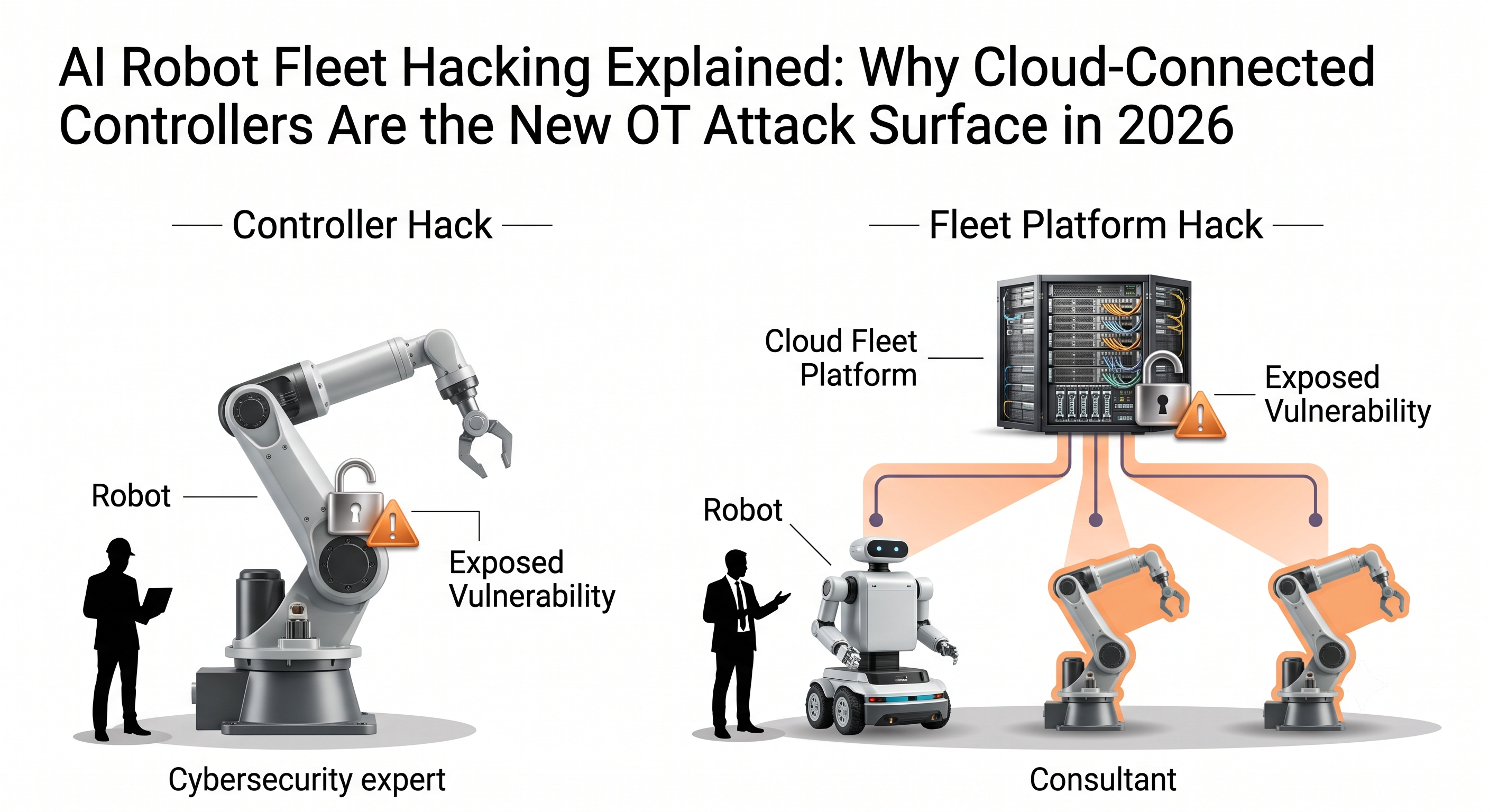
AI robot fleet hacking in 2026 is less about any single robot getting popped and more about the cloud platform that manages hundreds of them at once — the fleet dashboard, the over-the-air firmware pipeline, and the telemetry API every connected robot phones home to. A flaw in one robot's controller ruins one machine's day; a flaw in the cloud platform that manages the fleet ruins every robot's day at once, because the credentials, the firmware-push mechanism, and the trust relationship are shared across the whole deployment. The International Federation of Robotics (IFR) named cybersecurity a top-five 2026 robotics trend for exactly this reason — pointing to rising attacks against both robot controllers and cloud platforms as adoption scales toward a record $16.7 billion in 2026 industrial robot installations. This isn't a rehash of one disclosed CVE or a vendor-VPN governance problem — it's about an architecture layer most OT security coverage still treats as sitting outside the model entirely.
By The Whitepaper Skeptic — placed cloud fleet dashboards inside OT zone reviews
Quick Facts
| Question | Answer |
|---|---|
| What's the core distinction this article makes? | A robot controller vulnerability compromises one machine; a fleet management platform vulnerability compromises every robot connected to that platform at once |
| Most severe 2026 controller-side data point | CVE-2026-8153 — Universal Robots PolyScope 5 Dashboard Server, CVSS 9.8, unauthenticated OS command injection, patched in version 5.25.1 (CISA advisory ICSA-26-134-17) |
| 2026 industrial robot installation value | Record $16.7B globally, per the IFR's "Top 5 Global Robotics Trends 2026" report — the same report names cybersecurity a top-5 trend |
| Architecture pattern illustrated (not an industrial incident) | IOActive found hardcoded MQTT credentials shared across every unit of one consumer robot product line, letting one compromised device escalate to the vendor's cloud broker and exposing 267 connected robots |
| Where does the cloud fleet platform sit in an IEC 62443 model? | As its own zone with its own trust boundary — not "outside" the OT security model, which is how most robotics-security coverage treats it |
Robot Controller Hack vs. Fleet Platform Hack: The Distinction This Article Turns On
These two failure modes get conflated constantly, and the conflation matters because the fix for each is different. A robot controller vulnerability lives on the machine itself — its dashboard server, its onboard web interface, its local network stack. Exploiting it compromises that robot, and maybe whatever it's directly wired or networked to. A fleet management platform vulnerability lives one layer up, in the cloud SaaS that operators use to monitor, dispatch, and push firmware to every robot in the deployment. Exploiting it doesn't compromise a robot — it compromises the thing that has administrative reach into every robot in the fleet simultaneously.
Our AMR Cybersecurity: How a CVSS 9.8 Flaw and 20 MiR Bugs Exposed Warehouse Robots in 2026 piece is the controller-side deep dive — it walks through a single disclosed CVE and a 20-vulnerability disclosure batch in detail, one vendor at a time. This article deliberately doesn't repeat that walkthrough. It's the broader-angle piece: the industry trend of attackers and researchers turning attention toward the cloud layer itself, which is architecturally a different attack surface than any individual robot's dashboard.
CVE-2026-8153: The Controller-Side Data Point, Not the Whole Story
The clearest 2026 illustration of the controller side of this problem is CVE-2026-8153 — a CVSS 9.8 unauthenticated OS command-injection vulnerability in Universal Robots' PolyScope 5 Dashboard Server, discovered by Vera Mens of Claroty Team82 and patched in PolyScope version 5.25.1. CISA published its own advisory (ICSA-26-134-17), and the flaw let an unauthenticated attacker with network access to the Dashboard Server achieve remote code execution on the controller and pivot to connected peripherals on flat, unsegmented networks.
That's one illustrative data point, not the article. It's mentioned here because it's the sharpest recent proof that robot controller dashboards left network-reachable are a real, patched-in-2026 exploitation path — the same underlying "reachable web dashboard becomes a command-execution path" pattern that shows up again, at a different layer, in the fleet-management platforms this article is actually about.
The Architecture Failure Pattern: One Compromised Credential, Fleet-Wide Exposure
The pattern that matters for cloud fleet platforms specifically is credential and trust-boundary design, not any single CVE. IOActive's "From Skynet to AI Agents: The State of Robot Security Nine Years Later" research found 38 vulnerabilities across three consumer robots it tested (16 critical, 14 high, 6 medium, 2 low). One finding is worth isolating as an architecture illustration: hardcoded MQTT credentials shared across every unit of a single product line let a single compromised device escalate to the vendor's own cloud broker using admin-level credentials — exposing all 267 connected robots on that broker to the same attacker.
A caution worth stating plainly, because it's easy to overstate: IOActive's research covered consumer robots — an autonomous lawnmower, an exoskeleton, and a window-cleaning robot — not industrial, warehouse, or manufacturing fleets. This isn't cited here as an industrial-fleet incident. It's cited as the class of architecture failure the robotics industry has repeatedly found when it tests fleet-connected devices: one shared credential set, baked into every unit at the factory, that turns "one device got compromised" into "the vendor's entire fleet broker is compromised." That's a structural pattern, not a headline about a specific breach — and it's the exact question an industrial fleet operator should be asking their own vendor: if one robot's stored credentials leaked, can an attacker reach the fleet dashboard, or only that one unit?
Separately, ExtraHop's 2026 Global Threat Landscape Report found that 55% of security and IT decision-makers now name AI agents and other agentic infrastructure as their single biggest attack-surface risk. That's a broad enterprise-IT finding, not a robotics-specific one — but it lines up with where fleet-management platforms are headed as they add more autonomous, API-driven behavior (auto-dispatch, predictive maintenance triggers, agentic scheduling) on top of what used to be a simple monitoring dashboard.
Why This Isn't the Air-Gap Myth: Robot Fleets Are Cloud-Connected by Design
It's worth being explicit about a distinction this article deliberately doesn't blur: The Air Gap Myth in OT Security argues that networks labeled isolated usually aren't — that "air-gapped" is a claim that erodes through USB drives, engineering workstations, and vendor remote access, not a verified state. That article is about isolation that was assumed and then quietly broken.
Robot fleets are a different situation entirely. A cloud-connected AMR or cobot fleet isn't accidentally bridged to the internet — it's intentionally cloud-connected by design. Fleet management SaaS, over-the-air firmware updates, and remote telemetry are the product, not a leak. Nobody has to break an assumption of isolation, because isolation was never the assumption in the first place. The risk this article is about isn't a broken air gap; it's a cloud architecture that was built connected from day one, and whether that architecture treats the cloud layer with the same rigor an OT security program applies to everything else on the network.
Where the Cloud Fleet Platform Sits in Your IEC 62443 Zones and Conduits Model
Most robotics-security coverage treats "the cloud" as a black box sitting entirely outside the OT security model — something the robot vendor handles, not something the plant's own security architecture needs to account for. That's the gap worth closing directly.
Our IEC 62443 Zones and Conduits Explained piece covers the general segmentation design process — defining zones by function and controlling the conduits between them rather than allowing flat access. Applied specifically to a cloud-connected robot fleet, the practical move is to stop treating the fleet-management platform as an undefined appendage and instead place it explicitly on the diagram as its own zone, with its own trust boundary, separate from both the OT control zone (the robots and their local controllers) and the enterprise IT zone:
| Zone | What Lives There | Conduit Discipline |
|---|---|---|
| OT control zone | The robots themselves, local controllers, charging/dock infrastructure | Traffic to the fleet platform should traverse a defined, monitored conduit — not a flat path to the internet |
| Cloud fleet-management zone | The vendor's SaaS dashboard, OTA firmware pipeline, telemetry API | Treated as its own trust boundary, not folded into either OT or enterprise IT — this is the zone most coverage skips |
| Enterprise IT zone | Corporate systems, ERP/MES integrations that consume fleet data | Receives filtered fleet data through the cloud zone's conduit, not direct robot-to-ERP paths |
This is a different question from the one covered in OT Remote Access Security Explained. That piece is about third-party vendors and integrators getting temporary or standing remote access into your OT network — a VPN account, an RDP session, a TeamViewer login someone else uses to reach your equipment. The robot fleet operator's own cloud platform isn't a third party reaching in; it's a standing architectural component the fleet was built around, with its own credentials, its own API surface, and its own blast radius if compromised. Both are real risks in the same cluster — they're just structurally different conduits, and conflating them means one of them ends up unmonitored.
How to Secure a Cloud-Connected Robot Fleet Without Disconnecting It
Disconnecting isn't the answer — a fleet platform that can't push firmware updates or pull telemetry loses most of the reason it exists. The controls that actually reduce exposure without giving up connectivity:
- Per-device credentials, not shared ones. The IOActive pattern above only works because every unit shared the same hardcoded MQTT credentials. Unique, rotatable credentials per robot mean one compromised device doesn't hand an attacker the keys to the fleet broker.
- Scoped API tokens over standing admin access. A telemetry-reporting robot doesn't need firmware-push privileges, and a dispatch API doesn't need read access to every other robot's location history. Scope each integration to what it actually does.
- Signed, verified OTA firmware. If the update pipeline is the conduit into every controller in the fleet, it needs the same integrity checks a PLC firmware update would get in a segmented OT environment — signed packages, verified before install, not trust-on-receipt.
- Monitor the cloud conduit like any other OT traffic path. If your organization already runs an OT-focused monitoring platform, check whether it extends visibility to fleet-management API traffic before assuming you need a separate tool. Our OT Security Vendor Comparison 2026 covers what Dragos, Claroty, and Nozomi Networks each actually monitor.
- Inventory the fleet platform itself as an asset. OT Asset Management covers building an inventory when you don't already know what's on the network — the fleet dashboard and its API credentials belong on that inventory the same as any PLC.
FAQ
Q: How do hackers gain access to robot fleet management platforms?
A: Not usually through the robots themselves. The typical path is credential-based — hardcoded or shared credentials baked into every unit at the factory, scoped-too-broadly API tokens, or an unpatched dashboard on the platform side. The controller-side flaw class (like CVE-2026-8153's unauthenticated command injection) is a different, narrower path that compromises one machine rather than the platform managing the fleet.
Q: Is a cloud-connected AMR or cobot fleet vulnerable to a single point of compromise?
A: It can be, and the failure pattern is well documented even though the clearest public example is from consumer robotics research rather than an industrial fleet: IOActive found that shared, hardcoded MQTT credentials across every unit of one product line let a single compromised device escalate to the vendor's cloud broker with admin-level credentials, exposing 267 connected robots. The defense is architectural — unique per-device credentials and scoped access — not something you can patch your way out of after the fact.
Q: How do I secure a cloud-connected robot fleet without disconnecting it?
A: Keep the connectivity and add the controls that were probably missing from day one: unique credentials per robot instead of shared/hardcoded ones, API tokens scoped to what each integration actually needs, signed and verified over-the-air firmware updates, and monitoring of the cloud API traffic as its own conduit rather than an unmonitored path. None of this requires air-gapping the fleet.
Q: What's the difference between a robot controller vulnerability and a fleet management platform vulnerability?
A: A controller vulnerability lives on the robot itself — its onboard dashboard, web interface, or local network stack — and exploiting it compromises that machine. A fleet management platform vulnerability lives in the cloud SaaS that monitors and pushes firmware to every robot in the deployment, and exploiting it can compromise the trust relationship the whole fleet depends on at once. They require different fixes: network segmentation and patching for the controller side, credential architecture and API scoping for the platform side.
Q: Was the IOActive robot-hacking research about industrial robots?
A: No — it tested three consumer robots (an autonomous lawnmower, an exoskeleton, and a window-cleaning robot), not warehouse, manufacturing, or industrial fleet robots. It's cited in this piece purely as an architecture-pattern illustration — shared hardcoded credentials enabling fleet-wide escalation — not as evidence of an industrial fleet incident.
Sources
- CISA, "Universal Robots Polyscope 5" advisory ICSA-26-134-17
- SecurityWeek, "Critical Vulnerability Exposes Industrial Robot Fleets to Hacking"
- IFR, "Top 5 Global Robotics Trends 2026"
- IOActive, "From Skynet to AI Agents: The State of Robot Security Nine Years Later"
- ExtraHop, "2026 Global Threat Landscape Report"
- Our own pillar: OT Cybersecurity 101: Why Smart Factories Need a Different Security Model Than IT
- Our own cross-cluster spoke: IEC 62443 Zones and Conduits Explained
- Our own cross-cluster spoke: OT Security Vendor Comparison 2026: Dragos vs. Claroty vs. Nozomi Networks
Author Bio
The Whitepaper Skeptic has direct experience with OT cybersecurity architecture reviews in industrial and smart-factory environments — including reviews where the hardest zone-boundary question wasn't the PLC or the HMI, it was where to put the vendor's cloud fleet-management dashboard that every robot on the floor phoned home to. Most zones-and-conduits diagrams either leave that dashboard off entirely or wave it off as "the vendor's problem, not ours" — this article treats it as its own zone with its own trust boundary because that's the standard those reviews were actually held to.
Related Posts
- OT Cybersecurity 101: Why Smart Factories Need a Different Security Model Than IT
- AMR Cybersecurity: How a CVSS 9.8 Flaw and 20 MiR Bugs Exposed Warehouse Robots in 2026
- OT Remote Access Security Explained: Why 88% of Manufacturers Let Third-Party Vendors Into Their Networks
- The Air Gap Myth in OT Security: Why "Isolated" Industrial Networks Aren't Actually Isolated
- IEC 62443 Zones and Conduits Explained: How to Actually Segment an OT Network in 2026
- OT Security Vendor Comparison 2026: Dragos vs. Claroty vs. Nozomi Networks for Industrial Environments


Comments
Post a Comment