Government Grant vs. Venture Capital: A 3-Stage Funding Sequence for Deep Tech Hardware Startups (2026)
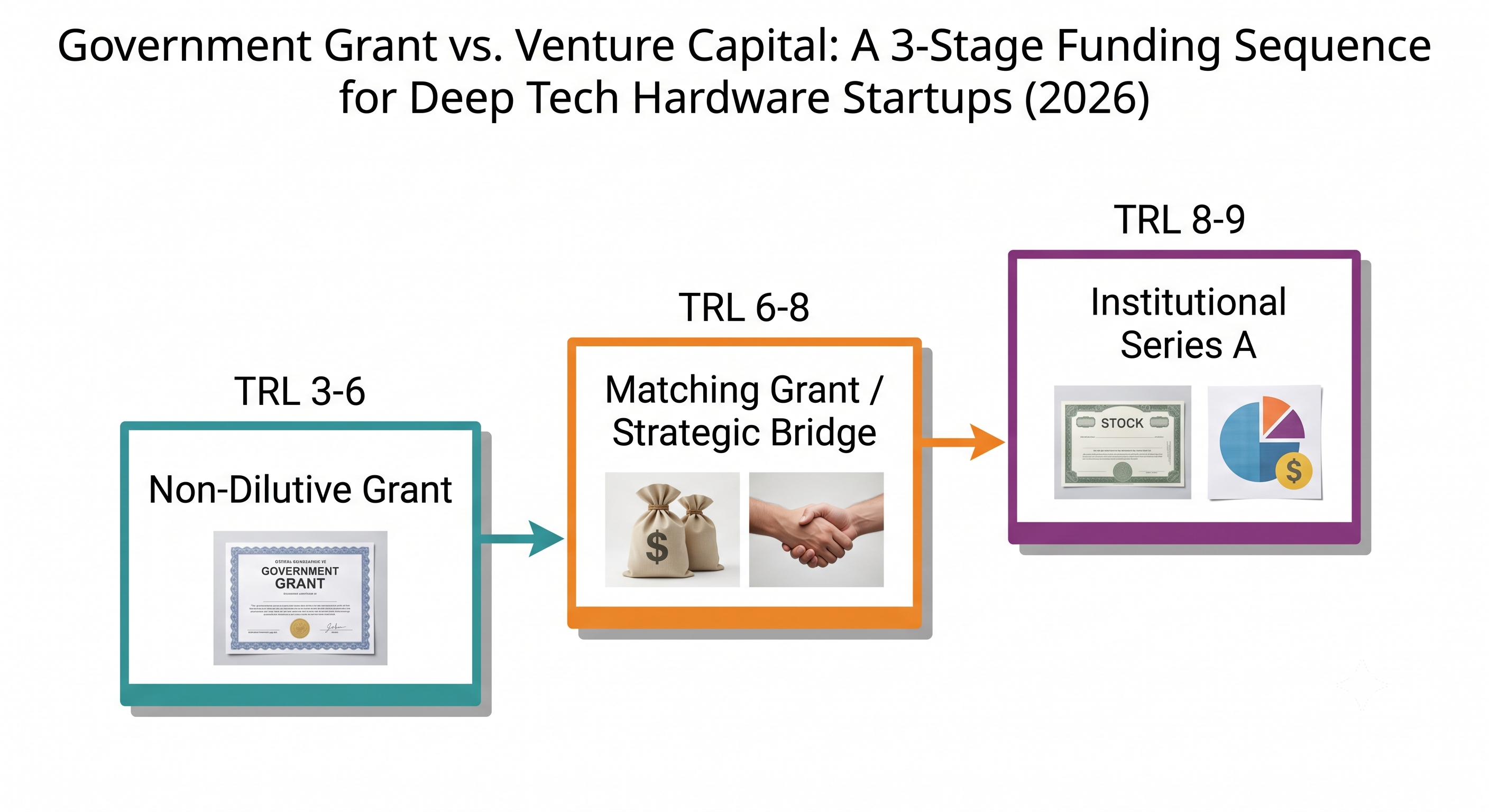
For a deep tech hardware startup, the right order is: non-dilutive grant funding first (roughly TRL 3–6, to derisk the core technology), a matching-grant or strategic-capital bridge second (TRL 6–8, once you have an early commercial signal), and institutional Series A equity last (once you're actually ready to spend on go-to-market, not on finishing the engineering). Reversing that order — taking VC money before the technology is derisked — is the single most common way hardware founders lose board control or get boxed into an 18-month commercial milestone the tech genuinely isn't ready for. Waiting too long to formalize the grant side has its own cost: several matching-fund programs, including Korea's TIPS, require you to still be pre-Series-A to qualify, so the window closes from the other direction too.
By The Whitepaper Skeptic — prepared TCB/government R&D grant funding-sequence documentation firsthand
Quick Facts
| Question | Answer |
|---|---|
| What's the right funding order for deep tech hardware? | Non-dilutive grant (TRL 3–6) → matching-grant/strategic bridge (TRL 6–8) → institutional Series A (GTM scale) |
| Why not raise VC first? | VC-first at low TRL risks losing board control and accepting commercial milestones the technology can't hit yet |
| Is TIPS a "grant" or "venture capital"? | Neither cleanly — it's a matching grant triggered by a private investor's commitment, which blurs the grant-vs-VC binary in Korea specifically |
| What's the biggest sequencing risk on the grant side? | Waiting too long can mean missing a matching-fund window (TIPS requires being pre-Series-A) |
| How concentrated is 2026 VC funding? | AI startups took roughly 90% (~$171B of $189B) of global VC funding in February 2026 (Crunchbase) — a reminder that hardware timelines don't run on the same clock as software VC timing |
"Grant vs. VC" Is the Wrong Frame — It's a Blended Stack, in a Specific Order
Most 2026 deep-tech funding commentary has converged on the same general idea: non-dilutive grants (SBIR/STTR, NSF I-Corps, DARPA in the US; TCB-linked government R&D grants in Korea) for early technical milestones, venture capital for scale, and strategic or customer funding once commercial validation exists. That's directionally correct, and it's also where most of the existing content on this topic stops — it names the ingredients of the blended stack without ever building a decision framework for when to reach for each one.
That gap matters more for hardware than for software, because the two failure modes aren't symmetric. A software startup that raises VC "too early" mostly loses equity it didn't need to give up. A hardware startup that raises VC too early can lose the ability to run the derisking work at its own pace — because VC term sheets come with governance rights and reporting cadences built for companies that are further along than a pre-TRL-6 hardware startup usually is.
The pace mismatch is sharper in 2026 than it's been in prior years. Crunchbase reported that AI startups absorbed roughly 90% of February 2026's record-setting $189B in global VC funding — about $171B of it went to AI companies, concentrated in a handful of very large software-adjacent rounds. That concentration held through the first half of the year: Crunchbase's H1 2026 data shows global startup investment hit a record $510B for the half, already surpassing the full $440B invested across all of 2025, with AI-focused companies (led by OpenAI and Anthropic, which alone took 43% of H1 funding) capturing more than 70% of global startup capital by Q2. The practical takeaway for a deep-tech hardware founder isn't that VC dollars have disappeared — it's that the pace and expectations attached to 2026 VC capital are increasingly calibrated to software iteration speed, not to the multi-year physical derisking timeline a hardware product actually needs. Assuming your hardware raise will move on a software-style timeline is a planning mistake before it's ever a negotiating mistake.
A TRL-Based 3-Stage Sequencing Framework
Technology readiness level (TRL) is a more useful anchor for sequencing than "how much money do we need," because it's the variable that actually determines what kind of capital you're eligible for — and what kind of capital you can survive taking.
| Stage | TRL Range | Funding Type | What It's Actually For |
|---|---|---|---|
| Stage 1 | TRL 3–6 | Non-dilutive grant / proof-of-concept funding | Derisk the core technology without giving up equity or board seats before you know if the tech works at scale |
| Stage 2 | TRL 6–8 | Matching-grant or strategic/CVC bridge | Fund the transition from lab-validated to pilot-deployed, with an early commercial signal (a paying pilot customer, a signed LOI) as the trigger |
| Stage 3 | TRL 8–9 | Institutional Series A (equity) | Fund go-to-market scale-up — manufacturing ramp, sales team, customer support — once the technology risk is largely retired |
The framework isn't "grants are free money, take as much as possible before touching VC." It's that each stage's capital type is matched to the kind of risk you're retiring at that point. Grant money is well-suited to technology risk because grantors (governments, foundations) aren't underwriting a return on capital the way an equity investor is — they can tolerate a slower, more uncertain derisking process. Equity investors are underwriting a return, so they price in governance rights and milestone pressure that make sense once commercial risk — not technology risk — is the main variable left.
Grant vs. Venture Capital: A Side-by-Side Comparison
| Dimension | Government Grant (Non-Dilutive) | Venture Capital (Equity) |
|---|---|---|
| Dilution | None — no equity given up | Meaningful — typically 15–25%+ per round |
| Governance strings | Usually none (reporting requirements, not board seats) | Board seat, protective provisions, information rights are standard |
| Typical timeline to close | Months (application/review cycles) — often slower to apply for, but no negotiation once awarded | Weeks once a term sheet is signed, but the fundraising process itself (pitching, diligence) can take months |
| What it's underwriting | Technical merit / national-interest criteria | Commercial return on a specific timeline |
| IP/data-rights strings | Can carry encumbrances (data rights, march-in rights, or — in Korea — 기술료/technology-fee obligations) that must be structured correctly from day one | Typically none directly, but VC due diligence will scrutinize any prior grant's IP terms closely |
| Milestone pressure | Technical milestones, generally more forgiving of delay | Commercial/revenue milestones, tied to the next raise's timeline |
| Signal to the next-stage investor | Non-dilutive capital + a completed grant milestone is itself a credibility signal in later fundraising | A completed VC round sets the valuation floor and governance precedent for every round after it |
The Two Failure Modes: Too Early on VC, Too Late on Grants
Taking VC money too early. The clearest failure pattern is a hardware team that raises an institutional round while the core technology is still at TRL 4 or 5 — before it's actually been derisked outside the lab. The VC term sheet arrives with board control provisions and an 18-month path to meaningful revenue baked into the model, because that's the standard software-calibrated cadence discussed above. When the physical engineering doesn't cooperate with a software-speed milestone schedule, the founder is now renegotiating governance terms with an already-seated board, from a position of weakness — a much worse spot than never having taken the round in that shape to begin with.
Applying for grants too late. The mirror-image mistake is less discussed but just as costly: assuming grant applications can happen "whenever, in parallel." Several matching-fund programs are structurally time-boxed against your cap table stage, not just your technology stage. Korea's TIPS program is the clearest example — it requires being pre-Series-A to qualify, because the whole mechanism depends on a private investor's initial commitment triggering the government match (see our dedicated TIPS breakdown for the exact matching structure). A founder who closes an institutional Series A before structuring the TIPS-eligible bridge round has permanently closed that door — there's no reapplying once you're past the eligibility line. This is the failure mode I got wrong myself: preparing grant and TCB documentation, I treated the application calendar as something that could run in parallel with a raise, on the assumption that the binding constraint was technical readiness — TRL 6-ish evidence, test data, a defensible commercialization plan. It isn't. On a matching program the binding constraint is cap-table stage, and no amount of technical strength reopens a door the cap table has already closed.
Why Korea's TIPS Program Breaks the Clean "Grant vs. VC" Binary
Most English-language deep-tech funding content treats "grant" and "VC" as a clean binary — SBIR/STTR in the US genuinely is pure non-dilutive money, no equity, no private-investor prerequisite. Korea's TIPS program doesn't fit that binary at all: it's structurally a hybrid, where the government matches a private accelerator's or investor's dollar commitment dollar-for-dollar, up to a program cap. That means TIPS isn't really "Stage 1 grant money" in the pure sense — it functions more like the Stage 2 bridge in the TRL framework above, because it requires an early commercial/investor signal (the private match) as a precondition, not just a technical proposal.
This matters for sequencing specifically: a founder planning a purely US-style "SBIR first, VC later" sequence in Korea will misjudge the timeline, because the Korean equivalent of "Stage 1" (pure non-dilutive government R&D grants, distinct from TIPS) and the Korean "Stage 2 bridge" (TIPS) require different levels of private-market validation before you're even eligible to apply. Korea's 2026 program landscape also includes newer non-dilutive tracks worth knowing about at Stage 1 specifically — the Super-Gap Startup Project (초격차 스타트업 프로젝트) offers up to ₩1.2 billion per company (up to ₩600 million for commercialization over three years, plus up to ₩600 million for R&D over up to two years) to roughly 120–200 deep-tech startups a year across 12 strategic industries. A separately branded Deep Tech-Specialized Startup Package also exists for 2026, though the specific KRW figures attached to it vary across secondary sources — treat any specific number you see quoted for that particular program with caution until you've checked the current official K-Startup or Ministry of SMEs and Startups (중소벤처기업부) notice directly.
There's a second, less obvious way the Korean context complicates a clean sequence: government R&D grants in Korea carry IP and data-rights terms that must be structured correctly from the start, or they create friction in later VC due diligence. We've covered the mechanics of the 기술료 (technology fee) and IP ownership rules from Korean government R&D grants in detail elsewhere — see Who Owns the IP From a Korean Government R&D Grant? — but the sequencing point is this: a Stage 1 grant with poorly structured IP terms is exactly the kind of thing a Series A due-diligence process will flag at Stage 3, potentially slowing or repricing the round you're trying to close. Structuring it right at Stage 1 is cheaper than fixing it at Stage 3.
A related non-dilutive lever worth sequencing correctly alongside grants — Korea's R&D tax credit for startups — is a different mechanism again (a tax offset rather than a cash award), and gets its own detailed treatment in Korea's R&D Tax Credit for Startups Explained: Rates, Eligibility, and the 2026 Changes. And once you're ready to raise the institutional round this framework's Stage 3 describes, Korea's three major corporate VC arms are a specific class of Stage 3 (or late Stage 2 strategic-bridge) investor worth understanding on their own terms — see Which Korean Conglomerate CVC Should Deep Tech Hardware Startups Target? Samsung, SK, and LG Compared.
A US Contrast Point: SBIR/STTR Data Rights
For context on how differently a "pure" non-dilutive grant program can be structured, it's worth noting that US SBIR/STTR awards can carry government data rights lasting up to 20 years for properly marked technical data — a figure confirmed both by Foley & Lardner's 2026 IP due-diligence guidance and by the DoD's final rule codifying the 20-year SBIR data protection period (after which the government moves from limited/restricted rights to perpetual Government Purpose Rights, not full public disclosure). That's a materially longer encumbrance window than most founders assume going in, and it's a useful reminder — whether you're in the US SBIR system or the Korean government-grant system — that "non-dilutive" doesn't mean "no strings attached." It means the strings are attached to data and IP rather than to equity and board seats, which is a different kind of cost, not the absence of one.
FAQ
Q: Should I apply for a government grant before raising venture capital?
A: For most deep tech hardware startups, yes — apply for non-dilutive grant funding first, roughly while your technology is at TRL 3–6, before you're ready for an institutional equity round. This derisks the core technology without giving up board control, and a completed grant milestone becomes a credibility signal when you do raise VC later.
Q: How does taking venture capital money too early hurt a deep tech hardware startup?
A: VC term sheets typically come with board seats, protective provisions, and commercial milestones calibrated to a software-speed timeline (often around 18 months to meaningful revenue). If your hardware technology isn't actually derisked yet, you end up renegotiating governance terms with an already-seated board from a weaker position than if you'd waited.
Q: Is Korea's TIPS program a government grant or venture capital?
A: Neither cleanly — TIPS is a hybrid where the government matches a private accelerator's or investor's capital commitment dollar-for-dollar, up to a program cap. It requires a private-investor signal as a precondition, which makes it function more like a bridge between pure grant funding and institutional VC than like either one alone.
Q: How do Korean government R&D grant IP rights affect later VC due diligence?
A: Korean government R&D grants can carry IP ownership terms and 기술료 (technology fee) obligations that, if not structured correctly at the time of the grant, become friction points in a Series A investor's due diligence process later. Structuring the IP terms correctly at the grant stage is significantly cheaper than trying to fix them once a VC term sheet is on the table.
Q: What TRL should a hardware startup be at before raising an institutional Series A?
A: Generally TRL 8–9 — meaning the core technology risk is largely retired and what's left to fund is go-to-market scale-up (manufacturing ramp, sales, customer support) rather than finishing the underlying engineering. Raising institutional equity while still at TRL 4–6 is the most common sequencing mistake this framework is built to avoid.
Sources
- Crunchbase News: "Massive AI Deals Drive $189B Startup Funding Record In February" (2026) — February 2026 global VC funding total and AI-startup concentration figure
- Crunchbase News: "Global Startup Investment Hit Record $510B In H1 2026 As AI Boom Accelerates Funding And Exits" (2026) — H1 2026 global startup funding total vs. full-year 2025, AI concentration figures
- Foley & Lardner: "IP Due Diligence in Government-Funded Industries" (2026) — US SBIR/STTR government data-rights duration context
- Crowell & Moring: "Final DOD Rule Codifies 20-Year SBIR Data Protection Period" — corroborates the 20-year SBIR/STTR data-rights protection period and the transition to Government Purpose Rights after expiration
- 대한민국 정책브리핑 (Korea.kr): "지역 초격차 스타트업 육성 본격화…최대 12억 원 지원" — Super-Gap Startup Project (초격차 스타트업 프로젝트) 2026 per-company funding structure
- TIPS Program Korea: How the $580K Matching R&D Grant Actually Works for Deep Tech Founders in 2026 — our own dedicated breakdown of TIPS's matching mechanics, reused rather than re-verified here
- Who Owns the IP From a Korean Government R&D Grant? Ownership Rules and the Technology Fee Explained — our own breakdown of Korean R&D grant IP/기술료 mechanics
- How South Korea Funds Deep Tech Startups: TCB Certification & Government R&D Grants Explained — our own pillar article on the broader Korean funding system this piece builds on
Author Bio
The Whitepaper Skeptic has prepared TCB certification documentation and Korean government R&D grant applications for deep tech hardware startups, including structuring non-dilutive funding timelines and IP/technology-fee terms so they hold up under later VC due diligence — the same sequencing tension this article is built around.
Related Posts
- How South Korea Funds Deep Tech Startups: TCB Certification & Government R&D Grants Explained
- Korea's Deep Tech VC Ecosystem: Who's Funding Semiconductors, Robotics, and Advanced Materials Startups in 2026
- How to Structure a Series A Pitch Deck for Deep Tech Hardware Startups
- Who Owns the IP From a Korean Government R&D Grant? Ownership Rules and the Technology Fee Explained
- TIPS Program Korea: How the $580K Matching R&D Grant Actually Works for Deep Tech Founders in 2026
- Korea's R&D Tax Credit for Startups Explained: Rates, Eligibility, and the 2026 Changes
- Which Korean Conglomerate CVC Should Deep Tech Hardware Startups Target? Samsung, SK, and LG Compared
Tags
government grant vs venture capital, deep tech funding sequence, TRL funding strategy, hardware startup capital stack, non-dilutive funding hardware startup


Comments
Post a Comment