K-Startup Grand Challenge 2026: How Foreign Founders Get Up to ₩950M to Launch in Korea
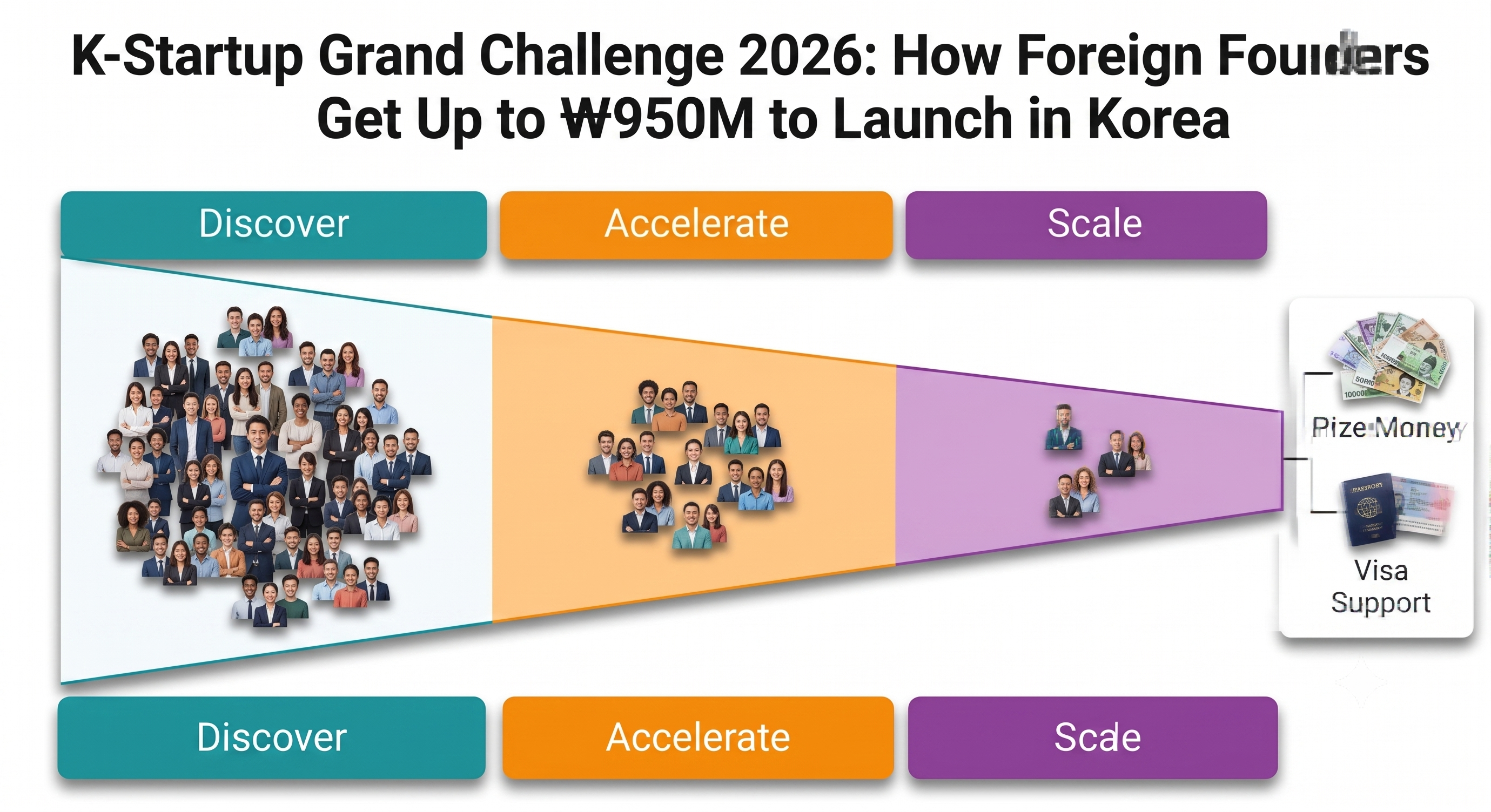
The K-Startup Grand Challenge (KSGC) is South Korea's flagship market-entry program for non-Korean founders: it offers up to ₩950M (~US$690K) in equity-free prize money, scale-up grants, and stipends, and it doesn't require a founder to have a Korean-registered company at the time of application. The core eligibility test is simple — your CEO/representative must hold non-Korean nationality, and your startup must generally be within 7 years of incorporation. The 2026 application window (May 6 – June 17, 2026) has already closed, so this article walks through exactly how that cycle worked — funding breakdown, phase structure, and visa tracks — as the reference point for founders preparing for the next cohort, not as a live call to apply.
By The Whitepaper Skeptic — assessed foreign-invested company eligibility for Korean government funding programs
Quick Facts
| Question | Answer |
|---|---|
| Total support package (2026 cycle) | Up to ₩950M (~US$690K), fully equity-free |
| Who's eligible | CEO/representative must be a non-Korean national; startup generally within 7 years of incorporation; Korean company registration is not required to apply |
| Program structure | 3-phase funnel — Discover, Accelerate, Scale — narrowing from roughly 80 teams to a final 20, then 8 for scale-up grants |
| Visa tracks bundled in | C-3 (short-term business), D-10-2 (startup preparation), D-8-4 (startup visa, up to 3 founders per company) |
| Program governance | Funded by Korea's Ministry of SMEs and Startups (MSS), managed by KISED, operated by GCCEI |
What Is the K-Startup Grand Challenge, and How Much Funding Is Actually on the Table?
KSGC is a government-backed accelerator built specifically for startups founded outside Korea — it's less a grant program and more a structured on-ramp that bundles funding, visa sponsorship, and market-entry support into one application. For the 2026 cycle, the total package tops out at roughly ₩950M in equity-free support, broken down across three pools:
| Component | Amount | Who Receives It |
|---|---|---|
| Demo Day prize money | ₩380M total | Split among the top 20 teams that complete Phase 3 |
| Scale-up grants | ₩250M total | Awarded to the top 8 teams selected out of that group of 20 |
| Participation and travel stipends | Not itemized as a single figure in public materials | All teams admitted into the program, plus office space and visa support |
None of this requires giving up equity — a meaningful difference from most accelerator models outside Korea, where seed funding typically comes with a percentage stake attached. That equity-free structure is consistent with how the rest of Korea's public deep tech funding stack works; our pillar guide to how South Korea funds deep tech startups covers the broader TCB certification and government R&D grant landscape that KSGC sits alongside.
Who Actually Qualifies as a "Foreign Founder" Here
The eligibility bar is narrower than "not Korean," and it's worth checking closely before assuming you qualify:
- CEO/representative nationality: The company's CEO or representative must hold non-Korean nationality. This is the single hard-line requirement — it's what separates KSGC from every other spoke in this funding cluster, all of which assume a founder already operating a Korean-registered entity.
- Company age: Startups are generally expected to be within 7 years of incorporation, extended to up to 10 years for companies in designated "new industry" (신산업) sectors — a category set under Korea's Support for Small and Medium Enterprise Establishment Act rather than a fixed list published inside the KSGC guidelines themselves. Public coverage of the program associates the extension with deep-tech-style fields (AI, biotech, advanced manufacturing) that have longer development cycles, but KSGC has not published a definitive, KSGC-specific sector list tied to the 10-year window. If your company is past the 7-year mark and hoping to qualify under the extension, confirm your sector's current designation directly against the official recruitment guidelines rather than assuming eligibility. Checking foreign-invested company eligibility for Korean grant and TCB pathways is what taught me to stop trusting the summary line: the 10-year extension here is defined by a 신산업 designation living in a separate statute, not in the KSGC guidelines a founder is actually reading. I have had to reverse my own reading of an eligibility rule after pulling the underlying designation list, and the error started where it usually does — an English-language program summary that had flattened a statutory cross-reference into one confident sentence.
- No Korean incorporation required at application: Unlike TCB certification or most government R&D grants — which assume a Korean-registered company already exists — KSGC explicitly does not require formal incorporation in Korea at the time you apply. That's the structural reason this program sits logically upstream of the rest of the tcb-funding cluster: it's designed for founders who haven't set foot in the Korean system yet.
The Three-Phase Funnel: From ~80 Teams to a Final 8
KSGC narrows its cohort in three stages, each with its own format and timeline. For the 2026 cycle, the schedule looked like this:
| Phase | Name | Timeline (2026 cycle) | Teams | Format |
|---|---|---|---|---|
| Phase 1 | Discover | July – September 2026 | ~80 teams | Online |
| Phase 2 | Accelerate | September – December 2026 | Top 40 | Hybrid |
| Phase 3 | Scale | December 2026 – June 2027 | Top 20 (then top 8 for scale-up grants) | Hybrid |
The funnel shape is worth internalizing on its own: roughly 80 teams enter Phase 1, less than half make it to Phase 2, and only 20 reach the Demo Day stage where the ₩380M prize pool is actually distributed — with a further cut to 8 teams for the ₩250M in scale-up grants. As of this writing, Phase 1 for the 2026 cohort is already underway, having started in July 2026.
Visa Pathways Bundled Into the Program
One of KSGC's more distinctive features is that it doesn't just fund a startup — it sponsors a path to actually being in Korea legally while you build it. Three visa tracks are bundled into the program:
- C-3 — a short-term business visa, typically used in the earliest phase before a longer-term status is needed
- D-10-2 — a startup preparation visa, intended for founders still setting up before formal incorporation
- D-8-4 — the startup visa itself, available to up to 3 founders per company
For a founder evaluating whether to relocate to Korea at all, this visa bundling is arguably as valuable as the cash — market-entry programs elsewhere in Asia often separate funding and immigration status into two applications with two different agencies. KSGC handles both through one track.
Why the 2026 Window Is Already Closed — and Why the Numbers Still Matter
The 2026 KSGC application window ran May 6 – June 17, 2026, 15:00 KST, and it has already closed. If you're reading this now, you can't apply into the 2026 cohort — Phase 1 (Discover) is already in progress with the teams that were selected back in the spring. That's a deliberate framing choice for this article: rather than treat this as a live "apply now" pitch, the goal here is to document exactly how the 2026 cycle's mechanics and funding numbers worked, because that structure — the ₩950M total, the 3-phase funnel, the visa bundle — is the most useful reference point for a founder deciding now whether to prepare an application for the next cohort. Historically, KSGC has run on an annual cycle, so treat the figures above as the current baseline to plan against, not a number that's likely to be stale by the time the next recruitment window opens.
Where KSGC Fits in Korea's Broader Deep Tech Funding Stack
KSGC solves a problem none of the rest of this funding cluster addresses: how a founder with no existing Korean footprint gets one. Everything else in Korea's public funding system — TCB certification, most government R&D grants, and Korea's VC ecosystem — generally assumes you already have a Korean-registered entity to evaluate. KSGC is the step before that.
A few things worth flagging once you're past KSGC and thinking about what comes next:
- KSGC's Demo Day prize money isn't meant to be your only runway. ₩380M split across 20 teams (and further concentrated toward the top 8 for scale-up grants) is meaningful seed-stage capital, but it's not a full funding round. Once you've used KSGC to establish a Korean foothold, our guide to Korea's deep tech VC ecosystem covers who actually writes the next check.
- KSGC's own funding is explicitly equity-free — don't assume that extends to every grant you apply for afterward. Other Korean government R&D grants often come with technology-fee (기술료) and IP-ownership obligations attached once a project succeeds commercially. KSGC's official guidelines, program site, and press coverage do not publicly specify any IP-ownership terms attached to its own Demo Day prize or scale-up grant money — that silence is notable given how explicit Korea's standard R&D grant terms tend to be about it, but it isn't confirmation that no such terms exist. Confirm directly with KISED/GCCEI before assuming there are no strings attached. Our explainer on who owns the IP from a Korean government R&D grant covers those technology-fee rules in detail — it's written for grants generally, not KSGC specifically, but it's the right next read once you're navigating Korea's broader grant system.
- KSGC vs. TIPS is a common next question, since both are non-dilutive, government-linked programs — see the FAQ below for the short version, and our TIPS program explainer for the full mechanics of the other track.
FAQ
Q: How much funding can you actually get from the K-Startup Grand Challenge?
A: Up to ₩950M (~US$690K) in total equity-free support for the 2026 cycle — ₩380M in Demo Day prize money split among the top 20 teams, plus ₩250M in scale-up grants for the top 8 teams that advance furthest, on top of participation and travel stipends, office space, and visa support.
Q: Do I need to already have a company registered in Korea to apply for the K-Startup Grand Challenge?
A: No. Unlike most other Korean government funding programs (TCB certification, standard R&D grants), KSGC does not require formal Korean incorporation at the time of application — that's what makes it a market-entry program rather than a growth-stage grant.
Q: What visa do K-Startup Grand Challenge participants get?
A: The program bundles three visa tracks depending on stage: C-3 (short-term business visa), D-10-2 (startup preparation visa), and D-8-4 (the startup visa itself, available to up to 3 founders per company).
Q: How many teams does the K-Startup Grand Challenge actually select?
A: The program runs a 3-phase funnel — roughly 80 teams start in Phase 1 (Discover), the top 40 advance to Phase 2 (Accelerate), and the top 20 reach Phase 3 (Scale) and Demo Day, where the final 8 are selected for scale-up grants on top of the shared prize pool.
Q: What's the difference between the K-Startup Grand Challenge and Korea's TIPS program?
A: KSGC is an entry-point program aimed at founders who aren't yet based in Korea and haven't incorporated there — it bundles funding with visa sponsorship. TIPS is a later-stage, private-investment-matched R&D grant program generally aimed at companies already operating and incorporated in Korea. In practice, KSGC is the more logical first step for a non-Korean founder, with TIPS becoming relevant once you're an established Korean entity raising a subsequent round — see our TIPS program explainer for the full mechanics.
Sources
- K-Startup Grand Challenge — official program site — eligibility, phases, visa tracks, official program description
- KSGC 2026 Recruitment Guidelines (PDF) — official recruitment guidelines, issued as Ministry of SMEs and Startups Notification No. 2026-316; the 7-year/10-year company-age rule is set here, though the guidelines do not spell out a fixed sector list specifically tied to the 10-year extension
- BusinessWire, "K-Startup Grand Challenge 2026: Korea's Full-Cycle Launchpad for Global Startups" — official program press release; funding breakdown and program governance (MSS/KISED/GCCEI)
- KoreaTechDesk, "The Real Value of KSGC Isn't Funding, It's What Founders Do After Acceptance" — secondary trade coverage on what founders actually do after acceptance
Author Bio
The Whitepaper Skeptic has directly evaluated foreign-invested company eligibility for Korean government R&D grants and TCB certification pathways as part of Series A and IPO roadmap work — the same eligibility-and-paperwork logic that determines whether a non-Korean-founded startup qualifies for entry programs like KSGC in the first place.
Related Posts
- How South Korea Funds Deep Tech Startups: TCB Certification & Government R&D Grants Explained
- Korea's Deep Tech VC Ecosystem: Who's Funding Semiconductors, Robotics, and Advanced Materials Startups in 2026
- Who Owns the IP From a Korean Government R&D Grant? Ownership Rules and the 기술료 Technology Fee Explained
- How to Structure a Series A Pitch Deck for Deep Tech Hardware Startups — the natural next read once KSGC funding and a Korean foothold are in place and you're preparing an institutional raise
- TIPS Program Korea: How the $580K Matching R&D Grant Actually Works for Deep Tech Founders in 2026


Comments
Post a Comment