AMR WMS Integration Explained: Why Deployments Take 4-24 Weeks (and What a WES Actually Does) in 2026
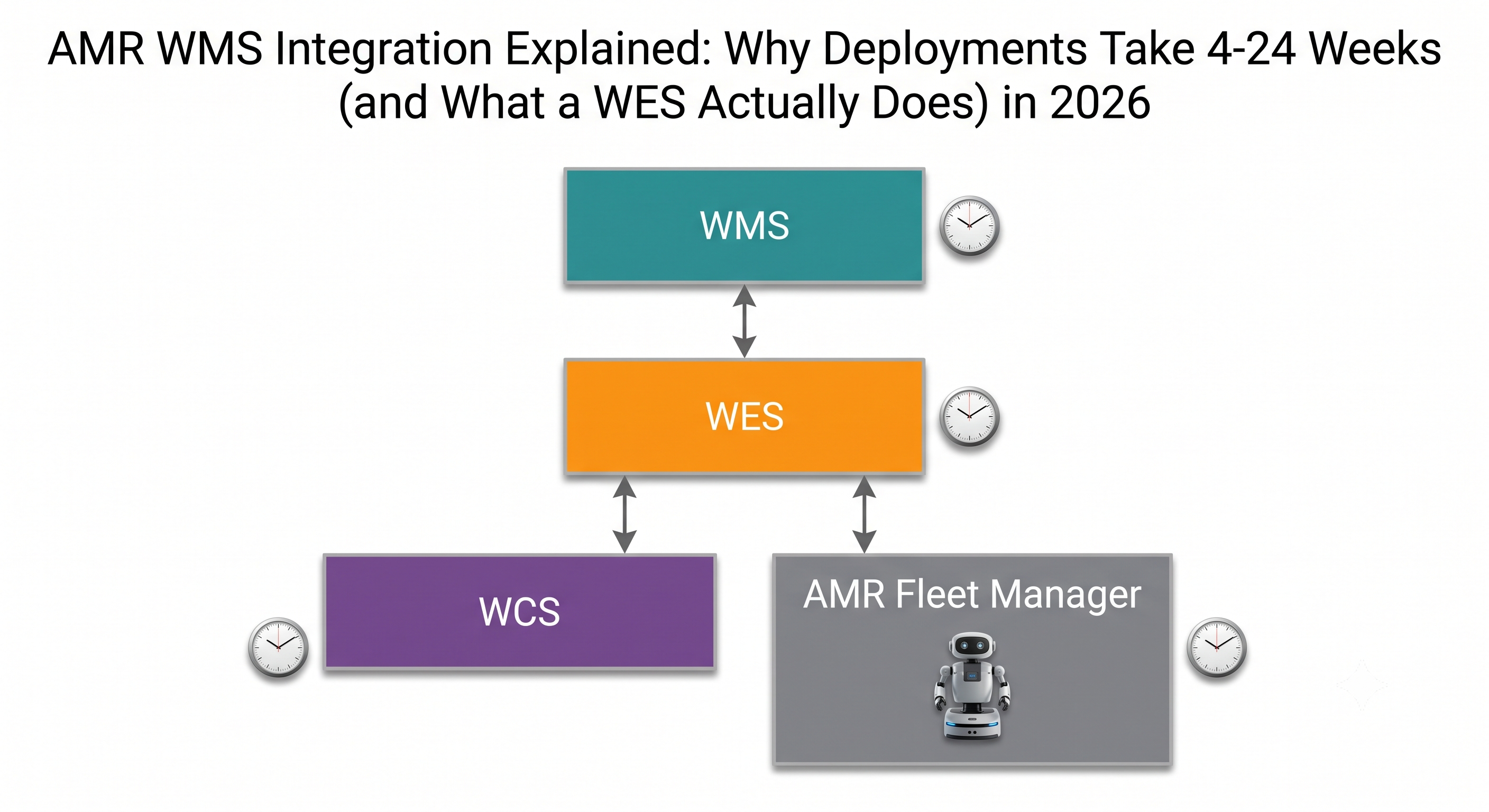
AMR-to-WMS integration, not robot hardware, is widely described in vendor and systems-integrator write-ups as the single largest source of deployment delay and cost overrun in warehouse automation projects — a standard single-vendor integration is commonly put at roughly 4-8 weeks, while a custom or multi-vendor integration is commonly put at 16-24 weeks. That range shows up consistently across implementation case studies, but it is not published as a formal benchmark by a named industry body such as MHI, Interact Analysis, or LogisticsIQ, so treat it as directional rather than a guaranteed timeline. The gap between those two numbers is almost never about the robots themselves — it's about whether a warehouse execution system (WES) sits between the WMS and the automation layer, or whether the fleet is bolted directly onto a WMS that was never designed to orchestrate real-time robot traffic. This piece breaks down the WMS/WES/WCS/fleet-manager stack that trade coverage routinely blurs, why integration eats the timeline, and what it actually costs to budget for correctly.
By The Whitepaper Skeptic — AMR deployment scoping and systems-integration planning experience
Quick Facts
| Question | Answer |
|---|---|
| What causes most AMR deployment delays? | Integration — WMS compatibility gaps, network infrastructure, floor/facility prep, worker change management, and multi-vendor coordination — not robot navigation or safety performance, per vendor and integrator postmortems (no single named industry study quantifies an exact failure-share percentage) |
| How long does AMR-WMS integration take? | Roughly 4-8 weeks for a standard single-vendor integration versus 16-24 weeks for a custom or multi-vendor integration, per vendor and integrator case-study commentary — directional, not a formal benchmark published by MHI, Interact Analysis, or LogisticsIQ |
| What's the difference between a WMS, a WES, and a WCS? | WMS decides what needs to happen (inventory, orders); WES orchestrates in real time across multiple systems including AMR fleets; WCS drives a single vendor's physical automation equipment directly |
| Is an AMR fleet manager the same thing as a WES? | No — a fleet manager drives one AMR fleet; a WES sits a layer above and orchestrates the fleet manager alongside conveyors, sortation, and other automation as one more system in the stack |
| How much of an AMR project's capital cost goes to integration? | Vendor cost breakdowns commonly cite integration-related costs in the 20-30% range on top of hardware pricing, with ongoing annual maintenance separately estimated at roughly 15-20% of equipment cost — both are secondary-source aggregates, not figures from a single named study |
Why "Buy Robots, Plug Into the WMS" Breaks Down
Most AMR sales conversations focus on robot specs — payload, navigation method, battery chemistry, VDA 5050 compliance. Our AMR fleet management software comparison covers exactly this layer: how to evaluate the software that drives one fleet. But a fleet controller that's excellent in isolation still has to be wired into whatever WMS is already running the warehouse, and that step is where most projects lose weeks or months, not at the robot-selection stage.
The instinct to connect an AMR fleet manager straight to the WMS makes sense on paper — the WMS already knows what needs to be picked, packed, or moved, so why not have it talk directly to the robots? The problem shows up the moment a facility runs more than one automation system: conveyors, pick-to-light stations, sortation, and more than one AMR vendor all competing for the WMS's attention, none of them built to coordinate with each other in real time. A WMS is built to plan work, not to referee live traffic conflicts between physical systems on a warehouse floor. That's the specific job a warehouse execution system exists to do — and skipping it is what turns a scoped 4-8 week integration into a 16-24 week one once the facility's automation mix gets more complex than a single robot fleet.
The Four-Layer Stack: WMS, WES, WCS, and the AMR Fleet Manager
Trade coverage frequently uses "WMS," "WES," and "WCS" almost interchangeably, and folds the AMR fleet manager into whichever term is convenient. They are four distinct layers with different jobs:
| Layer | What It Actually Does | Time Horizon | Typical Scope |
|---|---|---|---|
| WMS (Warehouse Management System) | Decides what needs to happen — inventory levels, order allocation, replenishment logic | Planning (minutes to days) | Whole-warehouse business logic |
| WES (Warehouse Execution System) | Orchestrates in real time across multiple execution systems — sits between the WMS and the automation layer | Real time (seconds) | Multiple automation systems, including AMR fleets, conveyors, and sortation, as peers it has to coordinate |
| WCS (Warehouse Control System) | Drives a single vendor's physical automation equipment directly — conveyors, sorters, ASRS | Real time (milliseconds to seconds) | One vendor's equipment |
| AMR Fleet Manager | Drives and coordinates one AMR fleet — task allocation, traffic management within that fleet, charging logic | Real time (seconds) | One AMR fleet, potentially multi-vendor if VDA 5050-compliant |
The distinction that matters most for a buyer: a WES does not replace the AMR fleet manager. It treats the fleet manager as one more system it has to orchestrate alongside everything else running on the floor — conveyors, pick-to-light, sortation, and whatever else the WMS's order stream ultimately has to touch. As warehouses move from single-vendor AMR pilots to heterogeneous fleets running alongside legacy automation, the WES is increasingly described in current trade coverage as the missing middleware layer that keeps those systems from all independently, and inconsistently, trying to talk to the WMS at once.
Why Integration Timelines Range From Weeks to Months
The 4-8 week versus 16-24 week gap commonly cited in implementation case studies tracks almost exactly with how many systems the integration actually has to touch:
- Single-vendor, greenfield deployment: one AMR fleet, one fleet manager, integrating against a modern WMS with a documented API. This is the scenario that lands in the shorter end of the range.
- Multi-vendor or brownfield deployment: multiple AMR brands, existing conveyors or sortation already running under a WCS, a WMS that predates API-first architecture, or a facility that needs a WES introduced for the first time. This is the scenario that stretches toward the longer end.
The difference isn't robot capability — it's how many existing systems the new fleet has to be reconciled against, and whether a WES already exists to absorb that coordination work or has to be stood up as part of the same project. A facility introducing its first AMR fleet into an already-automated warehouse is effectively doing two projects at once: deploying the robots, and building (or buying) the orchestration layer that lets the robots coexist with everything already running.
I have scoped a deployment against the short end of that range on the strength of "one fleet, one vendor" — the part of the checklist that's easy to verify — and missed that the orchestration layer the fleet had to report into didn't exist yet. That's the question worth pressure-testing before a go-live date gets committed: not how many robot brands are in the project, but whether the WES that has to sit above them is already running in the building or is arriving on the same purchase order. Those two answers sit at opposite ends of the 4-8 versus 16-24 week spread, and the fleet looks identical either way.
What Actually Causes Deployment Failures (It's Rarely the Robots)
Vendor and integrator postmortems consistently attribute the majority of AMR deployment shortfalls to a cluster of integration-adjacent causes rather than to robot navigation or safety performance:
- WMS compatibility gaps — the WMS wasn't built to expose real-time state to an orchestration layer, requiring custom middleware
- Network infrastructure gaps — Wi-Fi coverage, latency, or bandwidth that wasn't scoped for constant fleet-to-system communication
- Floor and facility prep — aisle widths, charging infrastructure, or floor conditions that weren't validated before robots arrived
- Worker change management — operators and floor staff who weren't trained or bought in before go-live
- Multi-vendor coordination — reconciling more than one AMR brand, or an AMR fleet alongside an existing WCS-driven system, without a WES to sit above both
None of these are robot problems. They're systems-integration and change-management problems that show up regardless of which AMR vendor a buyer picks — which is also why vendor-authored content tends to undersell this section of the project.
What ROI Calculators and RaaS Contracts Miss About Integration Cost
Integration cost is where AMR project math most often goes wrong, because it's easy to leave off a budget built around robot hardware pricing. Vendor cost breakdowns commonly put integration-related costs in the 20-30% range on top of hardware pricing, with ongoing annual maintenance separately estimated at roughly 15-20% of equipment cost — both are secondary-source aggregates rather than figures from a single named study, so budget them as a directional planning range rather than a guaranteed ceiling. Our warehouse AMR ROI calculator guide walks through payback-period math in detail — the practical point for this piece is that any ROI model that treats integration as a rounding error rather than a line item will systematically understate payback period, sometimes by months.
The same gap shows up in robotics-as-a-service (RaaS) contracts: whether integration work is bundled into the monthly subscription or billed separately as a one-time project fee varies significantly by vendor, and that distinction changes the real total cost of a RaaS deployment more than the headline per-robot monthly rate does. A buyer comparing RaaS quotes without asking explicitly which model each vendor uses is comparing incomplete numbers.
A Practical Integration Scoping Checklist
- Ask whether the deployment needs a WES, or whether the existing WMS and fleet manager can talk directly — this depends on how many other automation systems are already on the floor, not on fleet size alone.
- Get integration and testing cost quoted as an explicit line item, not folded into hardware or software pricing.
- Confirm whether a RaaS quote bundles integration into the monthly rate or bills it separately, and get that in writing before comparing vendors.
- Scope network infrastructure (Wi-Fi coverage, latency, bandwidth) before robots arrive, not during commissioning.
- Build worker change management into the project timeline as its own workstream, not an afterthought during go-live week.
- If the facility already runs a WCS-driven automation system, ask explicitly how the new AMR fleet manager will coordinate with it — "we'll figure it out during integration" is a red flag, not a plan.
FAQ
Q: How long does AMR integration with a WMS take?
A: Roughly 4-8 weeks for a standard single-vendor integration against a modern, API-first WMS, versus 16-24 weeks for a custom or multi-vendor integration involving an existing WCS-driven system or a WMS that needs middleware to expose real-time state — a range drawn from vendor and integrator case studies rather than a single formal benchmark. The gap tracks with how many existing systems the new fleet has to be reconciled against, not with robot capability.
Q: What is a warehouse execution system (WES) and do I need one?
A: A WES is the real-time orchestration layer that sits between a WMS (which plans what needs to happen) and the automation layer (AMR fleets, conveyors, sortation) that actually executes it. You likely need one once more than one automation system — for example, an AMR fleet alongside existing conveyor or sortation equipment — has to be coordinated in real time; a single-fleet, greenfield deployment can sometimes integrate directly against a modern WMS without one.
Q: What's the difference between AMR fleet management software and a WES?
A: An AMR fleet manager drives and coordinates one AMR fleet — task allocation, in-fleet traffic management, charging logic. A WES sits a layer above and orchestrates the fleet manager alongside other execution systems (conveyors, sortation, pick-to-light) as one more system it has to coordinate, not as a replacement for it. See our AMR fleet management software comparison for how to evaluate the fleet-manager layer specifically.
Q: Why do AMR deployments go over budget?
A: Most commonly because integration cost — WMS compatibility work, network infrastructure, floor prep, worker training, and multi-vendor coordination — wasn't budgeted as an explicit line item. Vendor cost breakdowns commonly put integration-related costs in the 20-30% range on top of hardware pricing, which is easy to underestimate when a budget is built primarily around robot hardware pricing.
Q: Is a WES the same as a WCS?
A: No. A WCS (warehouse control system) drives a single vendor's physical automation equipment directly — conveyors, sorters, ASRS — at a millisecond-to-second time horizon. A WES orchestrates across multiple systems, including one or more WCS-driven equipment lines and AMR fleets, at a real-time but slightly higher level of abstraction. A WES commonly sits above one or more WCS instances rather than replacing them.
Sources
- Modern Materials Handling, "WMS, WES and WCS in the automation era"
- CXTMS, "Warehouse Execution Systems Explained: Why WES Is the Missing Middleware Between WMS and Automation in 2026"
- GoASRS, "WES vs WMS vs WCS: Warehouse Execution System Explained"
- Numina Group, "The Complete Guide to a Warehouse Execution System (WES)"
- Veridian, "The $30 Billion Warehouse Robotics Problem Nobody Wants to Talk About" — background on integration as a warehouse-automation cost/timeline bottleneck (includes a DHL case study on integration middleware); general context, not a direct source for the 4-8/16-24 week range cited in this piece
- The Network Installers, "50+ Warehouse Automation Statistics, Market Size & ROI Data (2026)" — confirms the 15-20% annual maintenance cost figure; the 20-30% integration-cost figure cited in this piece is a broader secondary-source estimate, not stated verbatim in this article
- Our own pillar: AMR vs AGV: What's the Real Difference in Warehouse and Outdoor Robotics?
- Our own cluster mate: Warehouse AMR ROI: How to Calculate Payback Period Before You Buy
- Our own cluster mate: AMR RaaS Pricing Explained
- Our own cluster mate: AMR Fleet Management Software Compared: What to Look for Beyond VDA 5050 Support
Author Bio
The Whitepaper Skeptic scoped AMR deployment timelines and budget lines as part of AMR strategy and vendor-evaluation work at The Won, including reconciling how a fleet controller actually had to be wired into an existing warehouse software stack once budget ceilings and go-live dates were already fixed — the point where "integration" stops being a line item and starts being the project.
Related Posts
- AMR vs AGV: What's the Real Difference in Warehouse and Outdoor Robotics?
- AMR Fleet Management Software Compared: What to Look for Beyond VDA 5050 Support
- Warehouse AMR ROI: How to Calculate Payback Period Before You Buy
- AMR RaaS Pricing Explained: How Robotics-as-a-Service Contracts Really Cost $2K–$8K a Month in 2026
- VDA 5050 Explained: How Multi-Vendor AMR Fleets Actually Talk to Each Other


Comments
Post a Comment