KOSDAQ Technology Special Listing Explained: How Deep Tech Startups Exit Without Profit in 2026
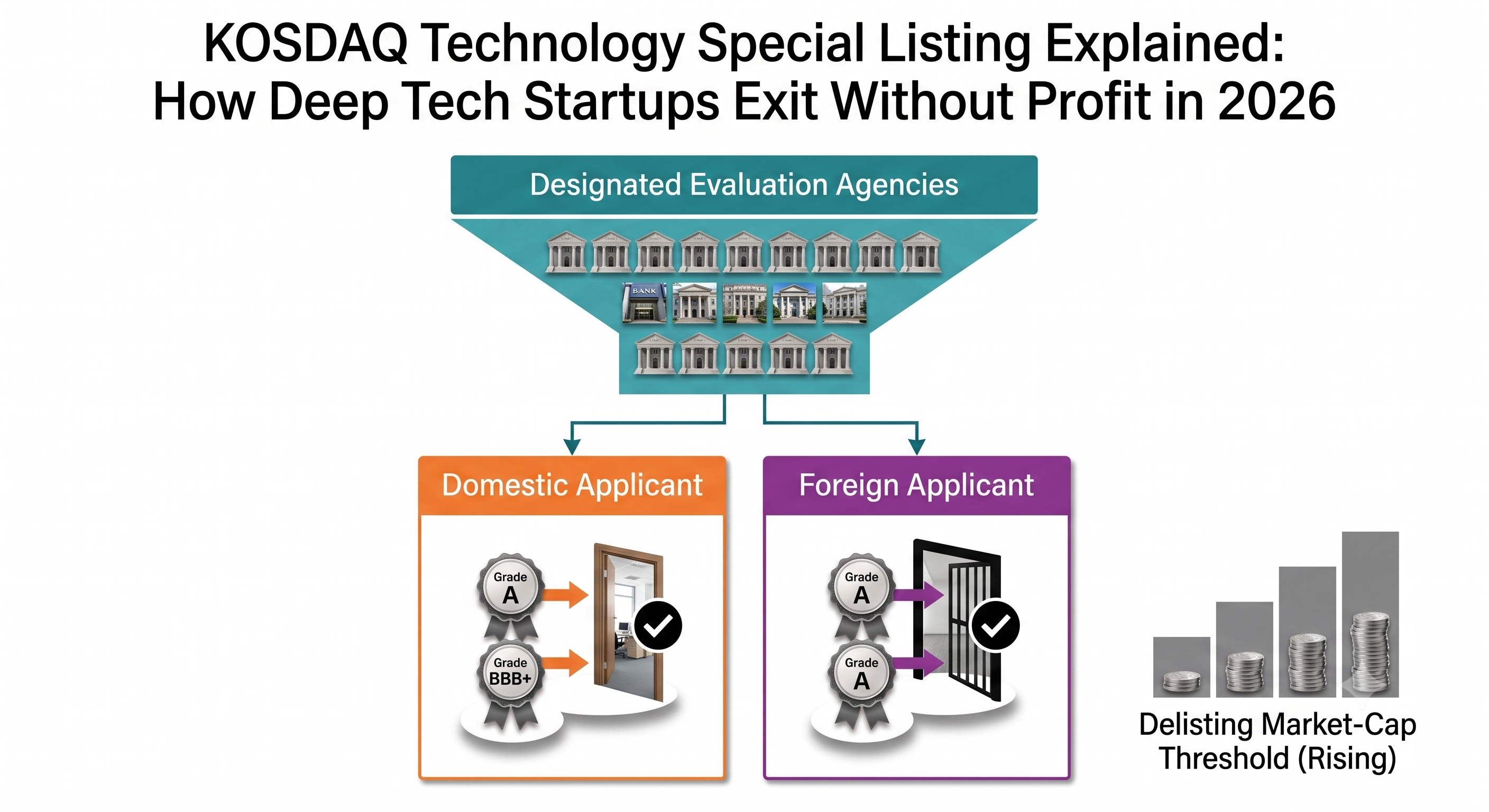
KOSDAQ technology special listing (기술특례상장) is the track that lets a pre-profit Korean deep tech company go public by clearing two independent technology evaluations instead of meeting standard revenue and profitability thresholds. In 2026, Korea Exchange (KRX) tightened this path hard: the pool of designated evaluation agencies was cut from 26 to 16, effective March 3, 2026, investment bankers now estimate the odds of clearing the top evaluation grade have roughly halved, and the market-cap bar a listed company must hold to avoid delisting jumped sharply the same year. If you're a founder plotting an exit or an investor assessing a Korean deep tech portfolio company's IPO timeline, the mechanics below are what actually determines whether — and when — that listing happens.
By The Whitepaper Skeptic — TCB certification and R&D grant preparation for Series A and IPO roadmap work
Quick Facts
| Question | Answer |
|---|---|
| What is it? | A KOSDAQ IPO track letting pre-profit deep tech companies list based on technology evaluation grades instead of standard profitability requirements |
| Domestic grade requirement | One A-grade + one BBB-grade-or-higher, from two designated technology evaluation agencies |
| Foreign-domiciled grade requirement | A-grade from BOTH designated evaluation agencies (per KIBO's official technology special listing evaluation program page) — a higher bar than the domestic standard |
| Designated evaluation agencies (2026) | Pool cut from 26 to 16, effective March 3, 2026 (announced March 9, 2026) |
| Delisting market-cap threshold | Raised from 4B won to 15B won effective January 2026, then accelerated to 20B won (July 2026, already in effect) and 30B won (January 2027) |
What KOSDAQ Technology Special Listing Actually Is
Most IPO tracks require a company to show a multi-year record of revenue and profit before it can list. That requirement effectively locks out deep tech companies — semiconductor, biotech, robotics, energy — whose technology can be worth hundreds of millions of dollars years before it generates meaningful revenue. Korea's answer is the technology special listing track: instead of a profitability test, the company submits to a technology evaluation (기술평가) performed by two KRX-designated evaluation agencies. If both evaluations clear the required grade bar, the company can proceed to list on KOSDAQ without ever having shown a profit.
The evaluation itself looks at the underlying technology's maturity, competitive differentiation, and commercialization potential — not the balance sheet. This is the same basic evaluation infrastructure that underpins Korea's TCB (기술신용평가) certification and government R&D grant system covered in our pillar article on Korea's deep tech funding system — a startup's technology gets formally evaluated early to unlock grants and financing, and years later a similar (though more rigorous) evaluation becomes the gate it has to clear to go public.
How the Grading System Works: A/BBB and the Two-Agency Rule
KRX designates a fixed pool of technology evaluation agencies (기술평가기관) — typically a mix of public institutions like KIBO (기술보증기금) and private technology assessment firms — that are authorized to issue the grades used for listing eligibility. A company applying for tech-special listing must obtain evaluations from two of these designated agencies, and the combination of grades those two agencies return determines whether the company clears the bar.
For a domestically incorporated applicant, the standard is one A-grade plus one grade of BBB or higher from the second agency. That's a meaningfully lower bar than requiring two A-grades — it reflects the reality that technology evaluation grading is inherently somewhat subjective, and requiring unanimous top marks from two separate evaluators would filter out too many otherwise-viable companies.
I used to think a grade like this was essentially a property of the technology. Assembling technology-evaluation dossiers on the TCB side changed my view: a meaningful share of the outcome tracks how legibly the evidence is organized for an evaluator working inside a fixed review window — 30 business days for a domestic applicant here, 40 for a foreign one — and identical technical content lands differently depending on how the commercialization case is laid out around it. With two agencies grading independently and only one of the two grades permitted to sit at BBB, that presentation gap is not a rounding error on the way to an A.
The Foreign-Company Bar Is Higher: Dual A-Grade Requirement
Here's the detail that most English-language coverage of KOSDAQ listing skips entirely: foreign-domiciled applicants face a stricter standard. KIBO's own technology special listing evaluation program page states the requirement directly: domestic applicants need "A-grade & BBB-grade or higher," while foreign companies (외국기업) need results that are "all A-grade or higher" — i.e., an A-grade from both designated evaluation agencies, not the domestic standard of one A plus one BBB-or-higher. Foreign-company applications also carry a higher evaluation fee (30 million won versus 20 million won domestic, plus travel expenses) and a longer review window (40 business days versus 30).
This matters directly for foreign VCs and multinational portfolio companies weighing a Korean listing versus other exit paths: a foreign-domiciled holding structure doesn't just face the same odds as a domestic applicant — it faces a structurally harder evaluation bar on top of an already-tightened evaluator pool.
2026 Tightening: Fewer Evaluators, a Higher Delisting Bar
Two separate 2026 reforms changed the calculus for anyone tracking KOSDAQ tech-special listings, and it's worth keeping them distinct because they hit different points in a company's lifecycle.
Getting in got harder. KRX announced on March 9, 2026 that it was cutting the pool of designated technology evaluation agencies from 26 to 16, terminating 10 agencies' evaluation authority effective March 3, 2026, citing insufficient track record, personnel, and infrastructure at the removed agencies. Fewer authorized evaluators combined with a market that hasn't gotten any less competitive means longer queues and, per investment banker estimates cited by Sedaily, roughly half the odds of clearing the A-grade bar compared to before the reform. Several 2026 applicants illustrate the tightened bar: cardiovascular diagnostic device maker AIMEDIC failed its technology evaluation outright, while brain-disease drug developer Sovargen and autonomous-driving company Autonomous A2Z each received BBB-and-BBB grades (short of the required A-and-BBB-or-higher) from both designated agencies and postponed their listing plans as a result, per Sedaily's April 2026 reporting.
Staying listed got harder too. For companies that already cleared the bar and are trading on KOSDAQ under the tech-special track, KRX raised the market-cap threshold that triggers delisting review — and then accelerated that schedule further:
| Effective Date | Delisting Market-Cap Threshold | Revenue Threshold |
|---|---|---|
| Pre-2026 | 4 billion won | 3 billion won |
| January 2026 | 15 billion won | 3 billion won |
| July 2026 (current) | 20 billion won | 3 billion won |
| January 2027 | 30 billion won | 5 billion won |
| 2028 | 30 billion won | 7.5 billion won |
| 2029 | 30 billion won | 10 billion won |
The market-cap column above reflects an acceleration: KRX's original January 2026 rule change called for the 20-billion-won step in January 2027 and the 30-billion-won step in January 2028, but the FSC/KRX's February 2026 "delisting reform plan" moved those up to July 2026 and January 2027 respectively — meaning the 20-billion-won threshold is already in force as of this writing. The revenue-threshold column has not been reported as accelerated on the same timeline and still follows the original 2027/2028/2029 schedule. (Sourced to Korea's official government policy briefing service (korea.kr) and Korean financial press; figures are denominated in 억원 in the original Korean and converted here at 1억원 = 100 million won.)
KRX also introduced industry-specific screening criteria around the same January 2026 reform window, splitting out separate qualitative evaluation criteria for AI value-chain companies (further segmented into AI semiconductor design/manufacturing, AI model/application, and "physical AI" sub-categories), energy companies (ESS and renewables), and space-sector applicants — with additional customized criteria for advanced robotics, K-content, and cybersecurity sectors reportedly planned as a next step.
The Informal "100 Billion Won Safe Zone" — And Why It Isn't a Rule
One figure circulating among Korean IPO advisors deserves a specific caution: per Sedaily's April 2026 reporting, KRX has conveyed to securities-firm IPO staff that a confirmed offering-price market cap of at least 100 billion won ("1,000억원") should be treated as the informal "safe zone" for pricing a tech-special IPO, comfortably above the 30-billion-won delisting ceiling the schedule above reaches by January 2027. This is reported as guidance conveyed informally to underwriters, not a codified KRX rule, and should not be treated as a formal listing requirement. A founder or advisor hearing "you need 100 billion won" secondhand may not realize that number is market practice responding to the new delisting schedule, not a published listing requirement. The only published, binding thresholds are the technology grade requirements and the delisting market-cap schedule above.
Basic Listing Requirements Once You Clear the Tech Grade
Passing the technology evaluation doesn't complete the listing on its own — it substitutes for the profitability test, but the company still needs to meet baseline listing requirements shared with other KOSDAQ tracks, including minimum shareholders' equity of 1 billion won (자기자본 10억원) or a minimum market capitalization of 9 billion won (시가총액 90억원) at listing — the two are alternative, not cumulative, thresholds. In practice, most tech-special applicants list well above these floors; they exist as a baseline rather than a realistic target.
What This Means for Foreign VCs and Deep Tech Founders
For a foreign investor evaluating a Korean deep tech portfolio company's exit options, technology special listing is worth modeling as one path among several — alongside trade sale and cross-border listing — rather than a default. The 2026 tightening changes the expected timeline and probability of a KOSDAQ exit meaningfully: fewer evaluators mean longer queues, a harder foreign-applicant grade bar narrows the pool of foreign-domiciled structures that clear cleanly, and the steeper post-listing delisting schedule means "getting listed" is no longer the finish line — staying listed now requires sustained scale.
Once a company actually lists and its shares become publicly tradable, Korean retail investors have their own separate optimization question: how to hold the stock tax-efficiently. Domestic growth stocks are commonly held inside an ISA account for the dividend and capital-gains tax exemption, rather than a standard brokerage account.
For founders, the practical takeaway is to treat the technology evaluation not as a one-time hurdle late in the company's life, but as a continuation of the same technology-credibility work that should have started with TCB certification and R&D grant applications years earlier. A company that has already been through rigorous third-party technology evaluation for grant or financing purposes walks into the KOSDAQ evaluation with a real head start — the evaluators, methodology, and underlying question ("is this technology actually differentiated and commercializable?") are more similar than most founders expect.
FAQ
Q: What is KOSDAQ technology special listing (기술특례상장)?
A: It's a KOSDAQ IPO track that lets pre-profit deep tech companies list by passing two technology evaluations from KRX-designated agencies, instead of meeting standard revenue and profitability requirements.
Q: Can a foreign company list on KOSDAQ under the technology special track?
A: Yes, but under a stricter grading bar than domestic applicants — per KIBO's official evaluation program page, foreign-domiciled companies need an A-grade from both designated evaluation agencies, versus the domestic standard of one A-grade plus one BBB-grade-or-higher.
Q: What technology evaluation grade do you need to qualify for KOSDAQ tech-special listing?
A: Domestic companies typically need one A-grade and one BBB-grade-or-higher from two separate designated evaluation agencies. Foreign-domiciled companies face a higher bar of A-grade from both agencies.
Q: How many technology evaluation agencies does Korea Exchange currently designate?
A: The designated pool was cut from 26 to 16 agencies, effective March 3, 2026 (announced March 9, 2026), making the evaluation process more competitive than in prior years.
Q: What happens if a KOSDAQ tech-special company's market cap falls below the delisting threshold?
A: It faces delisting review. KRX raised this threshold from 4 billion won to 15 billion won effective January 2026, then accelerated the schedule to reach 20 billion won in July 2026 (already in effect) and 30 billion won in January 2027 — roughly a year ahead of the original 2027/2028 timeline.
Sources
- Seoul Economic Daily (Signal) — "인색한 A등급 평가…혁신기술 보유해도 특례상장 어려워" (April 21, 2026) — AIMEDIC/Sovargen/Autonomous A2Z evaluation outcomes and the "100 billion won safe zone" guidance
- Hankyung — "거래소, 코스닥 기술특례상장 평가기관 26곳→16곳 축소" (March 9, 2026) — evaluation-agency pool reduction, effective March 3, 2026
- 대한민국 정책브리핑 (korea.kr, Financial Services Commission) — "금융위, 코스닥 부실기업 퇴출 속도…올해 최대 150개사 상폐 대상" — delisting market-cap/revenue threshold schedule, including the February 2026 acceleration
- MakinaRocks — "MakinaRocks Earns 'A, A' Ratings in Technology Evaluation for KOSDAQ Special Listing"
- FSC (Financial Services Commission) — "FSC to Ease Listing Rules for Tech Start-ups & Scale-ups"
- KIBO (기술보증기금) — KOSDAQ Technology Special Listing Evaluation program page (grade requirements: domestic A&BBB, foreign A&A)
- therise.kr — 기술특례상장 가이드라인 column (secondary source, procedure/requirements detail)
Note on figures: two Seoul Economic Daily English-edition articles previously cited here (Jan 2026, Apr 2026) render the delisting market-cap schedule as "40 billion won → 150 billion won → 200 billion won → 300 billion won." Cross-checking against the Korean-language originals (원문 "40억원→150억원→200억원→300억원") and the official government policy briefing above shows the correct conversion is 4/15/20/30 billion won (1억원 = 100 million won) — the English edition appears to have mis-converted 억원 to "billion" 1:1. This article uses the corrected figures; the two Sedaily English links remain useful for the AIMEDIC/Sovargen/Autonomous A2Z narrative, the evaluator-odds estimate, and the industry-specific screening detail, which are unaffected by the unit issue.
Author Bio
The Whitepaper Skeptic has direct experience preparing TCB certification materials and government R&D grant applications as part of Series A investment and IPO roadmap work — including tracing how a startup's early technology-evaluation track record carries forward into the technology evaluations required for a later KOSDAQ technology special listing.
Related Posts
- How South Korea Funds Deep Tech Startups: TCB Certification & Government R&D Grants Explained
- Korea's Deep Tech VC Ecosystem: Who's Funding Semiconductors, Robotics, and Advanced Materials Startups in 2026
- Due Diligence on Korean Deep Tech Startups: 7 Things Foreign Investors Actually Verify in 2026
- Who Owns the IP From a Korean Government R&D Grant? Ownership Rules and the Technology Fee Explained


Comments
Post a Comment