Samsung vs. SK vs. LG Corporate Venture Capital: Which CVC Should Deep Tech Hardware Startups Target in 2026?
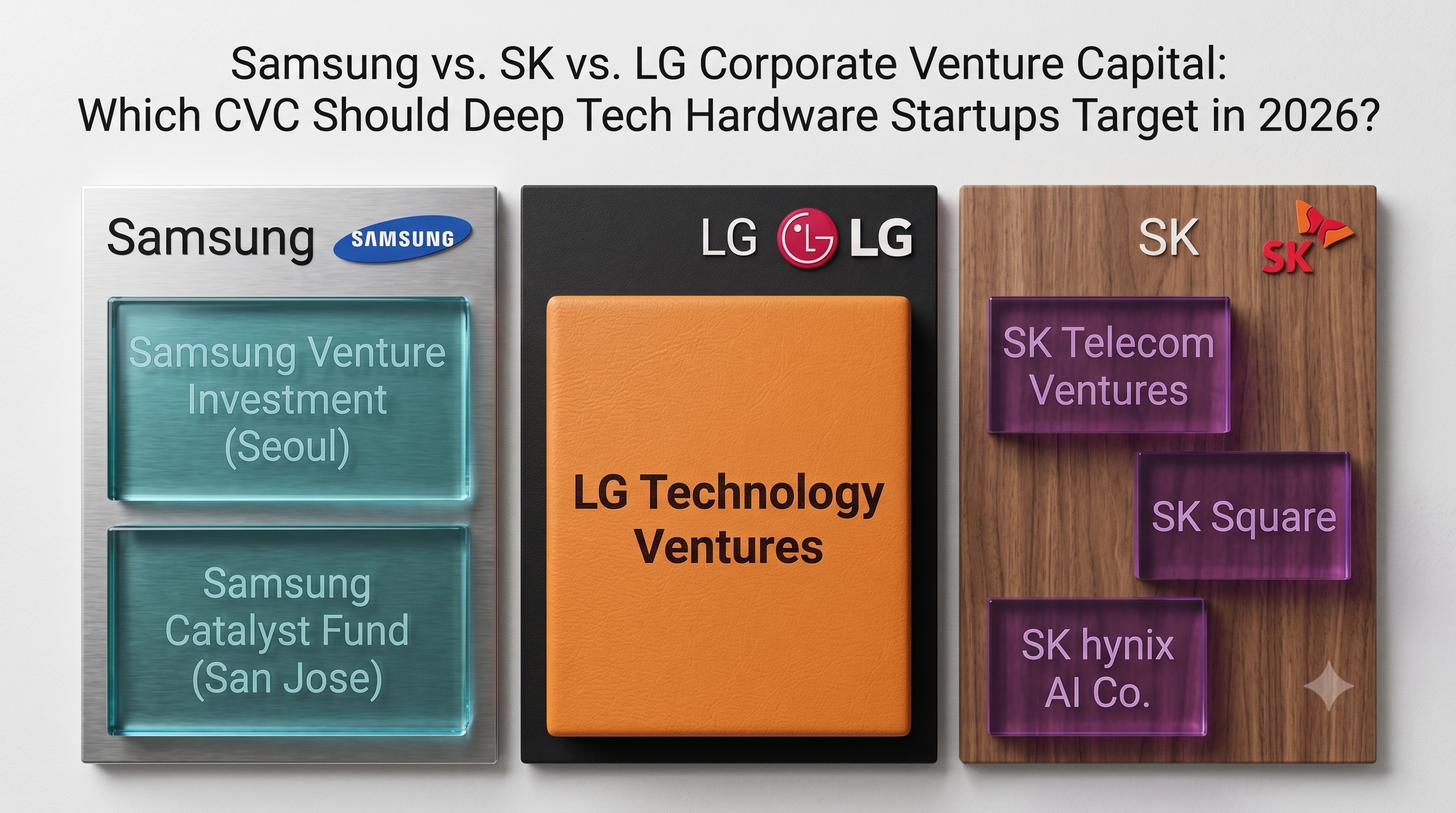
Samsung runs two separate corporate venture arms — Samsung Venture Investment (Seoul, Series A through pre-IPO) and Samsung Catalyst Fund (San Jose, evergreen multi-stage) — while LG concentrates its strategic capital in one vehicle, LG Technology Ventures, focused mainly on Series A/B. SK, by contrast, has no single branded CVC comparable to either: its capital is split across SK Telecom Ventures, SK Square, and a newly announced SK hynix-backed AI investment platform, each with a different mandate. For a deep tech hardware founder deciding where to send a deck, that structural difference matters more than any single fund's check size.
By The Whitepaper Skeptic — prepared Korean government R&D grant and TCB certification applications firsthand
Quick Facts
| Question | Answer |
|---|---|
| How many CVC arms does Samsung run? | Two — Samsung Venture Investment (Seoul, founded 1999, ~1,188 companies invested cumulatively per the fund's own "At a Glance" site stats, Series A–pre-IPO) and Samsung Catalyst Fund (San Jose, evergreen/multi-stage, 40+ active portfolio companies per the fund's own site, deep-tech/AI/robotics/quantum focus) |
| What stage does LG Technology Ventures invest at? | Mainly Series A and B, through a single ~$780M Silicon Valley-based fund covering AI, mobility, advanced materials, next-gen display, and semiconductor infrastructure |
| Does SK have one unified CVC like Samsung or LG? | No — SK's capital is fragmented across SK Telecom Ventures (SKTVC, now operating under the SK Telecom Americas/SKTA brand), SK Square (portfolio holding company, not deal-by-deal CVC), and SK hynix's 2026 "AI Co." platform |
| What is Samsung committing to CVC funding in 2026? | A fresh ₩800 billion across two new Samsung Venture Investment funds — ₩500B for semiconductor startups, ₩300B for DX startups. Samsung's explicit robotics/medtech M&A language comes from a separate, much larger ₩110 trillion (~$76B) 2026 capex plan announced earlier the same year, not from this CVC allocation |
| Which conglomerate's CVC actively connects portfolio companies to internal business units? | LG Technology Ventures runs an in-house business-development team specifically for this purpose |
Samsung's Two CVC Arms: Samsung Venture Investment vs. Samsung Catalyst Fund
Founders researching Samsung's venture arm often assume there's one fund to pitch. There are two, and confusing them wastes a cycle.
Samsung Venture Investment is the Seoul-based arm, founded in 1999, with roughly 1,188 companies invested cumulatively to date according to the fund's own official site. It writes checks from Series A through pre-IPO and, in 2026, is deploying a fresh ₩800 billion across two new funds: ₩500 billion (SVIC No. 82) for semiconductor startups and ₩300 billion (SVIC No. 83) for DX (digital-transformation) technologies. Worth separating out clearly: that CVC commitment is distinct from Samsung Electronics' much larger ₩110 trillion (~$76B) 2026 capital investment plan, announced earlier the same year, which is where the company explicitly said it would "pursue meaningful M&A in future growth areas including advanced robotics, medtech, automotive electronics, and HVAC." That robotics M&A language is a capex-level strategic priority for Samsung Electronics as a whole — not a stated mandate of the ₩800B Venture Investment funds themselves. If your startup is later-stage, Korea-adjacent, or squarely in semiconductor/DX territory, Samsung Venture Investment is the entity to approach; just don't assume the CVC funds are earmarked for robotics M&A specifically.
Samsung Catalyst Fund is the San Jose-based arm — evergreen, multi-stage (it doesn't run on a fixed fund-life clock the way most VC funds do), with 40+ active portfolio companies according to the fund's own site (plus 40+ additional exits/acquisitions over its history since 2013). Its stated focus areas are AI, autonomous systems/robotics, quantum computing, and cloud/data infrastructure — deep-tech infrastructure plays more than consumer-facing products. This is the entry point for a Silicon Valley-based or globally distributed deep-tech hardware startup that wants Samsung's strategic backing without necessarily having a Korea nexus.
The practical takeaway: geography is a reasonable first filter. A Seoul-based or Korea-incorporated Series B robotics company should default to Samsung Venture Investment; a Bay Area deep-tech infrastructure startup with no Korea presence should default to Samsung Catalyst Fund. Sector and stage overlap enough between the two that founders sometimes qualify for both — worth checking rather than assuming either fund is the only door.
LG Technology Ventures: One Fund, More Concentrated
LG doesn't split its venture capital the way Samsung does. LG Technology Ventures is a single, Silicon Valley-run fund — roughly $780 million in size, led by CEO Dong-Su Kim — investing mainly at Series A and B into AI, mobility, advanced materials, next-generation display, and semiconductor infrastructure. Life sciences shows up in its sector list as well, which is broader than either Samsung arm's stated focus.
What distinguishes LG Technology Ventures operationally is its in-house business-development team, which actively works to connect portfolio companies to relevant LG business units — display, battery, mobility, and materials divisions among them. For a hardware startup, that's a meaningfully different value proposition than a purely financial check: the fund is explicitly designed to open a path to a strategic commercial relationship with an LG operating company, not just capital.
The narrower stage focus (Series A/B, versus Samsung Venture Investment's Series A through pre-IPO range) means LG Technology Ventures is a poor fit for a company past Series C looking for a strategic check, but a strong candidate for an earlier-stage materials, display, or mobility startup that wants both capital and a credible path into LG's supply chain or product roadmap.
Why SK Doesn't Have One CVC to Pitch
This is the least obvious — and most useful — finding for a founder trying to figure out "who do I even send a deck to" at SK. Unlike Samsung and LG, SK has no single branded, deal-by-deal corporate venture fund with a clear hardware-startup mandate. Its capital is split across at least three distinct entities, each with a different function:
- SK Telecom Ventures (SKTVC) — North America-focused, and historically structured as two separate funds: SKIF for seed/early-stage deals and SKAF for growth-stage deals, with a sector focus on semiconductors, mobile, and enterprise infrastructure. Note for founders: the entity now operates under the SK Telecom Americas (SKTA) brand at skta.com; the SKIF/SKAF fund names still surface on third-party trackers (Crunchbase, PitchBook) but are not itemized separately on the current official site, so confirm current fund structure directly before assuming SKIF/SKAF still apply as named.
- SK Square — functions more as a strategic portfolio holding company than a deal-by-deal CVC, managing an ICT/semiconductor/blockchain portfolio rather than actively sourcing and writing new startup checks the way Samsung Venture Investment or LG Technology Ventures do.
- SK hynix's "AI Co." — a newly announced (2026) $10 billion Silicon Valley investment platform focused on AI memory infrastructure. This behaves more like a late-stage strategic and M&A vehicle than an early-stage startup CVC — it's built to secure AI memory supply-chain positioning, not to fund a Series A hardware startup.
I built investor target lists next to TCB and grant paperwork for long enough to have made this exact mistake on a spreadsheet: "SK" sat in one row beside Samsung and LG, and nobody caught it until someone asked which entity the deck was actually addressed to. Three rows would have been the honest version, because a seed/early North America fund, a portfolio holding company, and a late-stage AI memory vehicle are not one reader. Getting that wrong doesn't just waste a meeting — it costs a cycle, since the deck that works for an early-stage semiconductor pitch is not the one that survives a strategic supply-chain conversation.
For a founder, the practical consequence is that "SK" isn't a single address the way "Samsung Catalyst Fund" or "LG Technology Ventures" is. Which SK entity (if any) makes sense depends heavily on your stage and sector: SKIF/SKAF for an early- or growth-stage North America-facing semiconductor or infrastructure startup, SK Square only if you already have a strategic ICT/semiconductor/blockchain relationship worth managing rather than a fresh pitch, and SK hynix's AI Co. essentially not at all unless you're a late-stage AI memory infrastructure play SK hynix would consider acquiring or strategically anchoring.
Samsung vs. SK vs. LG Corporate Venture Capital at a Glance
| Aspect | Samsung Venture Investment | Samsung Catalyst Fund | LG Technology Ventures | SK (fragmented) |
|---|---|---|---|---|
| Structure | Single branded fund | Single branded fund | Single branded fund | Split across 3+ entities |
| HQ | Seoul | San Jose | Silicon Valley | Seoul (SK Square) / North America (SKTVC/SKTA, AI Co.) |
| Founded | 1999 | 2013, evergreen (no fixed fund vintage) | — | SKTVC/SKTA: North America-focused, ongoing; AI Co. announced Jan. 2026 |
| Investment stage | Series A – pre-IPO | Evergreen, multi-stage (seed through growth) | Mainly Series A/B | SKIF: seed/early; SKAF: growth (per third-party trackers); AI Co.: late-stage/strategic |
| Sector focus | Chip/DX equity investments | AI, autonomous systems/robotics, quantum, cloud/data infra | AI, mobility, advanced materials, next-gen display, semiconductor infra, life sciences | Semiconductors, mobile, enterprise infra (SKTVC/SKTA); ICT/semiconductor/blockchain (SK Square); AI memory infra (AI Co.) |
| Portfolio size (disclosed) | ~1,188 companies invested cumulatively (per fund's own official site "At a Glance" stats) | 40+ active (per fund's own site; plus 40+ historical exits) | ~78 companies / 10 unicorns (per Tracxn's investor database, third-party aggregator — not itemized on LG's own site) | No single unified portfolio count |
| 2026 signal | ₩800B across two new funds (₩500B semiconductor + ₩300B DX); separately, Samsung Electronics' broader ₩110T (~$76B) 2026 capex plan is where explicit robotics/medtech M&A language appears | Ongoing evergreen deployment | Active in-house BD team linking portfolio to LG business units | SK hynix "AI Co." — $10B Silicon Valley AI investment platform |
Which Conglomerate CVC Should You Actually Target?
Match your stage and sector to the fund's actual mandate before you pitch, rather than treating "Samsung," "SK," and "LG" as interchangeable strategic-money options:
- Seoul-based or Korea-incorporated, Series B+, semiconductor/DX/robotics → Samsung Venture Investment. The 2026 ₩800B chip/DX commitment — plus Samsung Electronics' separate, much larger capex-level robotics/medtech M&A ambitions — make this the most active-looking door of the five right now.
- Silicon Valley or globally distributed, deep-tech infrastructure (AI, robotics, quantum, automotive, cloud) → Samsung Catalyst Fund. Its evergreen structure means there's no fund-vintage clock forcing an artificial deployment deadline the way a traditional 10-year VC fund might.
- Series A/B, materials, display, mobility, or semiconductor infrastructure, want a path into LG's supply chain → LG Technology Ventures. The in-house BD team is the differentiator here — take the meeting expecting a conversation about commercial fit with an LG business unit, not just a check.
- North America-facing, semiconductor/mobile/enterprise infra, seed through growth stage → SK Telecom Ventures (SKIF for seed/early, SKAF for growth) — but confirm this is genuinely the right SK entity before assuming "SK" has one address, since SK Square and SK hynix's AI Co. serve entirely different mandates.
- Late-stage AI memory infrastructure with a strategic supply-chain fit for SK hynix specifically → SK hynix's AI Co. is realistically the only SK entity worth approaching, and even then it behaves more like an M&A conversation than a venture check.
How Corporate Money Differs From Independent VC Money
Every fund above is strategic capital — money that comes with an implicit or explicit expectation of commercial alignment with the parent conglomerate, not just a financial return. That's a different calculus than approaching Korea's independent VC ecosystem (Korea Investment Partners, Hashed, Kakao Ventures, Company K Partners, and others), which this blog covers separately in our guide to Korea's deep tech VC ecosystem. A strategic CVC check can open doors a financial VC can't — supplier relationships, pilot customers, even eventual M&A interest — but it can also come with information-sharing expectations or a soft preference for exclusivity with the parent's business units that a purely financial investor wouldn't ask for. Founders deciding between grant funding, financial VC, and strategic CVC as a sequencing question should also see our funding sequence framework for deep tech hardware startups, which covers when to bring in each type of capital.
Strategic and financial capital aren't mutually exclusive, either — most Series B+ deep tech rounds in Korea blend both, with a CVC check anchoring the strategic side of the cap table alongside independent VC leading the round. Where the CVC money comes from within that Series B is exactly what the comparison above is meant to clarify.
FAQ
Q: What's the difference between Samsung Catalyst Fund and Samsung Ventures?
A: Samsung Venture Investment is the Seoul-based arm (founded 1999, ~1,188 companies invested cumulatively per the fund's own site, Series A through pre-IPO). Samsung Catalyst Fund is the separate San Jose-based arm (evergreen, multi-stage, 40+ active portfolio companies per the fund's own site, deep-tech/AI/robotics/quantum focus). They're run independently and target different founder profiles — Samsung Venture Investment skews toward Korea-nexus, later-stage deals; Samsung Catalyst Fund toward globally distributed deep-tech infrastructure plays.
Q: What stage and sectors does LG Technology Ventures invest in?
A: Mainly Series A and B, through a single ~$780 million Silicon Valley-based fund. Sector focus spans AI, mobility, advanced materials, next-generation display, semiconductor infrastructure, and life sciences, with an in-house business-development team that connects portfolio companies to relevant LG business units.
Q: Does SK have a corporate venture capital fund like Samsung or LG?
A: Not a single unified one. SK's capital is split across SK Telecom Ventures (SKTVC, now branded SK Telecom Americas/SKTA, with separate SKIF seed/early and SKAF growth-stage funds per third-party trackers), SK Square (a strategic ICT/semiconductor/blockchain portfolio holding company rather than a deal-by-deal CVC), and SK hynix's January 2026-announced "AI Co." — a $10 billion Silicon Valley platform that functions more like a late-stage strategic/M&A vehicle than an early-stage startup fund.
Q: Which Korean conglomerate CVC should a deep tech hardware startup target?
A: It depends on stage, sector, and geography — there's no single right answer. Seoul-based Series B+ semiconductor or robotics companies fit Samsung Venture Investment; Silicon Valley-based deep-tech infrastructure startups fit Samsung Catalyst Fund; Series A/B materials or display companies wanting a path into LG's supply chain fit LG Technology Ventures; and North America-facing semiconductor or infrastructure startups at seed through growth stage fit SK Telecom Ventures — with SK Square and SK hynix's AI Co. realistically only relevant for very specific strategic or late-stage cases.
Q: How is Korean corporate venture capital different from independent VC money?
A: Corporate venture capital comes from a conglomerate's own balance sheet and typically carries an implicit expectation of strategic or commercial alignment — supplier relationships, pilot programs, or eventual M&A interest — alongside the financial return that independent VCs like Korea Investment Partners or Hashed are solely optimizing for. Most later-stage Korean deep tech rounds blend both types of capital rather than choosing one exclusively.
Sources
- Samsung Catalyst Fund — official portfolio and focus-area disclosures: Samsung Catalyst Fund — Portfolio (samsungcatalyst.com; live-verified, shows 40+ active portfolio companies and current sector focus).
- Samsung Venture Investment — official site "At a Glance" stats confirming 1999 founding date and cumulative portfolio count: Samsung Ventures — official site (samsungventure.co.kr; live-verified Aug 2026, states "founded in 1999" and lists 1,188 companies invested, $2.8B AUM, 75 total funds/44 active funds).
- Samsung Venture Investment — 2026 ₩800B chip/DX fund commitment (₩500B semiconductor + ₩300B DX): Samsung to Invest 800 Billion Won in Chip, DX Startups — Seoul Economic Daily, July 30, 2026. Note: the explicit robotics/medtech/automotive M&A language cited elsewhere in this article comes from a separate, much larger capex announcement, not this CVC fund: Samsung Electronics Plans Record $75B Investment, Eyes Robotics M&A — Seoul Economic Daily, March 19, 2026.
- LG Technology Ventures — official site and original fund-size announcement. Note: the correct domain is lgtechventures.com, not lgtechnologyventures.com (which does not resolve — the article-writer's cited domain was incorrect and has been fixed here): LG Technology Ventures — official site and LG Technology Ventures Raises $780 Million Fund — LG Corp press release, Nov. 20, 2023. The $780M figure traces to this 2023 announcement (KRW 600B initial + KRW 400B follow-on ≈ KRW 1T ≈ $780M); the fund's current site cites AUM approaching $1B, reflecting growth/additional deployments since 2023 — treat $780M as the sourced founding-fund figure rather than a real-time AUM number. Portfolio count (78 companies, 10 unicorns) is not itemized on LG's own site; it is corroborated only by LG Technology Ventures — Investor Profile, Tracxn (live-verified Aug 2026, states "As of Aug 2026, LG Technology Ventures... having invested in 78 companies... 10 unicorns, 4 IPOs and 7 acquisitions") — treat as a third-party aggregator figure, not an LG-disclosed number, consistent with how this article treats SKIF/SKAF sourcing below.
- KED Global — coverage of SK Square's investment-arm reorganization and SK hynix's "AI Co." announcement: SK Square Set to Turn SK Hynix Windfall Into Firepower for AI, Chip Deals — KED Global, Aug. 16, 2026 and SK Hynix Plans $10 Billion AI Investment Arm in US — KED Global, Jan. 29, 2026.
- SK Telecom Ventures — SKIF/SKAF fund structure. Note: sktelecomventures.com does not resolve (confirmed dead/nonexistent domain — the article-writer's cited domain was incorrect and has been fixed here). The entity's real domain, sktvc.com, now 301-redirects to skta.com, reflecting a rebrand to "SK Telecom Americas (SKTA)": SK Telecom Americas — official site. The current official site does not itemize SKIF/SKAF by name (it shows an unsegmented portfolio list); those fund names are corroborated only by third-party aggregators (PitchBook, Crunchbase, VentureRadar), so treat SKIF/SKAF as historically accurate but not independently confirmed as still-active fund names in 2026.
Author Bio
The Whitepaper Skeptic has direct experience preparing TCB certification materials and government R&D grant applications as part of Series A investment and IPO roadmap work — including advising on which category of investor, strategic CVC arms among them, actually fits a startup's stage and sector before a deck goes out.
Related Posts
- How South Korea Funds Deep Tech Startups: TCB Certification & Government R&D Grants Explained
- Korea's Deep Tech VC Ecosystem: Who's Funding Semiconductors, Robotics, and Advanced Materials Startups in 2026
- How to Structure a Series A Pitch Deck for Deep Tech Hardware Startups
- Due Diligence on Korean Deep Tech Startups: 7 Things Foreign Investors Actually Verify in 2026
- Korea's R&D Tax Credit for Startups Explained: Rates, Eligibility, and the 2026 Changes
- Government Grant or Venture Capital First? A Funding Sequence Framework for Deep Tech Hardware Startups
Tags
Samsung Ventures, LG Technology Ventures, SK corporate venture capital, Korea CVC, deep tech hardware fundraising


Comments
Post a Comment