Korea's D-8-4 Tech Startup Visa Explained: How the OASIS Points System Replaces the ₩100M Capital Requirement in 2026
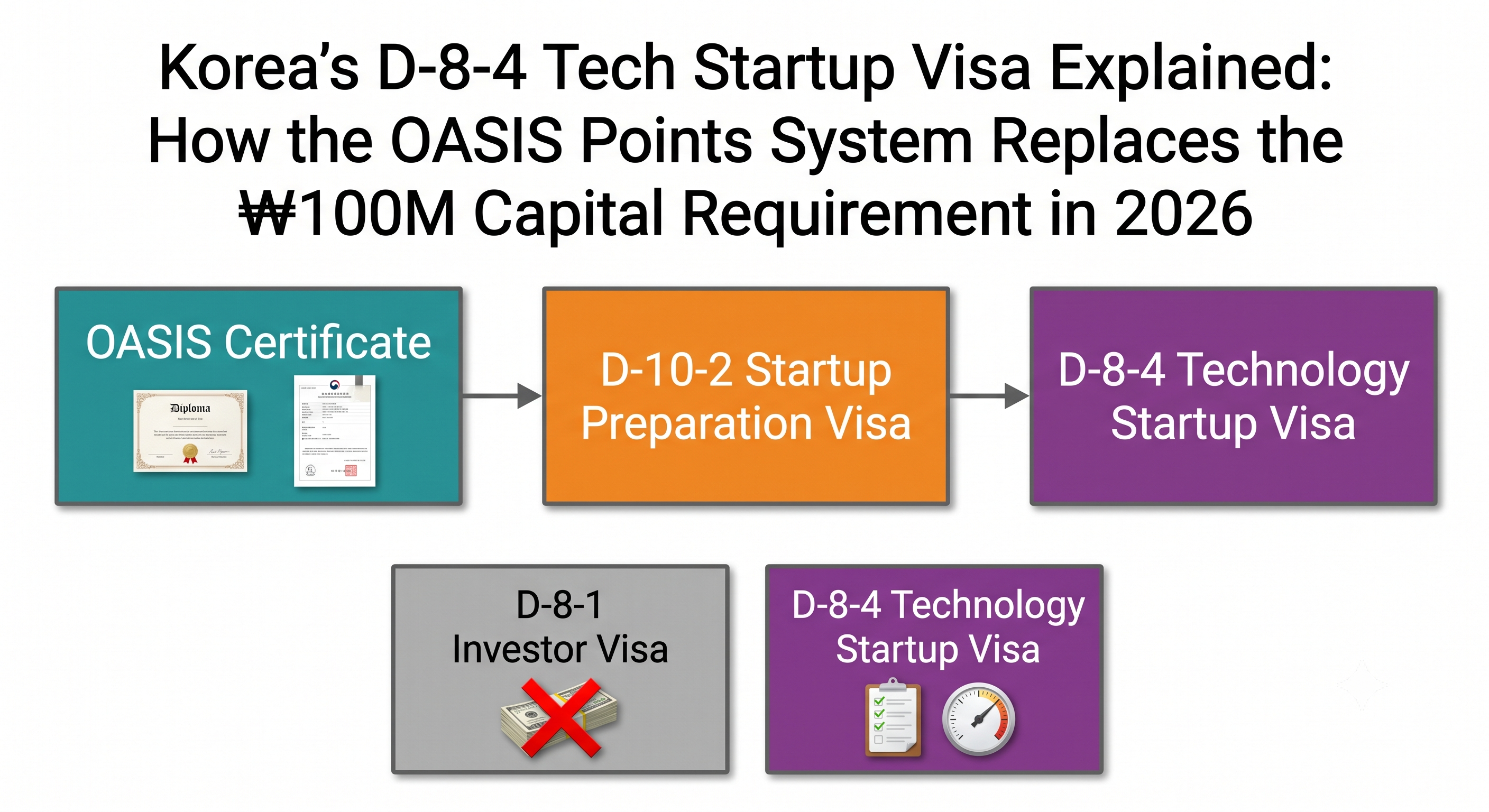
Korea's D-8-4 Technology Startup Visa lets a foreign founder legally run a Korean startup without meeting the older D-8-1 investor visa's roughly ₩100M (~US$75K) minimum capital requirement. Instead, D-8-4 uses a merit-based points system — administered through the OASIS program — that scores applicants on education background, IP holdings, Korean-language proficiency, and completion of government-designated startup education. The pathway runs OASIS Certificate → D-10-2 Startup Preparation Visa → D-8-4, and it's the general-purpose route for any non-Korean founder, not tied to a single accelerator cohort.
By The Whitepaper Skeptic — prepared Korean government R&D grant and TCB certification applications firsthand
Quick Facts
| Question | Answer |
|---|---|
| What replaces the capital requirement? | A points system (OASIS) scoring education, IP, Korean proficiency, and startup education — not a fixed cash deposit |
| How do you earn points? | Complete OASIS courses — OASIS-4 (Entrepreneurship Education, 10 points) and OASIS-5 (Startup Mentoring, 15 points) — among other scored categories |
| What's the pathway sequence? | OASIS Certificate → D-10-2 (Startup Preparation Visa) → D-8-4 (Technology Startup Visa) |
| How does D-8-4 compare to D-8-1? | D-8-1 requires ~₩100M (~US$75K) minimum investment capital; D-8-4 does not have that fixed capital floor |
| Is D-8-4 the same as the K-Startup Grand Challenge visa? | No — KSGC bundles D-8-4 as one benefit of a specific accelerator cohort; D-8-4 via OASIS is a standalone route open to any qualifying founder |
What the D-8-4 Visa Actually Is
The D-8-4 Technology Startup Visa is Korea's residency track for foreign founders of Korea-incorporated tech startups. It sits alongside the older D-8-1 corporate investor visa as one of the two main ways a non-Korean can hold founder-level residency status while running a company in Korea — but the two visas qualify applicants on completely different bases.
D-8-1 is a capital-based track: it requires the founder to bring in a minimum investment, commonly cited at roughly ₩100M (~US$75K), into the Korean entity. D-8-4 replaces that capital floor with a points-based evaluation. Applicants accumulate points across several categories — educational background, intellectual property holdings (patents, utility models, design rights), Korean language proficiency (TOPIK), and completion of government-designated startup education — and qualify once they clear a threshold score. Korean immigration-law-firm sources commonly cite a threshold of 80 points out of 368 total possible points, with at least one "mandatory item" (such as IP holdings, government startup support, or a qualifying investment) also required — this figure is not independently confirmed against a primary Ministry of Justice or Hi Korea (hikorea.go.kr) publication, and score cutoffs are reported to be adjusted annually, so applicants should reconfirm the current-cycle threshold directly with Hi Korea before applying.
It's also worth being precise about what "no capital requirement" actually means here: D-8-4 removing the fixed capital floor is not the same as requiring zero money. The points system replaces the minimum investment threshold, not the practical need for startup capital — immigration-consultancy guidance indicates applicants may still be asked to separately demonstrate proof of operating funds sufficient to run the business, though the exact documentation standard has not been confirmed against a primary Ministry of Justice source.
The OASIS Pathway: How Points Actually Get Earned
OASIS (the government program that administers this points system) runs structured courses that function as the on-ramp to D-8-4 eligibility. As of the 2026 cycle, two of the scored components are:
- OASIS-4 (Entrepreneurship Education) — worth 10 points
- OASIS-5 (Startup Mentoring) — worth 15 points
The 2026 application window for these courses ran April 14 – May 18, 2026, across three staggered rounds. OASIS-4 and OASIS-5 are two entries within a broader numbered OASIS program series (OASIS-1 through roughly OASIS-9), where each number designates a distinct program type rather than a sequential cohort — OASIS-1 through 3 cover IP education, OASIS-4 is basic entrepreneurship education, OASIS-5 is coaching/mentoring, and later numbers (through OASIS-9, a commercialization-support grant) cover exhibitions, incubation, and corporate establishment support. An "OASIS-9" reference is therefore a different, later-stage program in the same series, not a contradiction of the OASIS-4/OASIS-5 point values above.
Completing OASIS coursework earns an OASIS Certificate, but the certificate alone does not grant visa status. The actual sequence a founder follows is:
- OASIS Certificate — earned by accumulating enough points through OASIS courses and other scored categories
- D-10-2 (Startup Preparation Visa) — lets the certificate holder legally stay in Korea while incorporating and preparing the business
- D-8-4 (Technology Startup Visa) — the actual founder visa, granted once the company is incorporated and the founder's OASIS-based qualification is confirmed
This is the step that generalist visa-guide content usually skips: the OASIS Certificate is a scoring credential, not a visa in itself. A founder who stops at "I got the OASIS Certificate" hasn't actually secured the right to stay and build in Korea yet — D-10-2 is what legally bridges that gap.
D-8-4 vs. D-8-1: Which Track Fits Your Situation
| Aspect | D-8-1 (Corporate Investor Visa) | D-8-4 (Technology Startup Visa) |
|---|---|---|
| Qualification basis | Minimum capital investment (~₩100M / ~US$75K) | Points system: education, IP, Korean proficiency, startup education |
| Fixed cash minimum | Yes | No fixed floor, though operating funds may still be required |
| Best fit for | Founders with capital ready to deploy immediately | Founders with strong technical/IP/education credentials but limited upfront capital |
| Path to get there | Direct application with proof of investment | OASIS Certificate → D-10-2 → D-8-4 |
| Renewal/duration | Initial stay commonly reported at 1–5 years depending on investment size (often 1 year for smaller investments), renewable in increments up to roughly 3 additional years based on business performance | Initial stay commonly reported at up to 1 year, renewable while the business remains active and conditions are met, with cumulative stay reported around 5 years |
The practical takeaway: D-8-4 exists because Korea recognized that "founder with a good idea and strong technical background" and "founder with ₩100M in liquid capital" are not the same population, and the older D-8-1 track only served the second group.
Why Visa Status Isn't Just an HR Footnote for Grant-Seeking Founders
Here's the connection generalist immigration blogs and expat lifestyle sites consistently miss: visa status in Korea isn't a side logistics issue you handle after securing funding — for several Korean government R&D grants and TCB certification tracks, it's a gating condition for eligibility in the first place. Many programs assume a Korean-registered entity with a resident representative, which means the founder's legal right to be in Korea can determine whether a company even qualifies to apply for grant money it might otherwise be a strong technical fit for.
I learned that in the wrong order. Working through grant and TCB application packets, I treated the representative's residency line as an HR detail to fill in near the end, and the residency question kept surfacing before anyone had read the technical section — it sits in the applicant-qualification part of the form, not the appendix. If a founder is still sitting at the D-10-2 preparation step of the pathway above, the company's grant calendar has to be drawn around the D-8-4 conversion date, not the other way around.
If you're mapping out how Korean government R&D grants and TCB certification actually work, or trying to understand who owns the IP once you take grant money, the visa question in this article is the mechanism that determines whether you're even eligible to reach that stage.
D-8-4 vs. the K-Startup Grand Challenge Visa Bundle
It's easy to conflate this standalone OASIS → D-10-2 → D-8-4 pathway with the visa support bundled into the K-Startup Grand Challenge (KSGC) — they're related but not the same thing. KSGC is a specific accelerator cohort that bundles funding with visa sponsorship (C-3, D-10-2, and D-8-4, available to up to 3 founders per company) as one benefit of being selected into that program. The pathway described in this article is the general-purpose route: it's open to any founder who qualifies on OASIS points, independent of whether they're admitted to KSGC or any other accelerator. If you don't make it into a KSGC cohort — or you're not applying to one at all — the OASIS-based D-8-4 track is still available to you on its own.
FAQ
Q: How is the Korea D-8-4 visa different from the D-8-1 investor visa?
A: D-8-1 requires a minimum capital investment, commonly cited at roughly ₩100M (~US$75K). D-8-4 replaces that fixed capital floor with a points-based system scoring education, IP holdings, Korean language proficiency, and completion of government-designated startup education.
Q: What is the OASIS points system for the Korea startup visa?
A: OASIS is the government program that administers point-earning courses and criteria toward D-8-4 eligibility. For the 2026 cycle, this includes OASIS-4 (Entrepreneurship Education, 10 points) and OASIS-5 (Startup Mentoring, 15 points), alongside points from education background, IP holdings, and Korean proficiency.
Q: Do I need to go through D-10-2 before I can get a D-8-4 visa?
A: Yes, in the standard pathway. The sequence is OASIS Certificate (earned through points) → D-10-2 Startup Preparation Visa (lets you legally stay in Korea while incorporating) → D-8-4 Technology Startup Visa (the actual founder visa). The OASIS Certificate alone doesn't grant residency status.
Q: Is the D-8-4 visa the same as the K-Startup Grand Challenge visa track?
A: No. KSGC bundles D-8-4 (along with C-3 and D-10-2) as a benefit for founders selected into that specific accelerator cohort. The OASIS-based D-8-4 pathway described here is a standalone route available to any qualifying founder, whether or not they're part of KSGC.
Q: Does D-8-4 really require zero startup capital?
A: Not exactly. D-8-4 removes the fixed minimum-investment threshold that D-8-1 requires, but applicants may still need to show sufficient funds to actually operate the business — immigration-consultancy sources report this proof-of-operating-funds requirement, though the precise documentation standard is not confirmed against current Ministry of Justice guidance.
Sources
- OASIS Programs — Startup Korea (official)
- D-8-4 Technology Startup Visa Requirements for Foreigners in Korea — A-One / InvestKorea blog
- Korea Startup Visa Pathway 2026: OASIS Certificate → D-10-2 → D-8-4 Explained — Start Company Korea
- K-Startup Grand Challenge 2026: Korea's Full Cycle Launchpad for Global Startups — BusinessWire
Author Bio
The Whitepaper Skeptic has direct experience preparing TCB certification materials and government R&D grant applications as part of Series A investment and IPO roadmap work — work that repeatedly surfaced how a founder's Korean visa/residency status gates eligibility for the funding programs this blog covers.
Related Posts
- How South Korea Funds Deep Tech Startups: TCB Certification & Government R&D Grants Explained
- Who Owns the IP From a Korean Government R&D Grant? Ownership Rules and the Technology Fee Explained
- K-Startup Grand Challenge 2026: How Foreign Founders Get Up to ₩950M to Launch in Korea
Tags
D-8-4 visa Korea, OASIS points system, Korea startup visa, Korea tech startup founder


Comments
Post a Comment