Autonomous Forklifts Explained: How They Differ From AGVs and AMRs in 2026
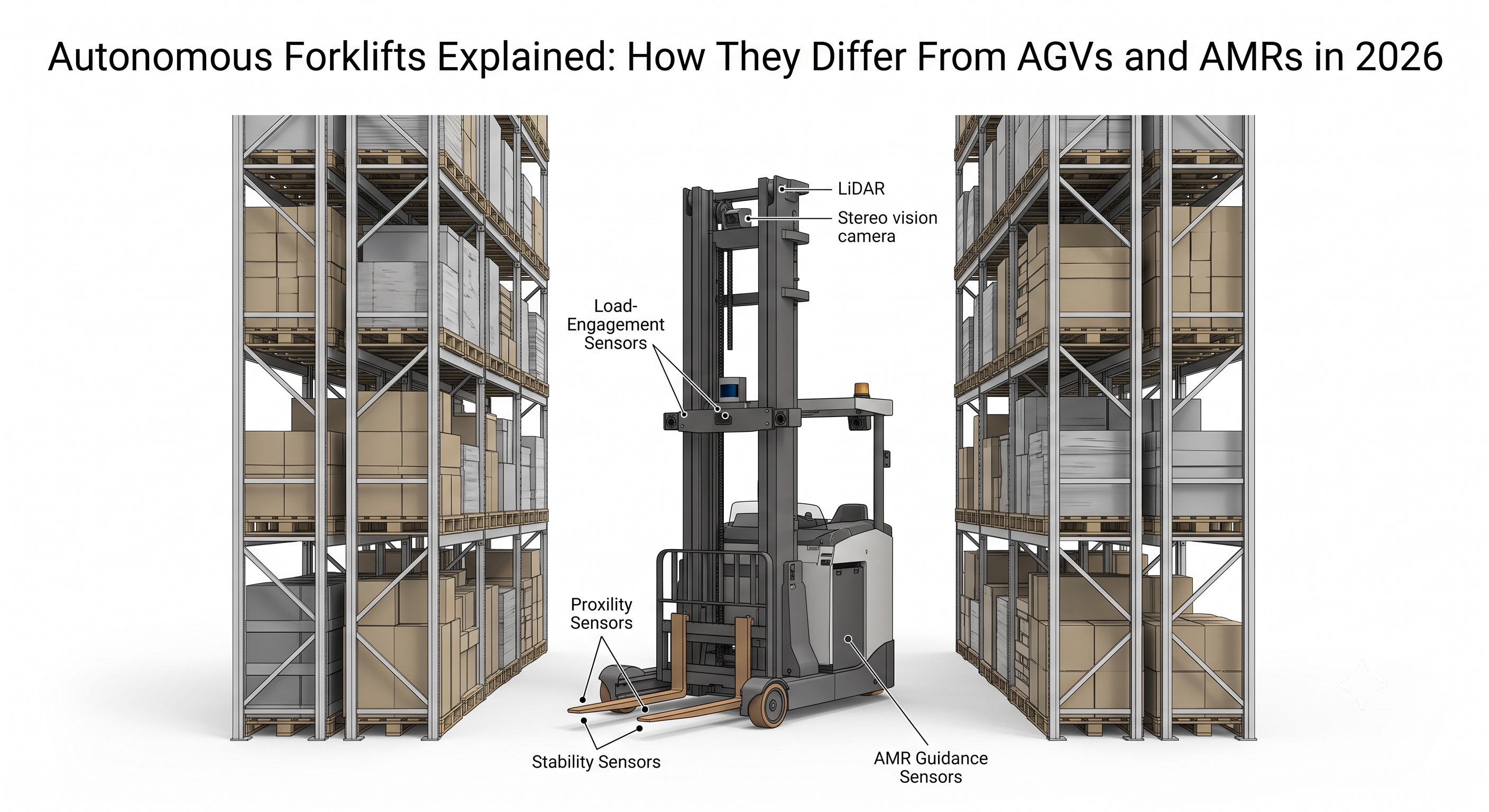
An autonomous forklift is neither a classic AGV nor a typical flat-floor AMR — it's a lift-capable vehicle that inherits AGV-era safety certification requirements (because a dropped or unstable elevated load can crush or drop onto someone) while increasingly running AMR-era natural-feature navigation instead of wire or tape guidance. The dividing line isn't a clean "AGV or AMR" binary; it's whether the vehicle can safely sense, control, and stabilize a load in the air, which is a mechanical and safety problem our AMR vs AGV pillar and our other AMR spokes never had to address, since none of them involve lifting anything. That's what this article actually covers: mast and lift dynamics, lift-specific safety zones that a ground-plane AMR doesn't need to model, and the very-narrow-aisle (VNA) warehouse use case where autonomous forklifts diverge most clearly from both classic AGVs and open-floor AMRs.
Quick Facts
| Question | Answer |
|---|---|
| Is an autonomous forklift an AGV or an AMR? | Neither cleanly — most modern autonomous forklifts use AMR-style natural-feature navigation but must meet AGV-era lift/load safety certification (ANSI/ITSDF B56.5, ISO 3691-4) |
| What makes it different from a tote-carrying AMR? | Load-moment control while lifting/tilting, lift-specific exclusion zones for elevated and overhead hazards, and tip-over risk during cornering with an off-center load — none of which a flat-floor AMR needs to solve |
| Where do autonomous forklifts fit best? | Very narrow aisle (VNA) racked warehouses and pallet-handling operations, not open-floor tote transport |
| Governing safety standards | ANSI/ITSDF B56.5 (North America) and ISO 3691-4 (international) for the vehicle itself; UL 3100 for the automated mobile platform layer |
| Market size (2026) | Estimates vary significantly by research firm and methodology — cited below as a range, not a single authoritative number |
Is an Autonomous Forklift an AGV or an AMR?
The honest answer is: it depends on the specific vehicle, and the question itself is a little malformed. Established material-handling OEMs — Toyota Material Handling, KION Group, Jungheinrich, Mitsubishi Logisnext, Crown, and Hyster-Yale among them — built their automated forklift lines on classic AGV-style wire-guided or rail-guided navigation for decades. Automation-native vendors — Seegrid, Vecna Robotics, Balyo, Cyngn, and Rocla — have increasingly put AMR-style natural-feature SLAM navigation onto forklift-class, lift-capable vehicles instead. The result is a category that's genuinely split down the middle on navigation method while sharing the same underlying safety obligation, because the thing that makes a forklift dangerous (an elevated, sometimes multi-ton load) has nothing to do with whether it navigates by wire or by LiDAR.
The more useful framing, and the one this article uses throughout: autonomous forklifts sit at an intersection. They inherit AGV-era safety certification requirements because they lift and can crush or drop a load, while increasingly running AMR-era navigation because natural-feature SLAM is now precise enough for many (though not all) aisle widths. It's not "which category," it's "which decade of navigation technology, wearing forklift-class safety obligations."
Load-Handling and Lift Mechanics: The Part Neither AGV Nor AMR Articles Cover
This is the genuinely forklift-specific engineering problem, and it's the reason autonomous forklifts can't just be a wheeled AMR chassis with a mast bolted on top:
- Mast dynamics and lift-on-the-fly load moment control. As a mast extends and a load rises, the vehicle's center of gravity shifts continuously. An autonomous forklift's control system has to compute and compensate for that shifting load moment in real time, not just while stationary — including while the vehicle is still moving.
- Tilt and vibration compensation. Forks tilt to secure a pallet against slippage, and mast extension introduces vibration and flex that a rigid-body AMR chassis never has to model. Autonomous systems need sensor feedback (typically load cells and inertial sensors near the mast and forks) to keep the load stable through that flex.
- Active load-moment sensing that derates performance near stability thresholds. As the vehicle approaches its stability limit — a heavy load lifted high, combined with a turn or an incline — the control system has to actively reduce drive power or cap lift speed to stay inside a safe stability envelope, rather than relying on a human operator's judgment to back off.
- Fork positioning and pallet-engagement sensing under fully autonomous control. Aligning forks with pallet openings and confirming a clean, centered engagement without a person watching (as opposed to remote teleoperation, where a human still makes the final call) requires its own sensor stack — typically a combination of vision and proximity sensing at the fork tips — layered on top of whatever navigation system gets the vehicle to the right aisle location in the first place.
None of this shows up in a general AMR-vs-AGV comparison, because a flat-floor tote-carrying AMR simply doesn't have a load moment to manage in the first place.
Lift-Specific Safety Zones: Why a Flat-Floor AMR's Safety Field Doesn't Apply
A typical indoor AMR's safety system models a 2D ground-plane field around the vehicle — LiDAR-based zones that slow or stop the robot as a person gets closer, all measured at roughly floor and knee height. An autonomous forklift needs all of that, plus a genuinely different, three-dimensional safety problem:
- Exclusion zones during elevated-load travel. A load raised several meters in the air changes the physical hazard envelope around the vehicle in a way a flat tote never does — the danger zone isn't just where the vehicle's wheels are, it's the volume of space the raised load could occupy if it shifted or fell.
- Overhead and vertical hazard zones. A ground-plane LiDAR AMR has no reason to model anything above roughly head height. An autonomous forklift operating near racking has to account for overhead hazards — both to people below an elevated load and to the load itself relative to rack structure above and beside it.
- Tip-over risk during cornering with an elevated or off-center load. Turning with a raised, heavy, or asymmetrically loaded pallet introduces a stability risk that has no equivalent in flat-floor AMR operation, and safety logic has to actively restrict turning speed and lift height together, not independently.
This is also where the safety-standards citation actually matters: ANSI/ITSDF B56.5 (North America) and ISO 3691-4 (the international equivalent) govern driverless, automatically guided industrial vehicles broadly, with clauses specific to lift and load-handling operation that a pure ground-navigation AMR standard doesn't need to invoke; UL 3100 separately covers the automated mobile platform layer. The current edition is ANSI/ITSDF B56.5-2024, "Safety Standard for Driverless, Automatic Guided Industrial Vehicles and Automated Functions of Manned Industrial Vehicles," effective December 16, 2025, which supersedes the prior B56.5-2019 baseline; the international counterpart is ISO 3691-4:2023, an updated edition of the original 2020 release. Our companion deep-dive on this exact standard — ANSI/ITSDF B56.5 Explained: The AMR Safety Standard Every Warehouse Buyer Should Know — is the more authoritative source for the standard's confirmed current edition and specific clause structure; this article treats it as a cited fact rather than re-explaining it in depth.
Very Narrow Aisle (VNA) Warehouses: Where Autonomous Forklifts Diverge Most
This is the use case where "autonomous forklift" most clearly separates from both classic AGV deployment patterns and typical open-floor AMR deployments — and it's untouched by every other spoke in this cluster. Very narrow aisle (VNA) operation is commonly described as running aisles as narrow as roughly 56 inches (about 1.4 meters) — Yale's current VNA turret-truck line cites exactly that figure, while Linde's VNA range cites a slightly wider 1.6–1.8 meters depending on truck type — with racking extending well past the 12-meter mark: Yale's VNA spec sheet cites racking up to 622 inches (roughly 15.8 meters/51.8 feet), and Linde cites VNA operation up to about 17 meters.
In aisles that tight, with racking that tall, wire-guided or rail-guided precision navigation — the classic AGV approach — still frequently outperforms free-roaming natural-feature SLAM navigation, because the physical tolerance for positioning error shrinks dramatically once a vehicle is threading a mast between two rows of racking rather than crossing an open warehouse floor. That's a meaningfully different tradeoff than the one our AMR sensor fusion for GPS-denied environments piece covers — that article is about keeping natural-feature navigation reliable when GPS drops out outdoors; VNA autonomous forklifts are the indoor mirror image of that same underlying question: when does free-roaming natural-feature navigation stop being precise enough, and when does a more rigid, infrastructure-guided approach still win. For VNA specifically, the answer today is often "guided navigation still wins in the tightest aisles," even as natural-feature SLAM continues closing that precision gap year over year.
Vendor Landscape and Market Size (2026)
The competitive field itself reflects the classification blur described above. Established OEMs (Toyota Material Handling, KION Group, Jungheinrich, Mitsubishi Logisnext, Crown, Hyster-Yale) now compete directly against automation-native entrants (Seegrid, Vecna Robotics, Balyo, Cyngn, Rocla) that are putting AMR-style navigation onto forklift-class vehicles. Seegrid's Lift CR1, for example, was announced at MODEX 2024 with a spec sheet citing roughly 15 feet of lift height and a 4,000 lb payload; Seegrid's current live product page still lists those same figures as the actively marketed specs in 2026, so the 2024 announcement numbers remain accurate today.
Market-size estimates for autonomous forklifts vary widely depending on the research firm and methodology used, and should be cited as a range rather than a single authoritative figure. On the more conservative end, Mordor Intelligence's "Autonomous Forklift Market Size & Share Analysis — Growth Trends and Forecast (2026-2031)" puts the market at USD 3.21 billion in 2026, growing at a 12.23% CAGR to USD 5.72 billion by 2031. Grand View Research's "Autonomous Forklift Market Size & Share Report, 2026-2033" is considerably higher, citing USD 5.9 billion in 2026 growing at a 13.7% CAGR to USD 14.5 billion by 2033. Precedence Research's "Autonomous Forklift Market Size to Hit USD 15.57 Billion by 2034" puts 2026 at USD 6.32 billion, growing to USD 15.57 billion by 2034. Even for the same base year (2026), the low and high estimates differ by nearly a factor of two — a function of differing scope definitions (some firms bundle broader semi-automated/AGV-hybrid forklifts in; others count only fully autonomous, sensor-navigated units) — so any single number quoted without its source firm and year should be treated with caution.
Payload and lift height are similarly vendor- and class-dependent rather than following one industry-wide spec. The commonly cited general-AGV range ("3 kg to 65 tons, up to 11m") comes from AGV Network's own vendor directory and spans the AGV category broadly, not autonomous forklifts specifically. Narrowed to forklift-class vehicles, AGV Network's comparison of automated forklift types cites: pallet movers up to roughly 1,500 kg with lift heights around 1.5 meters; counterbalance trucks up to roughly 2,500 kg with lift heights around 9 meters; reach trucks up to roughly 1,500 kg with lift heights around 9 meters; and VNA (very narrow aisle) trucks up to roughly 1,200 kg with lift heights around 11 meters. Individual vendor models vary well outside these figures in both directions, so always confirm a specific vendor's current spec sheet rather than relying on a category-wide range.
Autonomous Forklifts vs. AGVs vs. AMRs at a Glance
| Aspect | Classic AGV | Typical flat-floor AMR | Autonomous forklift |
|---|---|---|---|
| Navigation | Fixed path (wire, tape, or floor markers) | Dynamic natural-feature SLAM | Split — some still wire/rail-guided, increasingly AMR-style SLAM |
| Load handling | Usually flat tow/conveyor, no lift | None — flat tote or shelf carry only | Mast-based lift, tilt, and fork positioning under active load-moment control |
| Safety model | Fixed-path exclusion zones | 2D ground-plane pedestrian-avoidance field | 2D ground-plane field plus elevated/overhead exclusion zones and a tip-over risk envelope |
| Governing safety standard | ANSI/ITSDF B56.5 / ISO 3691-4 | Same standards apply in principle, but lift-specific clauses aren't invoked | ANSI/ITSDF B56.5 / ISO 3691-4, with lift/load-handling clauses directly relevant; UL 3100 for the automation layer |
| Best-fit environment | Structured, unchanging flat-floor routes | Open warehouse floor, wide aisles | Racked pallet storage, including very narrow aisle (VNA) operations |
Task-Fit: Forklifts, Wheeled AMRs, and Humanoids
Zooming out one more level, autonomous forklifts are also a useful data point in the broader argument our humanoid robots vs. AMRs piece makes: form factor determines task fit, not just which navigation stack a vehicle runs. A wheeled, flat-floor AMR is the right tool for moving totes and light shelving across open floor space. A humanoid form factor is being pitched for tasks that require general-purpose manipulation in spaces built for people. An autonomous forklift is the right tool specifically because it can lift, tilt, and stabilize a heavy palletized load — a job neither a flat-floor AMR nor (at least for now) a humanoid robot is built to do economically at scale. Reading these three form factors as competing on navigation sophistication alone misses the actual decision variable, which is what the vehicle physically needs to do to the load, not just where it needs to go.
FAQ
Q: Is an autonomous forklift an AGV or an AMR?
A: Neither cleanly. Most modern autonomous forklifts increasingly use AMR-style natural-feature navigation, but they still have to meet AGV-era lift and load-handling safety certification (ANSI/ITSDF B56.5, ISO 3691-4) because they can crush or drop an elevated load — a hazard neither term was originally built around.
Q: What safety standards govern autonomous forklifts?
A: ANSI/ITSDF B56.5-2024 (effective December 16, 2025) in North America and ISO 3691-4:2023 internationally, both covering driverless automatically guided industrial vehicles with clauses specific to lift and load-handling operation, plus ANSI/CAN/UL 3100:2025 for the automated mobile platform layer.
Q: Can autonomous forklifts operate in very narrow aisle (VNA) warehouses?
A: Yes, and VNA is one of the category's strongest use cases — but in the tightest aisles (commonly cited around 56 inches/1.4 meters wide per current OEM VNA spec sheets, with racking extending 15 meters or higher), wire-guided or rail-guided precision navigation still often outperforms free-roaming natural-feature SLAM navigation, unlike typical open-floor AMR deployments.
Q: How much can an autonomous forklift lift, and how high?
A: It varies significantly by vendor and model — a general AGV-wide range sometimes cited (roughly 3 kg to 65 tons, up to 11 meters) spans far more than forklift-class vehicles alone and shouldn't be read as a forklift-specific spec. Check a specific vendor's current spec sheet rather than a category-wide range.
Q: What's actually different between an autonomous forklift and a warehouse AMR?
A: A typical warehouse AMR carries flat totes or shelving on a 2D ground-plane safety field with no load to manage. An autonomous forklift adds mast-based lift and tilt mechanics, active load-moment control near stability thresholds, and a three-dimensional safety envelope that accounts for elevated loads, overhead hazards, and cornering tip-over risk — none of which a flat-floor AMR needs to solve.
Sources
- ANSI/ITSDF B56.5-2024, "Safety Standard for Driverless, Automatic Guided Industrial Vehicles and Automated Functions of Manned Industrial Vehicles" (effective 12/16/25, supersedes the B56.5-2019 edition)
- ISO 3691-4:2023, "Industrial trucks — Safety requirements and verification — Part 4: Driverless industrial trucks and their systems" (current edition, updating the original 2020 release)
- ANSI/CAN/UL 3100:2025, "Standard for Safety for Automated Mobile Platforms"
- Grand View Research, "Autonomous Forklift Market Size & Share Report, 2026-2033" — USD 5.9B (2026) growing to USD 14.5B by 2033 at a 13.7% CAGR
- Mordor Intelligence, "Autonomous Forklift Market Size & Share Analysis — Growth Trends and Forecast (2026-2031)" — USD 3.21B (2026) growing to USD 5.72B by 2031 at a 12.23% CAGR
- Precedence Research, "Autonomous Forklift Market Size to Hit USD 15.57 Billion by 2034" — USD 6.32B (2026) growing to USD 15.57B by 2034
- AGV Network, "Discover the Top 10 Autonomous Forklift Companies in 2026" (source for the general "3 kg to 65 tons, up to 11m" AGV-wide payload/lift range)
- AGV Network, "6 Types of Robot Forklift to Boost Your Material Handling" (source for the per-vehicle-class payload/lift-height figures — pallet mover, counterbalance, reach truck, and VNA)
- Seegrid — Lift CR1 AMR product/spec page (15' lift height, 4,000 lb payload; originally announced at MODEX 2024, figures confirmed still current on the live 2026 product page)
- Yale Materials Handling — Very Narrow Aisle Trucks product page (56-inch aisle width, racking up to 622 inches)
- Linde Material Handling — Very Narrow Aisle Trucks product page (aisles ~1.6–1.8m, racking up to ~17m)
- Our own pillar: AMR vs AGV: What's the Real Difference in Warehouse and Outdoor Robotics?
- Our own cluster mate: AMR Sensor Fusion for GPS-Denied Environments
- Our own cluster mate: Humanoid Robots vs AMRs: Why Warehouses Aren't Replacing Wheels with Legs (Yet)
Author Bio
The Whitepaper Skeptic evaluated multi-vendor AMR and lift-capable automation options as part of AMR strategy and vendor-evaluation work at The Won — including the cases where a flat-floor, tote-carrying AMR was the wrong form factor for the job and a lift-capable vehicle with real load-moment control was actually required.
Related Posts
- AMR vs AGV: What's the Real Difference in Warehouse and Outdoor Robotics?
- AMR Sensor Fusion for GPS-Denied Environments: How Outdoor Robots Stay on Track Without a Clean Signal
- Humanoid Robots vs AMRs: Why Warehouses Aren't Replacing Wheels with Legs (Yet)
- Warehouse AMR ROI: How to Calculate Payback Period Before You Buy
- ANSI/ITSDF B56.5 Explained: The AMR Safety Standard Every Warehouse Buyer Should Know


Comments
Post a Comment