Korea's Mother Fund Explained: How ~$1.2B in Government Capital Reaches Deep-Tech VCs in 2026
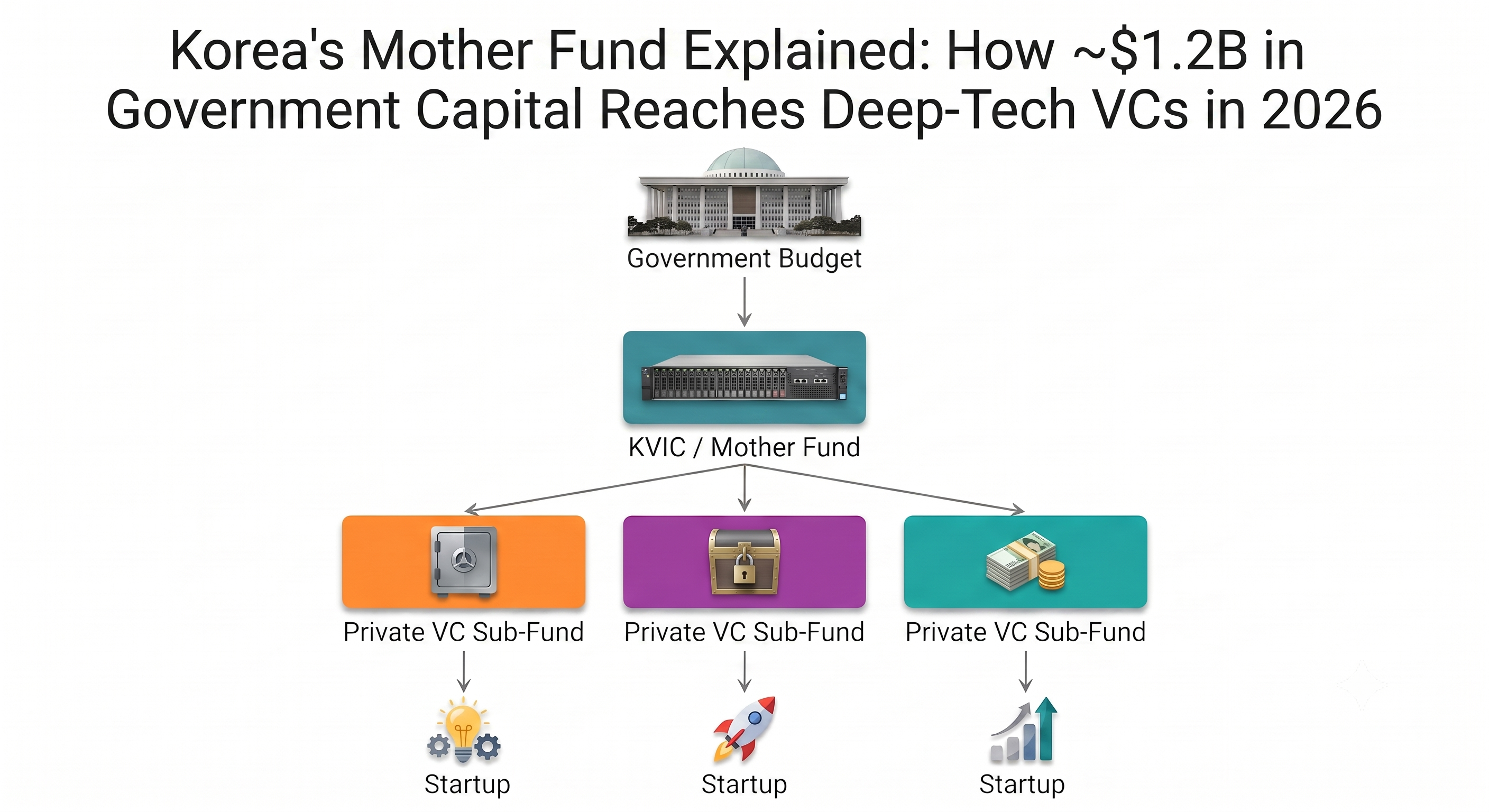
Korea's Mother Fund (모태펀드) is a government fund-of-funds run by the Ministry of SMEs and Startups through the Korea Venture Investment Corporation (KVIC) — it does not invest in startups directly. It commits capital (roughly KRW 1.6 trillion, or about $1.1–1.2B, for 2026 — an approximate conversion, since KRW/USD rates fluctuate) to privately managed venture funds (자펀드) selected through a competitive GP-selection process, and those private funds then invest in startups. It is one of three distinct Korean government funding vehicles that foreign founders and investors routinely conflate — the others being the much larger National Growth Fund (국민성장펀드, roughly ₩150 trillion over five years) and the non-dilutive TIPS grant-matching program — and mixing them up is the single most common mistake in how outsiders read Korea's startup funding landscape.
Quick Facts
| Question | Answer |
|---|---|
| What is Korea's Mother Fund? | A government fund-of-funds run via KVIC; it commits capital to private VC funds (자펀드) rather than investing in startups directly |
| 2026 total commitment | Roughly KRW 1.6 trillion (~$1.1–1.2B, approximate conversion) |
| How is it different from the National Growth Fund? | The National Growth Fund is a separate, far larger vehicle (~₩150T over five years) spanning 10 strategic industries — not managed by KVIC |
| How is it different from TIPS? | TIPS is a non-dilutive R&D-grant-plus-accelerator-matching program run through a different ministry mechanism, not an equity fund-of-funds |
| Can foreign VCs apply directly to KVIC? | Rarely, for deep-tech categories — most practical exposure comes indirectly through domestic VC GPs that already hold Mother Fund sub-fund allocations |
What Is Korea's Mother Fund (모태펀드), Exactly?
The Mother Fund is a fund-of-funds, not a direct investor. Government budget capital flows from the Ministry of SMEs and Startups into KVIC, KVIC runs competitive RFPs to select private asset managers as general partners (GPs), those selected GPs form 자펀드 (sub-funds) that combine the government's committed capital with private limited-partner capital, and it's the 자펀드 — not KVIC itself — that writes checks into individual startups. A startup's cap table can carry "Mother Fund-backed capital" without KVIC ever appearing as a named investor, because the actual counterparty is the private GP that won the sub-fund mandate.
For 2026, the Ministry of SMEs and Startups confirmed a KRW 1.6 trillion Mother Fund commitment via KVIC, with an explicit pivot toward AI and deep-tech growth-stage bets — language in Korean coverage describes this as targeting "next unicorn" candidates rather than only early-stage prototyping capital. KVIC's own materials, as reported by 전자신문 (etnews) in May 2026, frame the Mother Fund's 20-year history as having catalyzed roughly ₩50 trillion in cumulative venture investment since inception. That cumulative figure is KVIC/ministry framing reported by etnews, not an independently audited total this article can verify directly — treat it as directional context rather than a precise statistic.
How the Money Actually Moves: Inside a KVIC GP-Selection RFP
KVIC runs GP-selection RFPs the way many government-linked fund-of-funds do. It publishes a public RFP defining what kind of fund it wants formed — sector focus, minimum fund size, geographic mandate — private asset managers submit proposals to become the GP that will manage that specific 자펀드, and KVIC evaluates and selects a shortlist of GPs whose funds then draw matching private capital before any of it ever reaches a startup's cap table.
A concrete, publicly available example of this process is KVIC's 2026 Global League Fund (GLF) RFP, published April 17, 2026, with a total 2026 investment budget of roughly ₩60 billion (~$40M). Its mechanics illustrate the shape of a typical KVIC selection cycle: eligible applicants must be offshore vehicles (not funds organized as Korean-law partnerships) that commit to invest at least 1.0x KVIC's subscription into Korean culture/content companies; two or more firms may bid jointly as a Co-GP, provided all co-managing firms contribute capital to the fund and each has personnel sitting on the fund's Investment Committee — foreign-led Co-GP structures must raise that Korean-investment commitment to 1.5x or more; applicants with an existing Korea office receive evaluation preference, backed by documentation such as a lease agreement or business registration certificate; and the 2026 cycle's application window ran June 8–15, 2026, followed by document review, on-site due diligence for firms that pass that stage, and in-person Investment Committee presentations at KVIC's Seoul headquarters.
The scope caveat that matters here: the Global League Fund invests exclusively in offshore VC funds targeting Korea's culture and content industries — film, music, games, animation, and publishing. It is not a deep-tech or hardware program. Presenting GLF as "the" way a foreign VC accesses Korean deep-tech Mother Fund capital would be a mistake — one an English-language explainer working only from secondary coverage could easily make. This article uses GLF strictly as a worked example of how a KVIC RFP and GP-selection cycle is structured, not as a deep-tech access route.
Mother Fund vs. National Growth Fund vs. TIPS: How the Three Vehicles Actually Differ
This is the comparison that actually matters for a founder or investor trying to figure out which door to knock on.
| Vehicle | Manager / Ministry | 2026 Scale | Mechanism | Typical Access for Founders / Foreign VCs |
|---|---|---|---|---|
| Mother Fund (모태펀드) | KVIC, under the Ministry of SMEs and Startups | ~₩1.6T (~$1.1–1.2B) 2026 commitment | Equity fund-of-funds — commits to GP-selected 자펀드 sub-funds, which invest directly in startups | Indirect, via domestic VC GPs that hold sub-fund allocations; direct GP-selection RFPs exist, but scope varies by program (e.g., GLF covers culture/content only, not deep-tech) |
| National Growth Fund (국민성장펀드) | Korea Development Bank (KDB) and related government channels | ~₩150T planned over five years (expanded from an initial ~₩100T target), spanning 10 strategic industries | Mix of direct and matching investment across semiconductors, AI, bio, robotics, batteries, and other strategic sectors, via multiple sub-vehicles | Indirect, through sub-funds and co-investment structures; overall scale is roughly two orders of magnitude larger than the Mother Fund |
| TIPS (Tech Incubator Program for Startups) | Ministry of SMEs and Startups, via accredited private operators | Matching grant of up to roughly $580K per startup (see our dedicated TIPS spoke) | Non-dilutive R&D grant triggered by a private investor's initial commitment — not an equity fund-of-funds | Founders apply through an accredited TIPS operator; structurally distinct from both fund-of-funds vehicles above |
One nuance worth flagging: the ~₩150 trillion National Growth Fund figure is the government's five-year, cross-ministry target spanning all 10 strategic industries. The fund's own reported cumulative 2026 disbursement within that umbrella has separately been cited at roughly ₩8.4 trillion (~$6.3B) through April 2026 in other coverage — a useful reminder to always ask which specific figure is being referenced when a company says it's "backed by the National Growth Fund," since the headline five-year total and any single year's actual disbursed tranche are not the same number.
What's New in the 2026 Mother Fund: AI Pivot, a Non-Metro Mandate, and Two Deep-Tech Tracks
Three things distinguish the 2026 Mother Fund cycle from prior years:
- AI/deep-tech pivot toward growth-stage bets. The 2026 strategy explicitly weights capital toward later-stage "next unicorn" candidates in AI and deep-tech, a shift from a more evenly distributed early-stage focus in prior cycles.
- A 20% non-metro investment mandate. New for 2026, general Mother Fund GP-selection sub-funds must commit at least 20% of pledged capital to companies located outside the Seoul/Incheon/Gyeonggi metro area (수도권), with GPs that voluntarily pledge 30% or more receiving preferential scoring in the first screening round. Korean financial press coverage of the 2026 GP-selection cycle confirms that the Next Unicorn Project's Scale-up and 기업승계 (business-succession/M&A) tracks are specifically exempt from this mandate, reflecting their larger fund sizes and broader investment scope.
- Two distinct deep-tech tracks worth telling apart. The "Next Unicorn Project" (넥스트유니콘 프로젝트) is a Mother Fund GP-selection category, not a direct-to-startup grant — launched in 2025 with roughly ₩300 billion in government commitment that catalyzed about ₩570 billion in venture funds, and expanded in 2026 with roughly ₩150 billion in fresh Mother Fund capital — that steers KVIC sub-fund allocations toward AI/deep-tech VC funds. Separately, and through a different mechanism entirely, the Super-Gap Startup Project (초격차 스타트업 프로젝트), run by the Ministry of SMEs and Startups through Korea's K-Startup platform, is a direct non-dilutive grant selecting roughly 120–200 deep-tech startups a year across 12 strategic industries, offering up to ₩1.2 billion per company — up to ₩600 million for commercialization over three years, plus up to ₩600 million for R&D over up to two years. The two programs are sometimes conflated in secondary English-language coverage, but they run through different mechanisms, different budgets, and different selection bodies.
How Deep-Tech Founders and Foreign LPs Actually Get Exposure to Mother Fund Capital
For a deep-tech hardware founder or a foreign LP evaluating Korea, the practical question isn't "how do I apply to KVIC" — for most deep-tech categories, that's not how the capital reaches a startup's cap table. Mother Fund capital reaches deep-tech companies indirectly, through the domestic VC firms that have already won GP-selected 자펀드 allocations and then run their own investment process into individual startups. Our guide to Korea's deep tech VC ecosystem names the funds most active in this space — firms like Korea Investment Partners, Hashed, Kakao Ventures, and Company K Partners are the kind of domestic GP a deep-tech founder is more likely to pitch directly than KVIC itself, since these are the funds that typically sit downstream of KVIC's sub-fund selections in adjacent sectors.
The practical sequence for a founder: build the pitch — our Series A pitch deck guide for deep-tech hardware startups walks through the TRL-to-slide mapping investors expect — and be ready to explain the non-dilutive funding already on the cap table, whether that's TCB certification, a TIPS matching grant, or a government R&D grant and the IP terms attached to it. Then target the domestic VC funds directly, rather than a government fund-of-funds manager who, in most deep-tech categories, isn't the entity actually writing the check.
FAQ
Q: What is Korea's Mother Fund (모태펀드)?
A: It's a government fund-of-funds managed by KVIC under the Ministry of SMEs and Startups. It doesn't invest in startups directly — it commits capital (roughly KRW 1.6 trillion, ~$1.1–1.2B, for 2026) to privately managed venture funds (자펀드) chosen through a competitive GP-selection process, and those private funds invest in startups.
Q: What's the difference between Korea's Mother Fund and the National Growth Fund?
A: The Mother Fund is a KVIC-managed equity fund-of-funds with a 2026 commitment of roughly ₩1.6 trillion. The National Growth Fund (국민성장펀드) is a separate, much larger vehicle led primarily through KDB, with a five-year target of roughly ₩150 trillion spanning 10 strategic industries including semiconductors, AI, bio, robotics, and batteries — the two funds are not the same program and are not managed by the same institution.
Q: How is the Mother Fund different from the TIPS program?
A: TIPS is a non-dilutive R&D matching grant program — a private investor's commitment triggers a government-matched grant, run through accredited private operators, with an award cap around $580K per startup. The Mother Fund is an equity fund-of-funds that commits capital to private VC funds, which then take equity positions in startups. They're structurally different mechanisms, and a startup can use both at different points in its funding history.
Q: Can foreign VCs or founders apply directly to KVIC for Mother Fund capital?
A: For most deep-tech categories, not in practice. KVIC does run public GP-selection RFPs — the 2026 Global League Fund is one example — but individual programs are scoped to specific sectors (GLF, for instance, covers only culture and content industries, not hardware or deep-tech). Most deep-tech founders and foreign LPs get exposure indirectly, through the domestic VC funds that already hold GP-selected Mother Fund sub-fund allocations.
Q: How much money is in Korea's 2026 Mother Fund, and how is it being spent?
A: The Ministry of SMEs and Startups confirmed a roughly KRW 1.6 trillion (~$1.1–1.2B) 2026 commitment via KVIC, with an explicit pivot toward AI and deep-tech growth-stage "next unicorn" bets, plus a new requirement that at least 20% of committed capital go to companies outside the Seoul/Incheon/Gyeonggi metro area.
Sources
- KVIC (Korea Venture Investment Corporation) — 해외 VC 글로벌펀드 (Foreign VC Global Fund) program overview, official site — corresponds to the 2026 Global League Fund (GLF) RFP (PDF, kvic.or.kr, published April 17, 2026); primary source for GP-selection mechanics; explicitly scoped to offshore VC funds targeting Korean culture/content industries only, used here as a worked mechanics example, not as a deep-tech access route
- 전자신문 (etnews): "모태펀드 20년, 50조 벤처투자 마중물…AI·딥테크 육성 강화" (2026-05-14) — 2026 Mother Fund commitment, AI/deep-tech pivot, 20-year cumulative-investment framing
- 벤처스퀘어: "중기부, 2026년 모태펀드 출자 전략 논의…AI·딥테크 투자 확대" — 2026 Mother Fund strategy discussion, non-metro investment mandate
- 대한민국 정책브리핑 (Korea.kr): "국민성장펀드 '2차 메가프로젝트' 발표…바이오·소버린 AI 등 투자" — National Growth Fund 2nd mega-project announcement, April 2026
- 한국경제 (Hankyung): "150조 국민성장펀드, 5년간 AI·반도체 등 10대 첨단산업 투자" — National Growth Fund five-year, 10-industry scale figure
- 이투데이 (Etoday): "국민성장펀드, 소버린 AI부터 배터리·바이오까지…올해 8.4조 풀었다" — National Growth Fund 2026 disbursement detail
- 대한민국 정책브리핑 (Korea.kr): "지역 초격차 스타트업 육성 본격화…최대 12억 원 지원" — Super-Gap Startup Project (초격차 스타트업 프로젝트) per-company funding structure: up to ₩600M commercialization (3 years) plus up to ₩600M R&D (up to 2 years)
- 전자신문 (etnews): "AI·딥테크에 3100억 푼다…중기부, '넥스트 유니콘' 본격 시동" (2025-07-10) — Next Unicorn Project (넥스트유니콘 프로젝트) launch budget and fund-of-funds mechanism, confirming it is a distinct Mother Fund GP-selection category from the Super-Gap Startup Project
- How South Korea Funds Deep Tech Startups: TCB Certification & Government R&D Grants Explained — our own pillar article, background on the broader Korean deep-tech funding system this article builds on
Author Bio
The Whitepaper Skeptic has prepared TCB certification documentation and investor-facing funding-source breakdowns for deep tech startups navigating Korea's overlapping government and private capital programs, including work distinguishing non-dilutive grant capital from equity fund-of-funds allocations for IR materials and cap-table narratives.
Related Posts
- How South Korea Funds Deep Tech Startups: TCB Certification & Government R&D Grants Explained
- Korea's Deep Tech VC Ecosystem: Who's Funding Semiconductors, Robotics, and Advanced Materials Startups in 2026
- How to Structure a Series A Pitch Deck for Deep Tech Hardware Startups
- Who Owns the IP From a Korean Government R&D Grant? Ownership Rules and the Technology Fee Explained
- TIPS Program Korea: How the $580K Matching R&D Grant Actually Works for Deep Tech Founders in 2026


Comments
Post a Comment