AMR Cold Storage Deployment Explained: How Warehouse Robots Survive -25°C Freezers in 2026
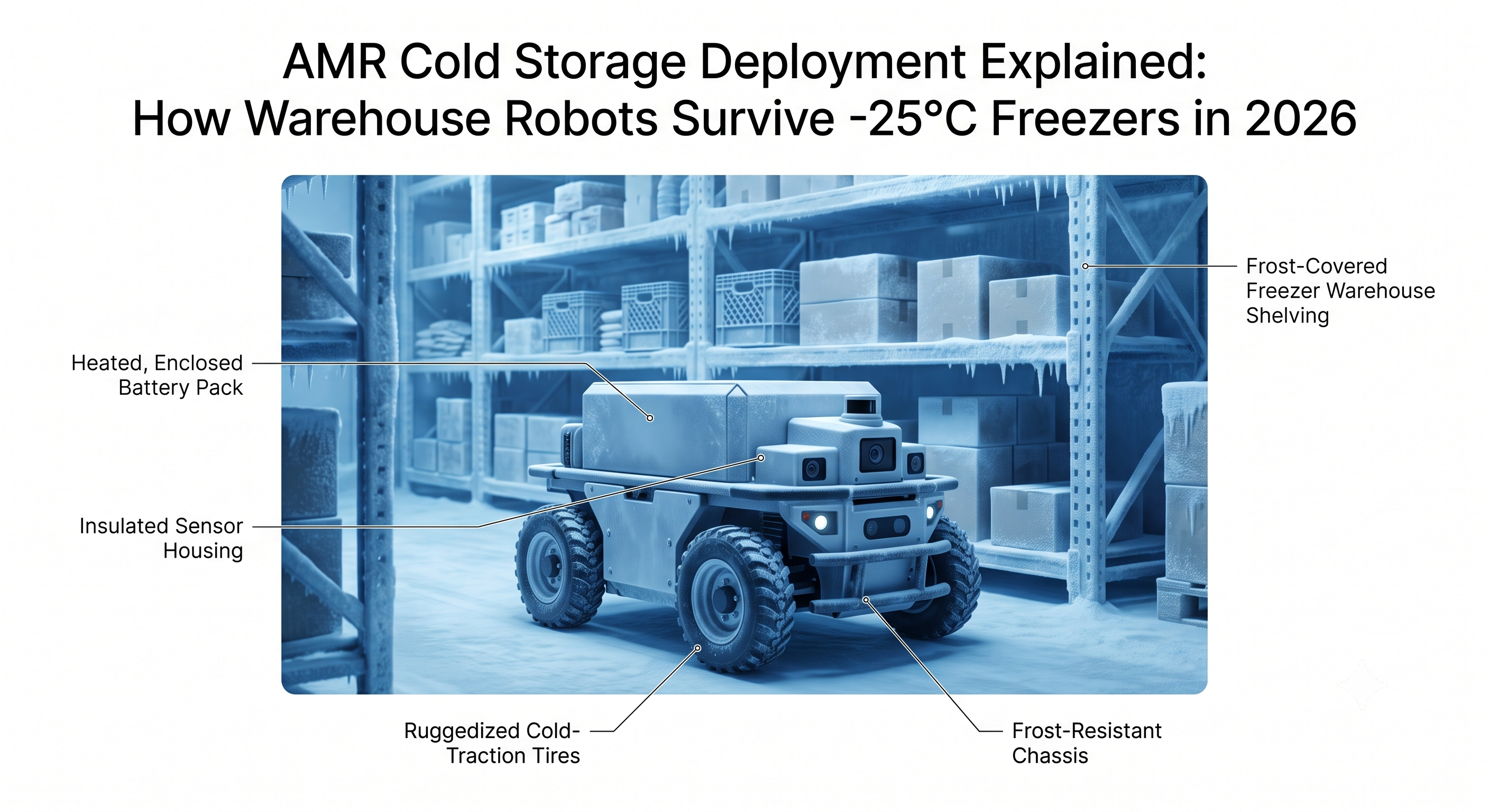
Standard AMRs are not a drop-in solution in freezer warehouses below roughly -20°C — lithium-ion and LiFePO4 batteries lose meaningful capacity and see internal resistance rise sharply at deep-cold temperatures, which is why AMR vendors sell dedicated cold-rated product lines rather than simply de-rating a standard robot. Cold-rated AMRs address this with heated battery compartments, sealed and anti-condensation electronics, and cold-grade lubricants — hardware that carries a real price and duty-cycle premium most vendor marketing glosses over. Cold storage is one of the fastest-growing AMR deployment verticals in 2026, driven by labor shortages that are especially hard to staff in -25°C to -30°C freezer environments. This piece breaks down what actually changes at deep-cold temperatures, what cold-rated hardware costs, and how it changes your charging strategy and TCO math.
By The Whitepaper Skeptic — AMR vendor evaluation and TCO modeling experience
Quick Facts
| Question | Answer |
|---|---|
| Do standard AMRs work in freezer warehouses? | Not reliably below about -20°C — standard lithium-ion/LiFePO4 batteries lose meaningful capacity and see internal resistance rise sharply, so vendors ship dedicated cold-rated product lines instead of de-rating standard units |
| How much battery capacity do AMRs lose at -20°C? | Estimates vary by chemistry — LiFePO4 packs (the chemistry most cold-rated AMR vendors use) typically lose roughly 10-30% capacity at -20°C per battery-manufacturer specs, while general lithium-ion cells not optimized for cold can lose up to roughly 50%; internal resistance rises sharply in both cases, cutting how much current the battery can safely deliver |
| How much more does a cold-rated AMR cost? | One published industry estimate (GrabaRobot's cold-storage AMR pricing guide) puts cold-rated units at roughly $45,000-$120,000 versus $35,000-$80,000 for ambient-rated AMRs (a ~20-40% premium); this hasn't been independently corroborated by an analyst report, so treat it as directional rather than a firm budgeting number |
| What hardware makes an AMR "cold-rated"? | Heated battery compartments, sealed/anti-condensation electronics, and cold-grade lubricants — purpose-built product lines from vendors including Geek+, Hai Robotics, Addverb, and Swisslog |
| Is cold storage a growing AMR deployment vertical in 2026? | Yes — Lineage opened a 19,000 sqm automated facility in Bremerhaven, Germany in June 2026 and separately committed $740M+ to two fully automated U.S. warehouses under its Tyson Foods partnership, while Americold announced a $1.3B North American cold-storage joint venture with EQT in May 2026. This is broader real-estate/automation capex, not confirmed AMR-specific unit counts |
Why Standard AMRs Aren't Drop-In Solutions Below -20°C
The core problem isn't navigation, traction, or sensor mounting — it's battery electrochemistry. Standard AMR fleets run on lithium-ion or LiFePO4 packs tuned for ambient warehouse conditions (typically 0°C to 40°C), and deep cold changes how those chemistries behave in two ways that matter operationally.
First, usable capacity drops. Lithium-based chemistries lose meaningful runtime as internal ion mobility slows in the cold, and the exact number depends heavily on chemistry: LiFePO4 packs — the chemistry most cold-rated AMR vendors specify, per manufacturers like RELiON — typically lose roughly 10-30% capacity at -20°C, while general lithium-ion cells not optimized for cold-weather use can lose up to roughly 50% of rated capacity at the same temperature. What's consistent across sources is the direction and the mechanism: internal resistance rises sharply in the cold, which throttles how much current a battery can safely deliver independent of the raw capacity number, and also drags down charging efficiency — battery-manufacturer data puts charging efficiency at -20°C at roughly 65% of what it is at 15°C.
Second, everything downstream of the battery gets harder. Charging lithium chemistries below freezing risks lithium plating on the anode, which permanently degrades the cell rather than just reducing that day's runtime — a failure mode standard chargers and battery management systems aren't designed to prevent. Electronics enclosures built for ambient warehouse humidity are also prone to condensation when a robot moves between a freezer and a loading dock at a different temperature and humidity, and standard lubricants in drivetrain components can stiffen or fail at deep-cold temperatures in ways that don't show up until a robot has been running for weeks.
None of this means AMRs can't work in a freezer — it means a robot spec'd for ambient conditions is the wrong starting point, which is exactly why cold-rated product lines exist as a separate SKU rather than a firmware setting.
Standard AMR vs. Cold-Rated AMR: What Actually Changes
| Factor | Standard (Ambient) AMR | Cold-Rated AMR |
|---|---|---|
| Typical operating range | 0°C to 40°C | Down to -25°C to -30°C, depending on vendor |
| Battery compartment | Unheated, standard insulation | Heated battery compartment to keep cells within a workable temperature band |
| Electronics enclosure | Standard sealing, not condensation-rated | Sealed/anti-condensation design for freezer-to-dock temperature swings |
| Lubricants and seals | Standard-temperature drivetrain lubricants | Cold-grade lubricants rated for sustained sub-zero operation |
| Duty cycle / runtime | Full rated runtime at ambient temperature | Reduced runtime relative to rated spec, even with cold-rated hardware — battery physics don't fully disappear, they're managed |
| Unit price | Typically $35,000-$80,000 per GrabaRobot's cold-storage AMR pricing guide (single-source estimate, not independently corroborated) | Typically $45,000-$120,000, roughly a 20-40% premium over ambient units, per the same source |
| Representative vendors | Broad general-purpose AMR vendor field | Dedicated cold-rated lines from vendors including Geek+, Hai Robotics, Addverb, and Swisslog |
The table above reflects the core buyer mistake vendor marketing content tends to obscure: cold-rated AMRs don't eliminate the runtime penalty of deep cold, they manage it well enough to make deployment viable. A buyer who reads "cold-rated" as "performs identically to a warehouse-floor robot" is going to be surprised by throughput numbers on day one.
The Cold-Rated Hardware Premium: What It Actually Costs
The most commonly cited figure for the cold-rated hardware premium — roughly $45,000-$120,000 for cold-rated units versus $35,000-$80,000 for ambient-rated ones, framed as a 20-40% price premium — traces back to GrabaRobot's published cold-storage AMR pricing guide rather than an independent analyst report or a directly verifiable vendor spec sheet; other robot-pricing roundups confirm cold-rated hardware adds meaningful cost but don't independently corroborate this exact dollar range. Treat the number as directional: cold-rated hardware costs meaningfully more than ambient-rated hardware, but the exact percentage shouldn't be quoted to a buyer as a firm budgeting figure without a vendor quote in hand.
The premium itself was never the line I got wrong in the TCO models I built — a 20-40% hardware uplift is easy to add once someone hands you a number. What I carried straight across without re-checking was the runtime figure from the ambient spec sheet, which silently assumes the fleet count stays the same. Put a derated duty cycle into the same model and fleet size moves, and fleet size moves payback period considerably more than the per-unit premium does.
That premium isn't purely a battery-and-heater line item, either. Reduced runtime at deep-cold temperatures means a cold-storage deployment may need more robots to hit the same throughput target as an equivalent ambient-warehouse deployment — a fleet-sizing effect that compounds the per-unit price premium rather than sitting alongside it as a separate cost.
Charging Strategy Gets Harder in Sub-Zero Environments
Battery cold-derating doesn't just reduce runtime — it directly changes which charging strategy is even viable, a decision our AMR fleet charging strategy guide covers in depth for ambient deployments. Opportunity charging, the default strategy for continuous multi-shift ambient fleets, depends on a battery chemistry that tolerates frequent partial charging without degrading quickly — and charging lithium chemistries in sub-zero temperatures risks lithium plating, a permanent degradation mechanism that standard opportunity-charging infrastructure isn't built to guard against. In practice, that pushes many cold-storage deployments toward charging robots in a warmed staging area just outside the freezer, or toward battery-swap strategies where the swap itself happens at ambient temperature and only the freshly charged pack re-enters the cold zone.
Either approach adds infrastructure and floor-space cost beyond what an ambient deployment needs: a warmed charging vestibule, or a swap-station and spare-pack setup sized for freezer-zone throughput rather than warehouse-floor throughput. A charging plan that simply imports an ambient-warehouse opportunity-charging model into a freezer environment without accounting for cold-derating and plating risk is one of the more common ways cold-storage AMR projects underperform their throughput projections.
Building the Cold-Rated Premium Into Your TCO Math
Vendor content on cold-storage AMRs tends to assert that cold-rated robots "just work" without quantifying what that costs the buyer in runtime, throughput, or capital. The two line items that most often get left out of a cold-storage AMR business case are exactly the two this article has walked through: the cold-rated hardware price premium, and the reduced duty cycle that can mean needing more robots to hit the same throughput as an ambient deployment. Our warehouse AMR ROI calculator guide walks through payback-period math for AMR deployments generally — for a freezer deployment specifically, both the hardware premium and the reduced-duty-cycle fleet-sizing effect need to go in as explicit line items, not be hand-waved as "similar to a standard deployment, just colder."
The same math matters if you're comparing outright purchase against a robotics-as-a-service contract. Our AMR RaaS pricing guide covers how monthly RaaS rates are typically structured for ambient deployments — for a cold-storage RaaS quote, ask explicitly whether the quoted monthly rate reflects cold-rated hardware pricing and duty-cycle assumptions, or whether it's a standard-rate quote that will need renegotiating once the vendor understands the operating environment.
Cold Storage Automation Investment in 2026
Cold storage has become one of the fastest-growing AMR deployment verticals in 2026, and the driver is straightforward: freezer environments (-25°C to -30°C) are especially hard to staff, and labor shortages in that specific work environment are pushing 3PL and cold-chain operators toward automation faster than in ambient warehousing generally.
Major cold-chain operators are backing that trend with real capital, though the two headline figures below describe separate facilities and shouldn't be conflated. Lineage opened a 19,000 sqm automated cold-storage facility in Bremerhaven, Germany in June 2026 — a seafood-logistics site with 40,000 pallet positions and direct quay access. Separately, in the U.S., Lineage's 2025 partnership with Tyson Foods includes plans to deploy more than $740M to design, build, and operate two next-generation, fully automated cold-storage warehouses that Tyson will anchor as a customer. Americold separately announced a $1.3B North American cold-storage joint venture with EQT in May 2026, in which Americold contributes 12 existing cold-storage facilities to the venture and retains a 30% stake. All three are genuine signals of cold-chain automation investment, but none of these figures should be read as a confirmed AMR fleet-size number — the underlying press releases describe automated-warehouse and real-estate capital deployment broadly, not specific robot counts or vendors.
On market sizing, MarketsAndMarkets puts the broader autonomous mobile robot market at $2.39B in 2025, growing to $7.07B by 2032 at a 17% CAGR — a directional estimate from a single market-research firm covering AMRs generally, not a cold-storage-specific figure, and worth treating the same way this cluster treats other market-size claims: attributed to the specific firm rather than presented as a settled number. A frequently repeated claim that "more than 70% of midsize and large warehouses plan to field AMR fleets by the end of 2026" traces to Intel Market Research's Autonomous Mobile Robot (AMR) Fleet Management Software Market report — a single market-research firm's projection without a disclosed survey methodology available to this article, so it should be read the same way as the MarketsAndMarkets figure above: attributed to its source rather than treated as an independently confirmed number.
FAQ
Q: Can AMR robots work in freezer warehouses?
A: Not with standard, ambient-rated robots below roughly -20°C — battery capacity drops meaningfully and internal resistance rises sharply at that temperature. Cold-rated AMR product lines with heated battery compartments, sealed electronics, and cold-grade lubricants are built specifically for -25°C to -30°C freezer environments, but even cold-rated robots run at a reduced duty cycle relative to their ambient-warehouse spec.
Q: How much battery capacity do AMRs lose in cold storage?
A: It depends heavily on chemistry — LiFePO4 packs, the chemistry most cold-rated AMR vendors use, typically lose roughly 10-30% capacity at -20°C per battery-manufacturer data, while general lithium-ion cells not optimized for cold can lose up to roughly 50%. Internal resistance rises sharply either way, which throttles how much current the battery can safely deliver. Treat any single precise percentage with caution and expect real-world loss to vary by battery chemistry, insulation, and how much of the robot's operating time is actually spent at deep-cold temperatures.
Q: How much does a cold-rated AMR cost compared to a standard one?
A: GrabaRobot's cold-storage AMR pricing guide puts cold-rated units at roughly $45,000-$120,000 versus $35,000-$80,000 for ambient-rated AMRs — a 20-40% premium — but this figure traces to a single published industry source rather than an independently corroborated analyst report, so get a direct vendor quote before budgeting against it as a firm number.
Q: What's the difference between a standard AMR and a cold-rated AMR?
A: A cold-rated AMR isn't a de-rated standard robot — it's a purpose-built hardware line with a heated battery compartment, sealed and anti-condensation electronics (to handle the temperature and humidity swing between a freezer and a loading dock), and cold-grade lubricants rated for sustained sub-zero operation. Vendors including Geek+, Hai Robotics, Addverb, and Swisslog sell dedicated cold-rated product lines rather than offering a cold-weather firmware mode on a standard unit.
Q: Does deploying AMRs in cold storage change how I should plan charging?
A: Yes. Charging lithium-based batteries in sub-zero temperatures risks lithium plating, a permanent degradation mechanism, which is why many cold-storage deployments charge in a warmed staging area outside the freezer or use battery-swap strategies where only a pre-charged pack re-enters the cold zone. Importing a standard ambient-warehouse opportunity-charging plan directly into a freezer environment without accounting for this is a common cause of underperforming throughput projections.
Sources
- GrabaRobot, "Cold Storage Warehouse Robots: Automation for Freezer and Refrigerated Facilities" — source for the $45,000-$120,000 vs. $35,000-$80,000 cold-rated AMR pricing estimate
- SmartLoadingHub, "Selecting a SLAM warehouse robot for cold storage at scale"
- RELiON, "Introducing RELiON's Low-Temperature Lithium Iron Phosphate Batteries"
- RELiON, "How do LiFePO4 batteries perform in cold temperatures?"
- Large Battery, "Lithium Batteries Discharging at High and Low Temperatures" — source for general lithium-ion cold-weather capacity loss and the -20°C charging-efficiency figure
- Lineage newsroom, "Lineage Announces Plans to Expand its U.S. Cold-Storage Network" — source for the $740M/two fully automated U.S. warehouses figure (Tyson Foods partnership)
- Lineage newsroom, "Lineage Expects to Strengthen its Footprint in Germany with Construction of New Facility in Bremerhaven" — source for the Bremerhaven, Germany facility (opened June 2026)
- Americold Realty Trust, "Americold Realty Trust, Inc. and EQT Announce a $1.3 Billion North American Cold Storage Joint Venture"
- MarketsAndMarkets, "Autonomous Mobile Robots Market Size, Share, Latest Trends & Growth Analysis, 2025-2032"
- Intel Market Research, "Autonomous Mobile Robot (AMR) Fleet Management Software Market 2026 to 2034" — source for the "70% of midsize and large warehouses" AMR-adoption estimate
- Our own pillar: AMR vs AGV: What's the Real Difference in Warehouse and Outdoor Robotics?
- Our own cluster mate: Warehouse AMR ROI: How to Calculate Payback Period Before You Buy
- Our own cluster mate: AMR RaaS Pricing Explained: How Robotics-as-a-Service Contracts Really Cost $2K–$8K a Month in 2026
- Our own cluster mate: AMR Fleet Charging Strategy Explained: Opportunity Charging vs. Battery Swap vs. Scheduled Charging in 2026
Author Bio
The Whitepaper Skeptic led AMR vendor evaluation and total-cost-of-ownership modeling at The Won, where runtime and duty-cycle assumptions in vendor spec sheets were consistently the numbers that needed the most scrutiny before they made it into a fleet-sizing model — the same scrutiny this article applies to cold-rated AMR hardware claims.
Related Posts
- AMR vs AGV: What's the Real Difference in Warehouse and Outdoor Robotics?
- AMR Fleet Charging Strategy Explained: Opportunity Charging vs. Battery Swap vs. Scheduled Charging in 2026
- Warehouse AMR ROI: How to Calculate Payback Period Before You Buy
- AMR RaaS Pricing Explained: How Robotics-as-a-Service Contracts Really Cost $2K–$8K a Month in 2026
Tags
AMR cold storage deployment, cold-rated AMR battery, freezer warehouse robots, AMR battery cold weather performance, cold chain warehouse automation


Comments
Post a Comment