Tandem OLED Explained: The Stacked-Layer Tech Set to Reach 36% of Laptop OLED Panels in 2026
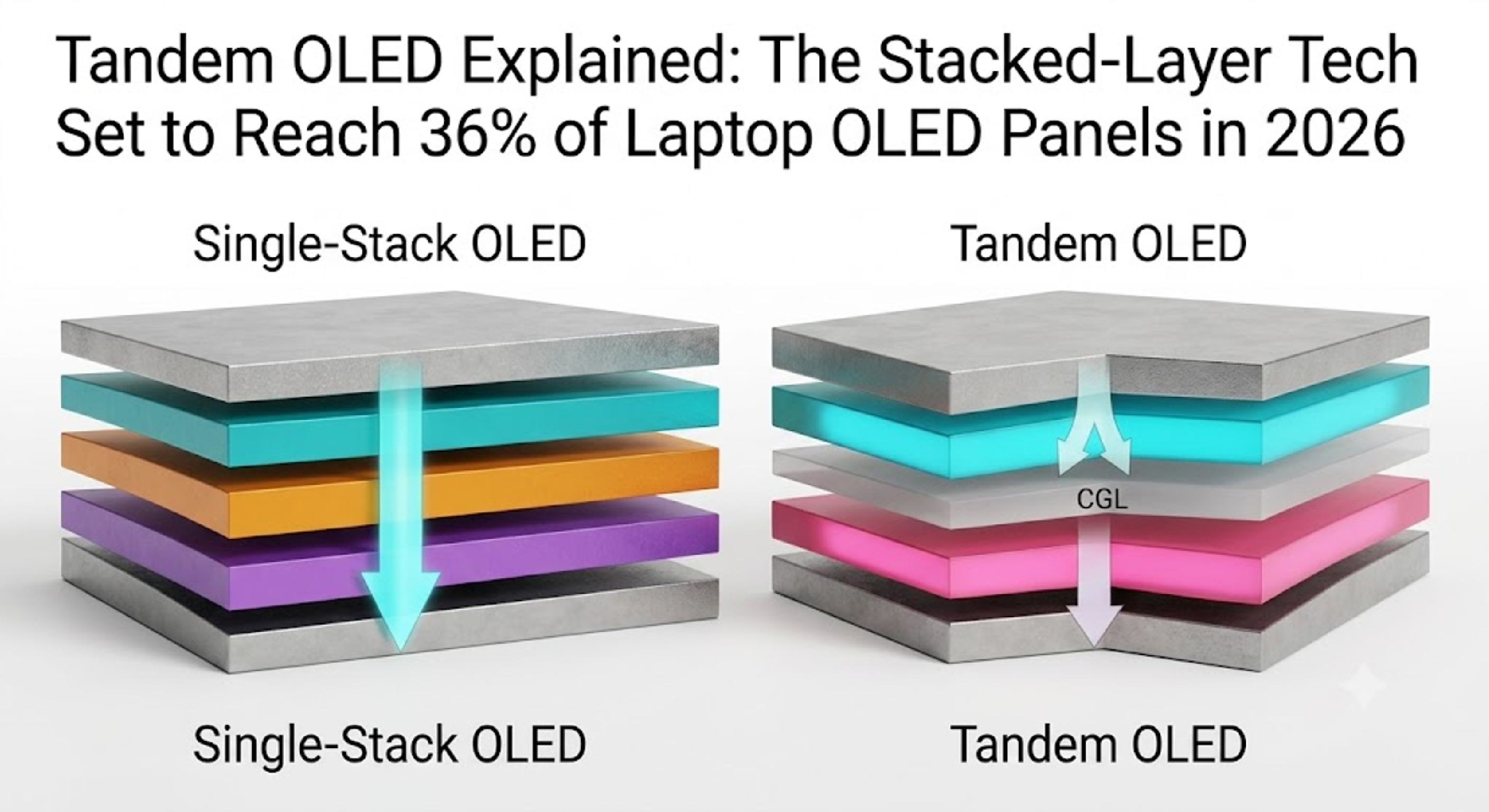
Tandem OLED is a panel structure that stacks two (or more) organic light-emitting layers on top of each other inside a single display, connected by a thin charge generation layer (CGL) instead of relying on one emissive layer to do all the work. Each stacked layer only has to carry part of the light output, so the panel can hit the same brightness at lower current per layer — which is the mechanism behind tandem OLED's longevity and efficiency gains over single-stack OLED. Omdia's April 2025 forecast projects tandem penetration reaching 36% of the OLED tablet/notebook panel market in 2026, up from roughly 30% in 2024 — a forecast figure, not a confirmed year-end measurement. Apple, Samsung Display, and LG Display are all building around this structure for their next generation of laptop and tablet screens in 2026.
By The Whitepaper Skeptic — display materials project experience and stacked-die interconnect analysis
Quick Facts
| Question | Answer |
|---|---|
| What is tandem OLED? | A panel structure with two or more stacked emissive OLED layers connected by a charge generation layer (CGL), instead of one single emissive layer |
| How is it different from single-stack OLED? | Splits light output across multiple layers, which lowers current per layer for the same brightness — the basis of its longer lifetime and lower power draw |
| Why does it cost more to build? | Roughly 50-75% more than single-stack OLED, per Omdia's tablet/notebook panel cost analysis (a category-wide figure, not tied to one manufacturer) — driven by extra evaporation steps, fine metal masks, and lower yields |
| How widely will it be adopted in 2026? | Omdia forecasts 36% of OLED tablet/notebook panels in 2026 (April 2025 forecast, up from ~30% in 2024) |
| Who's shipping it? | Apple's tandem-OLED iPad Pro and (reportedly) MacBook Pro line; LG Display rebranded its entire OLED lineup around the "tandem" name at CES 2026 |
What Is Tandem OLED, and What Does the Charge Generation Layer Actually Do?
A standard, single-stack OLED panel has one emissive layer sandwiched between electrodes. To hit a target brightness, that single layer has to carry the full current load — which is also what wears the organic material down over time and sets the ceiling on how efficient the panel can be.
Tandem OLED changes the architecture rather than the chemistry: it stacks two (or in some designs, more) emissive layers in series, with a charge generation layer between them. The CGL's job is to inject electrons into one layer and holes into the layer above it, effectively letting each stacked layer generate its own share of the light output for the same amount of current passing through the device. Ossila's technical explainer frames this as a theoretical relationship — "theory says" that stacking N emissive layers yields roughly N-times the efficiency of a single layer. That's an idealized physics model, not a guaranteed multiplier for any specific two-layer commercial panel: real-world yield loss and CGL inefficiency mean an actual two-layer panel won't hit a clean 2x in practice, which is why manufacturers describe gains in ranges rather than fixed multiples.
The practical result manufacturers care about: lower current density per layer for the same brightness, which is what drives the two headline claims attached to tandem OLED — longer usable lifetime and better power efficiency — without needing a fundamentally new emissive material.
Tandem OLED vs. Single-Stack OLED: What Actually Changes
| Factor | Single-Stack OLED | Tandem OLED |
|---|---|---|
| Emissive layers | One | Two or more, connected by a charge generation layer (CGL) |
| Current per layer at target brightness | Full load on one layer | Split across layers, lower per-layer current |
| Manufacturing cost | Baseline | Roughly 50-75% higher, per Omdia (category-wide figure for the tablet/notebook segment) |
| Reported lifetime/brightness vs. single-stack | Baseline | LG Display's own materials claim double the lifespan, triple the brightness, and up to 40% lower power draw for its laptop tandem panel — a vendor claim, not an independent benchmark, and separate from the 4,500-nit spec quoted for LG's TV-panel "Primary RGB Tandem 2.0" line |
| Structural complexity | Lower (fewer deposition/patterning steps) | Higher (extra emissive layer + CGL deposition and patterning) |
| Where it's shipping in 2026 | Most smartphone OLED, most existing laptop OLED | Apple iPad Pro (shipped), reportedly Apple MacBook Pro; LG Display's full 2026 OLED lineup rebrand |
The tradeoff in one line: tandem OLED buys longevity and efficiency by adding a full extra layer and a functional interconnect between the layers — which is exactly why it costs more to build than adding a single new material to an existing single-stack line.
Why Tandem OLED Is More Expensive to Manufacture
The added cost isn't from a single component — it comes from the CGL turning what was a single-deposition emissive stack into a multi-step structure that has to be deposited, aligned, and patterned with the same yield discipline as the rest of the panel. Omdia puts that premium at roughly 50-75% for tandem tablet/notebook panels versus single-stack OLED — a category-wide figure for the tablet/notebook IT-panel segment, not tied to a single manufacturer's production line, reflecting the added evaporation steps, fine-metal-mask requirements, and yield hit that come with a second emissive layer.
Working on display materials while also following how packaging engineers cost stacked-die interconnects left me with one habit I apply here: when a premium arrives as a range that wide, I treat the width as the finding rather than the footnote. A 25-point spread on a category figure tells you that the extra evaporation and patterning steps land very differently from one line to the next — so 50-75% is a useful read on what tandem costs the tablet/notebook segment, and a poor basis for guessing what a second emissive layer would cost any particular fab to add.
That cost premium is also the reason tandem OLED's rollout has concentrated first in premium categories — tablets and laptops — where buyers are already paying for OLED's contrast and thinness advantages over LCD, rather than in cost-sensitive smartphone tiers where single-stack OLED remains standard.
LG Display's CES 2026 Rebrand: "Tandem WOLED" Is Not the Same as "Tandem OLED"
At CES 2026, LG Display announced its first full OLED brand overhaul in 13 years, and split its lineup into two names that both foreground the word "tandem" — which makes them easy to confuse:
- Tandem WOLED covers large-format panels — TVs and monitors — including a new "Primary RGB Tandem 2.0" panel LG Display says reaches 4,500 nits peak brightness.
- Tandem OLED (no "W") covers small- and medium-size RGB panels for automotive displays, tablets, and laptops — the category this article is about.
Both names put the tandem structure in the marketing headline rather than treating it as a footnote spec, which is itself a signal of how central this architecture has become to LG Display's product story going into 2026. But the "W" distinction matters for anyone comparing specs across product categories: the 4,500-nit figure belongs to the large-panel Tandem WOLED line, not the laptop/tablet-focused Tandem OLED line, and the two should not be quoted interchangeably.
Where Tandem OLED Is Actually Shipping in 2026
Apple's tandem-OLED iPad Pro was the structure's first mainstream consumer product. The next confirmed step is the MacBook Pro line — Samsung Display's exclusive supply agreement for 14-inch and 16-inch MacBook Pro OLED panels was already sourced and verified in our Gen 8.6 OLED fab-race explainer, which covers where this new panel capacity is being built; this article keeps that fact consistent rather than re-deriving it.
The MacBook Air is not part of Apple's 2026 OLED transition at all. Bloomberg's Mark Gurman and display analyst Ming-Chi Kuo — independent supply-chain sources that agree on the sequencing — both report the MacBook Air is staying on its current LCD/mini-LED display through 2026, with an OLED MacBook Air not expected until 2028 (Gurman) or 2028-2029 (Kuo). When an OLED MacBook Air does eventually ship, supply-chain reporting expects it to use single-stack OLED rather than tandem, keeping tandem as a MacBook Pro differentiator — but that's a 2028-era product, not something arriving alongside the 2026 lineup.
The practical pattern for 2026 buyers and procurement readers: tandem OLED is arriving first in the higher tier of Apple's lineup (iPad Pro, then MacBook Pro), while the MacBook Air is skipping OLED entirely for now — mirroring how OLED itself first arrived in flagship phones before spreading to mid-tier devices, just on a longer timeline for Apple's lowest-cost laptop.
Why This Stacking Logic Sounds Familiar: The CGL and Chip Packaging
A charge generation layer connecting two stacked emissive layers "in series" is conceptually the same problem semiconductor packaging engineers solve when they connect stacked silicon dies: how do you route power and signal between physically stacked layers without each layer having to do all the work alone? Our CoWoS and hybrid bonding explainer covers how chipmakers physically interconnect stacked dies, and our HBM explainer covers why stacking memory dies vertically — rather than building one larger single-layer die — became the industry's answer to a similar tradeoff between output-per-layer and total system cost. The materials and processes are entirely different between a CGL and a TSV or hybrid-bonded interconnect, but the underlying engineering logic — split the load across stacked layers, connect them with a purpose-built interconnect, pay a manufacturing complexity premium for it — is the same story told in two different industries.
FAQ
Q: What is tandem OLED?
A: Tandem OLED is a display panel structure that stacks two or more organic emissive layers on top of each other, connected by a charge generation layer (CGL), instead of relying on a single emissive layer. Splitting the light output across layers lowers the current each layer needs to carry for a given brightness, which is the basis of tandem OLED's longer lifetime and lower power draw compared to single-stack OLED.
Q: What's the difference between tandem OLED and single-stack OLED?
A: Single-stack OLED uses one emissive layer that carries the full current load to hit a target brightness. Tandem OLED splits that load across two or more emissive layers connected by a charge generation layer, which reduces current density per layer. The tradeoff is manufacturing cost and complexity — Omdia reports roughly 50-75% higher manufacturing cost for tandem tablet/notebook panels versus single-stack OLED — in exchange for reported gains in lifetime and brightness.
Q: Why is tandem OLED more expensive to manufacture?
A: The added cost comes from the charge generation layer itself, which turns a single-deposition emissive stack into a multi-layer structure requiring additional deposition and patterning steps at the same yield discipline as the rest of the panel. Omdia describes the resulting 50-75% premium as a category-wide figure across the tablet/notebook IT-panel segment, not one tied to a specific manufacturer's production line.
Q: Is LG's "Tandem WOLED" the same as "Tandem OLED"?
A: No. At CES 2026, LG Display split its rebranded OLED lineup into two distinct names: "Tandem WOLED" for large-format TV and monitor panels (including a new panel reaching a reported 4,500 nits), and "Tandem OLED" (no "W") for smaller automotive, tablet, and laptop panels. Both use tandem-structure architecture, but they're different product categories and the specs shouldn't be quoted interchangeably.
Q: Does the MacBook Air have tandem OLED?
A: Not in 2026 — the MacBook Air isn't getting any OLED display in 2026 at all. Bloomberg's Mark Gurman and analyst Ming-Chi Kuo both report Apple's OLED MacBook Air won't arrive until 2028 (Gurman) or 2028-2029 (Kuo), with the Air staying on LCD/mini-LED until then. When it does ship, supply-chain reporting expects it to use single-stack rather than tandem OLED, unlike the MacBook Pro.
Sources
- Omdia: Tandem Penetration Forecast to Reach 36% Share of OLED Tablet and Notebook Panel Market in 2026 — BusinessWire
- Tandem OLED Display Technology | How Does It Work? — Ossila
- LG Display Starts Mass Production of Industry's First Tandem OLED for Laptops — LG Newsroom
- Updated: LG Display rebrands OLED lineup as 'Tandem WOLED' and 'Tandem OLED' — FlatpanelsHD
- LG Display Brings Tandem WOLED 2.0 to CES 2026, Pushing TV Panels to 4,500 Nits — Display Daily
- CES 2026: LG Display announces Tandem WOLED/OLED technology brands — ProVideo Coalition
- Tandem OLED Technology Explained — EveZone
- MacBook Air With OLED Display is Still Years Away — MacRumors
- Interfacial modification in multilayered charge generation layer structure for highly efficient charge generation in tandem OLEDs — ScienceDirect
Author Bio
The Whitepaper Skeptic has direct project experience working with a global materials supplier on a display-related manufacturing project, and separately has tracked semiconductor packaging interconnect design — including CoWoS/hybrid bonding and TSV-based die stacking — as part of ongoing AI hardware analysis. Both lenses inform this article's read on why a charge generation layer and a chip-packaging interconnect are solving the same underlying problem in two different industries.
Related Posts
- How Are OLED and LCD Displays Manufactured? A Guide to Panel Fabrication and Inspection — pillar guide
- Gen 8.6 OLED Explained: Why Samsung, BOE, and LG Are Racing to Build IT Panel Capacity in 2026 — cluster-mate: covers where the new IT-panel capacity is being built; this article covers what's actually different inside the panel those fabs produce
- OLED Thin-Film Encapsulation Explained: How Barrier Films Keep Flexible Displays From Dying in Days — cluster-mate covering a different OLED structural layer (barrier film vs. emissive stack)
- CoWoS / Hybrid Bonding Explained — cross-cluster: the semiconductor-packaging equivalent of connecting stacked layers, applied to chip dies instead of OLED emissive layers
- What Is HBM (High Bandwidth Memory)? A Beginner's Guide to AI Chip Packaging — cross-cluster: the same split-the-load-across-stacked-layers logic, applied to memory die stacking instead of OLED emissive layers
- OLEDoS Explained: How OLED-on-Silicon Microdisplays Are Powering the 2026 AR Smart Glasses Race — cluster-mate: the same OLED emissive stack built on a silicon backplane instead of glass, for AR microdisplays


Comments
Post a Comment