Semiconductor Fab AMR Explained: How SLAM and AI Path Planning Are Replacing Fixed Guide Paths in 2026
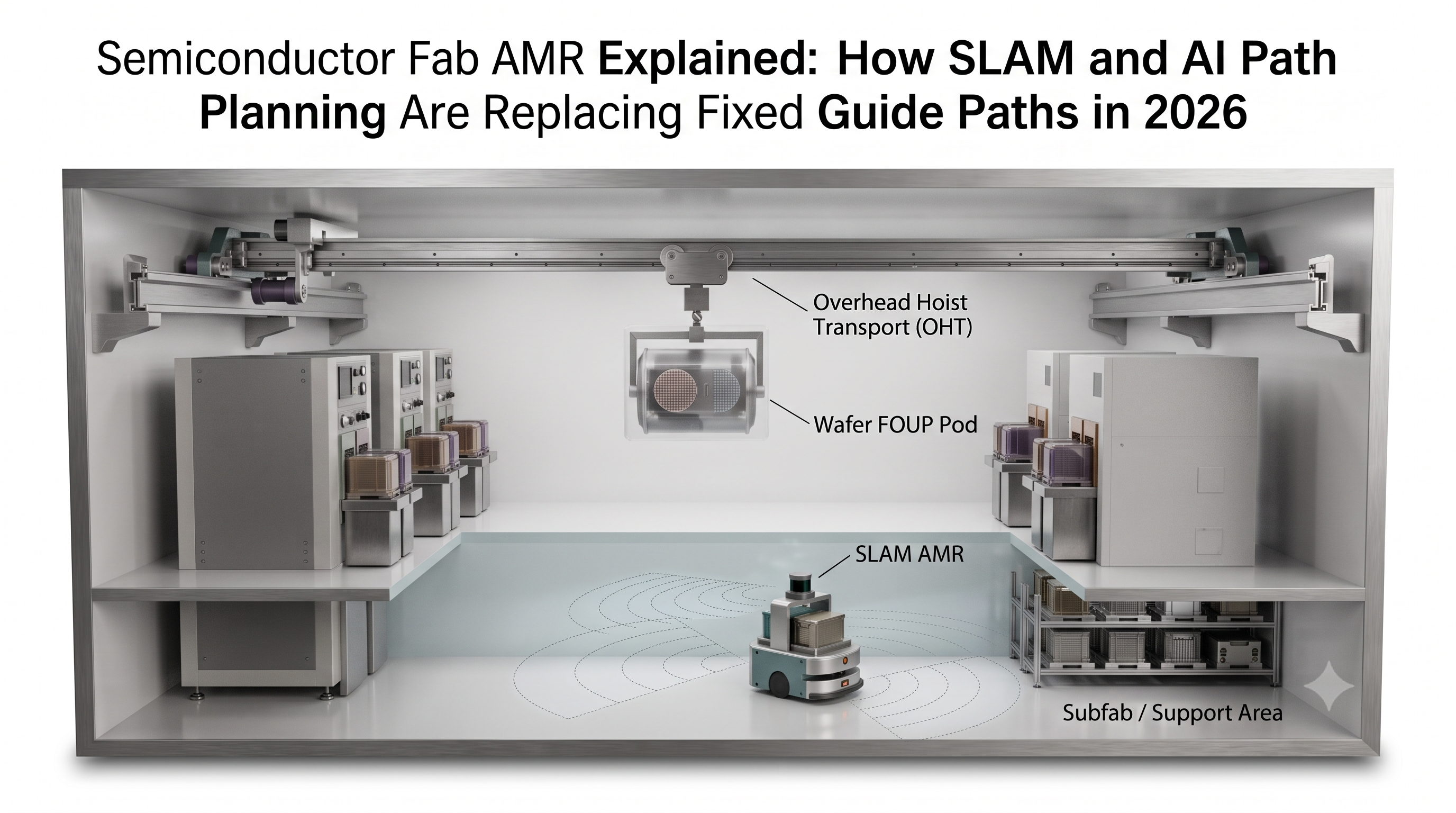
Semiconductor fab AMR deployment in 2026 does not replace overhead hoist transport (OHT) — the overhead rail network built by vendors like Daifuku and Muratec still carries the large majority of lot-critical wafer transport between process tools, and OHT alone holds roughly 28%+ of the total semiconductor AMHS (automated material handling system) market. What SLAM- and AI-path-planning-based AMRs are actually replacing is the older floor-based fixed-guide-path systems — magnetic tape, wire-guide, and QR-code AGVs — used in subfab, support-area, and reticle/consumable transport, where extending OHT rail is too slow and too capital-intensive to justify. Getting this distinction backwards is the most common framing mistake in fab-automation content, and it matters for anyone reading an AMR vendor's pitch: that vendor is answering a different transport problem than the one an OHT vendor solves, not competing head-to-head for the same lot-transport job.
By The Whitepaper Skeptic — AMR vendor evaluation and semiconductor packaging cleanroom-classification exposure
Quick Facts
| Question | Answer |
|---|---|
| Does AMR (SLAM-based) replace OHT in semiconductor fabs? | No — OHT remains the dominant fab AMHS backbone (Daifuku and Muratec together hold the large majority of that segment, OHT alone roughly 28%+ of the total semiconductor AMHS market as of 2024/2025). SLAM AMRs displace older floor-based fixed-guide-path systems in subfab, support-area, and reticle transport, not OHT rail itself |
| Can SLAM navigation alone hit sub-5mm tool-docking tolerance? | Not reliably on its own — most fab deployments pair SLAM with a hybrid vision/inductive fine-positioning step for the final approach into a tool or load port |
| First SLAM AMR validated under real fab production conditions | Fabmatics' HERO Scout — validated at Infineon Dresden's 200mm fab as part of the EU AIMS 5.0 project in 2026, cited as "technically ready" for highly automated fabs |
| Projected AMR share of the semiconductor AMHS market by 2034 | Roughly a third (~33.7%), per industry forecast (SNS Insider / market.us) — this is a market-forecast projection, not a measured, already-achieved figure |
| Cleanliness class semiconductor fab AMRs typically operate in | ISO 14644-1 "ISO Class" 1-3 for modern 300mm fabs — a different nomenclature from the older Fed-Std-209E "Class 1/10/100" system, and a different classification framework from pharma GMP grades A-D |
The Fab AMHS Hierarchy: Where OHT Ends and AMR Begins
Most "semiconductor fab robot" content skips straight to AMRs without ever mentioning what actually moves wafers today. Overhead hoist transport is the fixed rail infrastructure suspended from the ceiling that carries FOUPs (front-opening unified pods, the sealed wafer carriers) between process tools along interbay and intrabay routes. It's been the backbone of 300mm fab material handling for two decades, and it stays the backbone for a structural reason: OHT rail is a capital asset the fab already built into the building layout, and lot-critical wafer transport needs the throughput consistency and collision-free reliability that a fixed, dedicated rail network gives you. Ripping that out for a fleet of flexible robots isn't on the table for any fab operator evaluating automation in 2026 — it isn't a want, it's an unavailable option, because the OHT network is embedded in the facility's physical structure and production schedule.
Where AMRs enter the picture is everywhere OHT rail doesn't reach or doesn't make economic sense to extend: subfab utility areas, support-zone material staging, consumable replenishment, and specialty payloads like reticle pods that don't move at the volume that justifies a dedicated rail spur. Extending OHT into a new subfab zone is a multi-month capex and downtime project — you're modifying the physical rail network in a live production facility. Deploying a fleet of SLAM AMRs into that same zone is a software and hardware rollout measured in weeks, not months, because there's no rail to install.
Why SLAM and AI Path Planning Matter Specifically Here
The reason SLAM (simultaneous localization and mapping) and AI-based path planning are the relevant technology — rather than the older magnetic-tape or QR-code-guided AGVs that already exist in support zones — comes down to two practical problems fixed-guide-path systems don't handle well.
Fab layouts change more than warehouse layouts. A distribution center's floor plan is relatively static for years. A semiconductor fab's subfab and support areas get reconfigured as tool sets change, new process modules get installed, and production lines get reallocated — and every one of those changes to a magnetic-tape or wire-guide AGV route means physically re-laying guide infrastructure on the floor. A SLAM AMR reroutes in software: the robot builds and updates its own map of the environment, so a layout change is a re-scan and a path-planning update, not a floor-tape replacement project.
Dynamic obstacle avoidance matters more in an active fab. AI-based path planning lets a fleet reroute around temporary obstructions — maintenance carts, staged equipment, other robots — in real time, instead of stopping dead because something is blocking a fixed guide path. In evaluating AMR vendor pitches over the years, the SLAM-vs-fixed-guide distinction is consistently the single technical claim vendors lean on hardest and buyers verify least — it's worth pressure-testing specifically because "AI-powered navigation" gets marketed identically whether the deployment is a warehouse aisle or a vibration-sensitive fab support zone, and the actual engineering bar is not the same.
Reticle and FOUP Handling: The New Use Cases Fixed Rail Can't Cover
Beyond simply replacing old AGV routes, SLAM AMRs are opening use cases that fixed-guide infrastructure was never built to serve economically. Reticle (photomask) handling is the clearest example: reticles move in lower volume and along less predictable routes than production wafer lots, which makes a dedicated OHT spur hard to justify but leaves a real transport gap that manual handling or ad hoc carts otherwise fill.
Fabmatics' HERO Scout is the most publicly documented platform built specifically for this niche — a SLAM-based, AI-capable fleet-coordination AMR with on-the-fly inductive charging, validated under real 200mm production conditions at Infineon Dresden as part of the EU AIMS 5.0 project in 2026. BEC Robotics' FABMOVER is a second SLAM-based cleanroom AMR platform in this same category, giving buyers at least two vendors to compare rather than a single-source technology. Neither platform is trying to replace OHT — both are explicitly positioned for the subfab, support-area, and specialty-payload gaps that OHT doesn't cover.
The Precision-Docking Limit: Why SLAM Alone Often Isn't Enough
This is the part vendor marketing pages gloss over. SLAM gives a robot excellent relative localization — it knows where it is on its own map to a reasonably tight tolerance — but tool docking in a fab often requires sub-5mm precision to align a payload with a load port or metrology station. Pure SLAM, especially over longer runs where small localization drift accumulates, often can't reliably hit that tolerance on its own. Real deployments handle this with a hybrid approach: SLAM for the bulk of the route, then a final-approach fine-positioning step using machine vision fiducials or inductive/magnetic guidance right at the docking point, where the tolerance requirement is actually tight enough to matter.
This is the one question I learned to put in writing during AMR vendor evaluations rather than ask in a meeting: what is the docking repeatability at the load port, measured across a full shift — not the localization accuracy on the map. Pitch decks quote the two interchangeably, and they are not the same order of magnitude. A stack that looks comfortable at map level can still miss a sub-5mm docking tolerance once drift accumulates over a long route, which is why the fine-positioning step, not the SLAM claim, is the part of the architecture worth auditing before signing.
The same vibration sensitivity that governs tool placement in a fab applies to AMR routing near lithography and metrology equipment. Fab facility design commonly uses the Generic Vibration Criteria (VC) curves — originated by Eric Ungar and Colin Gordon and adopted by the Institute of Environmental Sciences and Technology (IEST) — where VC-D (6.25 µm/s / 250 µin/s) and VC-E (3.12 µm/s / 125 µin/s) are the tiers typically specified for lithography- and metrology-adjacent zones in advanced fabs. Those single-digit-micron-per-second thresholds constrain not just where equipment gets bolted down, but where a moving robot chassis is allowed to travel at all. A vendor's "AI path planning" claim rarely addresses this constraint explicitly, which is exactly the kind of gap a buyer-side evaluation needs to surface before signing an RFP, not after installation.
OHT vs. AMR in Semiconductor Fabs: A Side-by-Side Comparison
| Aspect | OHT (Overhead Hoist Transport) | SLAM/AI AMR |
|---|---|---|
| Primary role | Interbay/intrabay lot-critical wafer transport backbone | Subfab, support-area, and specialty-payload (reticle/consumable) transport |
| Infrastructure | Fixed overhead rail network, built into facility design | No fixed infrastructure — navigates via onboard mapping/sensors |
| Market position (2024/2025) | Dominant — Daifuku/Muratec hold the large majority share, OHT alone ~28%+ of total semiconductor AMHS market | Smaller but growing — projected toward roughly a third of the semiconductor AMHS market by 2034 (industry forecast) |
| What it typically replaces | Nothing at scale in an active fab — extending it is a capex/downtime project | Older floor-based fixed-guide-path systems: magnetic tape, wire-guide, QR-code AGVs |
| Reconfiguration cost when layout changes | High — physical rail modification | Low — software re-mapping and path-planning update |
| Precision at final docking | Purpose-built rail alignment, inherently precise | Often needs hybrid vision/inductive fine-positioning to hit sub-5mm tolerance |
Fab AMHS Market Sizing: Read the Forecast Numbers Carefully
Industry forecasts put the semiconductor AMHS market at roughly $2.66B in 2025, growing to around $5.42B by 2035 at a 7.37% CAGR, with AMR's share of that market climbing toward roughly a third by 2034. Those figures come from market-research aggregator reports (SNS Insider and market.us), and it's worth being explicit about what kind of claim that is: it's a forecast built on assumed adoption curves, not a measured, already-achieved market split. Treat the trendline — AMR share growing, OHT share still dominant — as the reliable signal, and treat the specific percentages as directional rather than precise.
Where This Fits: Semiconductor Fab AMR vs. Pharma Cleanroom AMR
This isn't the first "cleanroom robot" piece on this blog — our GMP Cleanroom AMR Deployment Explained piece covers pharma AMR deployment. The overlap stops at the word "cleanroom." That piece is about pharma GMP grade classification (A/B/C/D), validated decontamination-cycle compliance under EU GMP Annex 1, and the still-largely-manual problem of moving a payload across a grade-transition airlock. This piece is about a different industry (semiconductor fab, not pharma), a different cleanliness classification system (ISO 14644 fab cleanliness class, not GMP grade), and a different core technical problem — SLAM/AI navigation and path planning displacing fixed-guide floor infrastructure, not decontamination-cycle validation. If you came here looking for pharma cleanroom robotics, that's the piece you want instead; if you're evaluating fab-floor navigation technology, keep reading here.
FAQ
Q: Does AMR replace OHT in semiconductor fabs?
A: No. OHT remains the dominant fixed-infrastructure backbone for lot-critical wafer transport between process tools, holding the large majority of the semiconductor AMHS market. SLAM/AI-path-planning AMRs supplement OHT by replacing older floor-based fixed-guide-path systems (magnetic tape, wire-guide, QR-code AGVs) in subfab, support-area, and reticle/consumable transport — zones OHT rail doesn't economically reach, not the OHT network itself.
Q: What is SLAM navigation used for in a semiconductor fab?
A: SLAM lets an AMR build and continuously update its own map of the facility instead of following a physically laid guide path. In a fab, that matters because subfab and support-area layouts get reconfigured more often than a typical warehouse floor plan — a SLAM AMR reroutes through a software update, while a magnetic-tape or wire-guide AGV requires physically re-laying infrastructure every time the layout changes.
Q: Can SLAM AMRs dock precisely enough to load a semiconductor tool?
A: Not reliably using SLAM alone in most real deployments. Tool docking often requires sub-5mm precision, and small localization drift over longer SLAM-guided runs can exceed that tolerance. Most fab deployments handle this with a hybrid approach — SLAM for the bulk of the route, then a vision-fiducial or inductive fine-positioning step for the final approach into the tool or load port.
Q: What's the difference between a semiconductor fab AMR and a pharma cleanroom AMR?
A: They share the word "cleanroom" and little else. A semiconductor fab AMR operates under ISO 14644 fab cleanliness classes and has to navigate around vibration-sensitive lithography/metrology tools using SLAM and AI path planning. A pharma cleanroom AMR operates under GMP grade classification (A-D) and has to survive validated decontamination cycles (VHP/H2O2) — a compliance and contamination-control problem, not primarily a navigation problem. See our GMP Cleanroom AMR Deployment Explained piece for the pharma side.
Q: How big is the AMR share of the semiconductor material handling market expected to be?
A: Industry forecasts (SNS Insider / market.us) project AMR reaching roughly a third (~33.7%) of the total semiconductor AMHS market by 2034, up from a much smaller share today, while OHT still holds the largest single share as of 2024/2025. Treat this as a forecast trendline rather than an already-measured figure — the underlying assumption is gradual, multi-year adoption growth, not a fast displacement of OHT.
Sources
- Fabmatics — HERO Scout: The Future of Lithography Logistics (AIMS 5.0 / Infineon Dresden validation) — Silicon Saxony
- Fabmatics — Reticle Handling Automation press release
- Muratec USA — Overhead Hoist Transport (OHT) product/technical page
- SNS Insider — AMHS for Semiconductor Market Report (industry forecast — treated as forecast, not measured fact)
- market.us — AMHS for Semiconductor Market (industry forecast — treated as forecast, not measured fact)
- ISO 14644-1:2015 — Cleanrooms and associated controlled environments, Part 1: Classification of air cleanliness by particle concentration
- Colin Gordon Associates — Evolving Criteria for Research Facilities: Vibration (origin of the Ungar/Gordon Generic Vibration Criteria VC-A through VC-E curves, IEST adoption, semiconductor industry use of VC-E)
- Minus K Technology — Vibration Criterion (VC) Curves/Charts (VC-D = 6.25 µm/s / 250 µin/s, VC-E = 3.12 µm/s / 125 µin/s, and their lithography/metrology tool applications)
- BEC Robotics — FABMOVER cleanroom AMR product page
- GrabaRobot — Semiconductor Cleanroom Robot Guide 2026: FOUP Handling, EFEM & Wafer Transport (secondary/vendor-adjacent reference, used for cross-checking technical framing)
- Our own pillar: AMR vs AGV: What's the Real Difference in Warehouse and Outdoor Robotics?
- Our own cluster mate: GMP Cleanroom AMR Deployment Explained
Author Bio
The Whitepaper Skeptic led AMR vendor evaluation and fleet deployment work at The Won, including reviewing vendor navigation and precision-docking claims against the actual technical documentation behind them — the same scrutiny applied here to a vendor's "SLAM replaces fixed infrastructure" pitch. That AMR vendor-evaluation background sits alongside separate exposure to semiconductor cleanroom classification and vibration-sensitivity requirements from semiconductor packaging process analysis work — the ISO 14644 fab cleanliness and tool-adjacent vibration constraints that shape where an AMR can and can't go on a fab floor.


Comments
Post a Comment