GMP Cleanroom AMR Deployment Explained: How Grade A/B/C/D Robots Clear the Decontamination Barrier in 2026
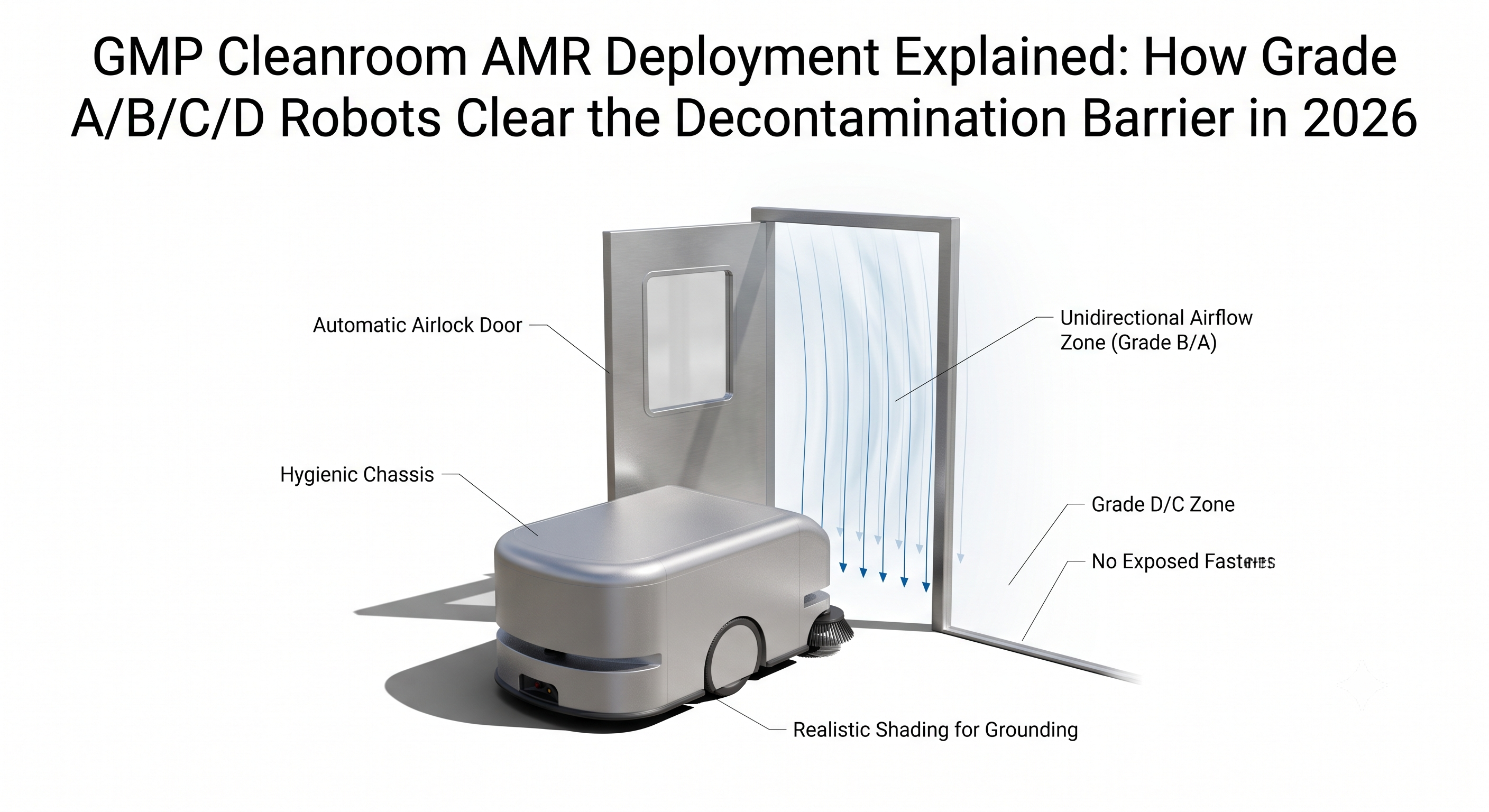
GMP cleanroom AMR deployment already works reliably in Grade C/D (non-sterile) support zones — raw-material and WIP transport has used mobile robots there for years. What's still mostly unsolved in 2026 is Grade A/B (aseptic core) access: only one platform, Stäubli's Sterimove, has been publicly validated to operate across all four grades, and even a validated robot still can't autonomously execute the validated decontamination cycle needed to carry a payload through a grade-transition airlock. In most real deployments today, that last step — the wipe-down inside the airlock — is still done by a person. This piece breaks down the grading system, what actually makes an AMR "cleanroom-rated," and why cross-grade transfer remains the open engineering problem.
By The Whitepaper Skeptic — AMR vendor evaluation and semiconductor cleanroom compliance review
Quick Facts
| Question | Answer |
|---|---|
| Can an AMR move a payload from Grade C into Grade A on its own? | Not fully — per ISPE technical literature, executing a validated decontamination cycle at the grade-transition airlock is still largely unautomated as of 2025-2026; most deployments keep a human performing the wipe-down/disinfection step inside the airlock |
| First mobile robot validated for Grade A/B/C/D use | Stäubli's Sterimove, first announced March 2025 and developed with an unnamed pharmaceutical partner — hygienic, retention-area-free design, H2O2/VHP-compatible materials, and a laminar-airflow-safe form factor. Per an August 2026 trade-press update, it remains a pre-commercial, "near-market-ready" platform with no publicly disclosed commercial installations yet |
| International AMR safety standard that applies | ISO 3691-4 ("Driverless industrial trucks — Safety requirements and verification — Part 4: Driverless industrial trucks and their systems") — separate from cleanroom classification (ISO 14644) and from GMP Annex 1 itself |
| Regulatory driver | Revised EU GMP Annex 1 — published August 25, 2022; general effective date August 25, 2023; lyophilization-specific provisions effective August 25, 2024 — names automation/robotics as an "appropriate technology" for cutting human interventions in aseptic areas |
| Unsolved engineering problem | Autonomous, validated decontamination at the grade-transition airlock — per industry technical literature, still largely a manual step in real-world deployments as of 2025-2026 |
GMP Cleanroom Grades A/B/C/D: A Fast Primer
GMP manufacturing cleanrooms are classified A through D by cleanliness and criticality, not just particle count — the classification (built on ISO 14644-1 particle-count principles) also reflects how close a zone sits to an open, sterile product. Grade A is the critical zone itself — the space immediately around an open sterile product or filling line, kept under continuous unidirectional (laminar) airflow. Grade B is the background environment that supports Grade A, typically the aseptic preparation and gowning area surrounding the critical zone. Grades C and D are progressively less controlled, used for earlier and lower-risk stages: component preparation, compounding, and general material staging.
Mobile robots have operated in Grade C/D spaces for years without much controversy — the contamination-control demands there aren't dramatically different from a well-run electronics or food-grade cleanroom. Grade A/B is where the requirements change category entirely, because the robot itself becomes part of the critical environment it's operating in.
Why Grade A/B Access Is a Different Engineering Problem Than Ordinary AMR Navigation
Three things change once an AMR needs to operate in or near the aseptic core, none of which are addressed by standard AMR safety or navigation engineering:
- Airflow disruption: Grade A relies on continuous unidirectional airflow to sweep particles away from the open product. A robot's chassis shape, fans, and even its wake as it moves can disturb that airflow pattern if it isn't specifically engineered (aerodynamically) not to.
- Particle shedding: Wheels, bearings, cable routing, and surface coatings that are fine in a warehouse can shed particles inside a Grade A/B space — retention areas (crevices, exposed fasteners, vents) that would never be scrutinized on a standard AMR become a real contamination risk here.
- Decontamination-cycle survivability: The robot's materials and electronics need to physically survive repeated vaporized hydrogen peroxide (VHP) fogging or wipe-down disinfection cycles — without outgassing, without surface degradation, and without moisture ingress into sealed electronics — cycle after cycle, for years of service life.
None of this is covered by AMR functional-safety standards like ISO 3691-4 or ANSI/ITSDF B56.5 (covered in our ANSI/ITSDF B56.5 explainer) — those standards govern whether the robot stops safely before hitting a person or object, not whether it's fit to operate next to an open sterile product.
The Real Bottleneck: Cross-Grade Material Transfer at the Airlock
This is the differentiator most vendor pages and generic "pharma robotics" roundups skip past: getting a robot into a Grade A/B space is a materials and airflow engineering problem that's now largely solved by purpose-built platforms. Getting a payload across a grade boundary — moving material from a Grade C staging area, through an airlock, into the Grade A aseptic core — is a separate and much harder problem.
Per ISPE's own technical perspective on automated cross-grade material transfer, most current systems can navigate a robot up to the airlock door, but very few can execute a fully autonomous, validated decontamination cycle for the payload itself inside that airlock. Validation is the operative word: a facility's quality system needs documented proof that the decontamination step reliably works to a defined standard, every time, and that's a much higher bar than "the robot ran the cycle and nothing looked wrong." As of this research pass, that validated-autonomous-cycle capability had not been demonstrated at scale in public technical literature — which is why, in most real deployments today, a person still performs the airlock wipe-down by hand, even on facilities that have otherwise automated the robot's navigation right up to that point. ISPE's Part I (published June 18, 2026) previews a Part II that will cover emerging technologies — cleanroom-compatible AMRs, UV disinfection, air showers, and robotic wiping — aimed at closing this gap; as of this research pass (August 2026), that Part II had not yet been published.
Stäubli's Sterimove: The First Platform Validated for Grade A/B/C/D
Stäubli Robotics, working with an unnamed pharmaceutical partner, publicly introduced Sterimove in March 2025 as reportedly the first mobile robot platform validated for use across all four GMP grades. The platform's design choices map directly onto the three engineering constraints above: a hygienic, retention-area-free chassis (no exposed crevices or fasteners for particles to hide in), materials compatible with VHP/H2O2 decontamination cycles, and an aerodynamic form factor engineered specifically not to disturb unidirectional airflow in the Grade A critical zone.
That's a meaningful technical milestone, but it's worth being precise about what it doesn't claim: Sterimove being validated to operate across all four grades is a different claim than Sterimove (or any other platform) having solved the autonomous cross-grade material transfer problem described above. A freshness check on the original March 2025 announcement confirms the platform is still pre-commercial: an August 2026 trade-press update describes Sterimove as "near-market-ready" following continued refinement shown at INTERPHEX 2026, with no publicly disclosed commercial installations yet — the multi-year development partnership with an unnamed pharmaceutical company has not yet converted into a named customer deployment.
GMP Annex 1's Push Toward Robotics and Automation
The regulatory tailwind behind all of this is the 2022 revision of EU GMP Annex 1, published August 25, 2022, with a general effective date of August 25, 2023, and lyophilization-specific provisions that became effective August 25, 2024. The revised Annex 1 explicitly names robotics and automation as an "appropriate technology" for reducing direct human critical interventions in aseptic manufacturing — human presence being one of the largest contamination-risk factors in a sterile filling line. Under the revision, a facility's automation choices are expected to be driven by its documented Contamination Control Strategy (CCS), the facility-specific risk assessment Annex 1 now requires.
This is a genuine regulatory pull, not just a vendor marketing narrative — but it's a pull toward reducing human interventions generally, and it doesn't specifically require or endorse autonomous cross-grade material transfer as the mechanism. A facility can satisfy the CCS-driven automation expectation with Grade C/D transport automation and isolator/RABS technology for the aseptic core itself, without needing an AMR that crosses grades on its own.
ISO 3691-4 vs. ANSI/ITSDF B56.5: Which AMR Safety Standard Applies in a Cleanroom?
Readers coming from our ANSI/ITSDF B56.5 explainer will recognize this question: does the US standard already covered on this blog apply inside a pharma cleanroom, or is there a separate international standard? There is — ISO 3691-4 is the applicable international standard for driverless industrial trucks and their systems, and it's the relevant baseline for cleanroom AMR deployments outside the US, or for any facility that needs CE marking.
| Aspect | ANSI/ITSDF B56.5 | ISO 3691-4 |
|---|---|---|
| Jurisdiction | United States (voluntary consensus standard) | International (widely referenced for EU CE marking) |
| Scope | Driverless/automatically guided industrial vehicles, plus automated functions on manned vehicles | Driverless industrial trucks and their systems — safety requirements and verification |
| Covers cleanroom classification (ISO 14644) or GMP Annex 1? | No | No |
| Covers cybersecurity? | No | No |
The key point for GMP deployments: neither standard says anything about cleanroom classification, decontamination-cycle validation, or GMP compliance. They govern whether the vehicle stops safely and behaves predictably around people and obstacles. A vendor's "ISO 3691-4 certified" or "ANSI/ITSDF B56.5 compliant" claim tells you the robot meets a baseline safety standard — it tells you nothing about whether it's cleanroom-rated, VHP-compatible, or GMP-deployment-ready. Those are separate, additional layers of validation a buyer has to verify independently.
I have let a vendor's "certified" line stand unchallenged further into a first evaluation pass than it deserved. Pulling up the actual scope statement of the standard behind the claim is a ten-minute exercise, and in the cleanroom case it closes the question immediately: neither ISO 3691-4 nor ANSI/ITSDF B56.5 mentions ISO 14644 particle classes, VHP material compatibility, or decontamination-cycle validation anywhere in scope. The certificate is real — it just answers a question the pharma buyer wasn't asking.
Cleanroom-Rated AMR vs. Standard Warehouse AMR: What Changes
| Aspect | Standard Warehouse AMR | GMP Cleanroom-Rated AMR |
|---|---|---|
| Baseline safety standard | ANSI/ITSDF B56.5 and/or ISO 3691-4 | Same baseline, plus cleanroom-specific validation |
| Chassis design | Optimized for cost and serviceability | Retention-area-free, hygienic design to minimize particle-shedding surfaces |
| Materials | Standard industrial coatings/plastics | H2O2/VHP-decontamination-compatible materials that survive repeated cycles without outgassing |
| Aerodynamics | Not a design consideration | Engineered not to disturb unidirectional (laminar) airflow in Grade A/B zones |
| Regulatory documentation | Safety-standard compliance certificate | Safety-standard compliance plus facility CCS alignment and GMP validation documentation |
| Deployment grades | Warehouse floor only | Grade C/D routine; Grade A/B requires a specifically validated platform |
This gap is also a real cost gap, not just a technical one — cleanroom-rated hardware and its validation documentation carry a meaningful premium over a standard warehouse-grade unit. If you're building a TCO model for a cleanroom deployment, start from the payback-period framework in our warehouse AMR ROI calculator and add the cleanroom-rated hardware premium as a distinct line item — it's not a rounding error on top of a standard warehouse AMR quote.
GMP Cleanroom AMR Is Another "Hostile Operating Envelope" Deployment
This blog has covered one other AMR deployment where the robot has to survive an operating envelope well outside standard warehouse conditions: cold storage deployment, where sub-zero temperatures degrade battery chemistry and require a dedicated cold-rated hardware SKU rather than a de-rated standard robot. GMP cleanroom deployment follows the same structural pattern — a regulatory/contamination-control constraint instead of an environmental one, but the same underlying lesson: a facility can't take a standard AMR and simply spec around the constraint. It needs a purpose-built hardware line, validated documentation, and a cost premium that a generic ROI model won't capture unless you add it explicitly.
Data Integrity and Cybersecurity: The GMP-Specific Angle AMR Buyers Often Miss
GMP facilities don't just carry contamination-control requirements — they also carry strict data-integrity and audit-trail obligations (21 CFR Part 11 in the US, and equivalent EU requirements) that apply to any system tracking batch records, including AMR fleet-management software logging what moved where and when. That makes the network-security posture of a cleanroom AMR fleet a compliance issue, not just an IT hygiene one. Our AMR cybersecurity vulnerabilities piece walks through the same zone-and-conduit network segmentation discipline OT security teams already apply to fixed plant-floor assets — a discipline that applies just as directly to a GMP-cleanroom AMR fleet's dashboard, fleet-management server, and audit logs as it does to a warehouse fleet's.
FAQ
Q: Can an AMR cross cleanroom grades — move from Grade C into Grade A?
A: Not fully autonomously, as of 2026. A robot can be physically and materially validated to operate across all four grades (Stäubli's Sterimove is the publicly documented example), but carrying a payload through a grade-transition airlock still requires a validated decontamination cycle that, per industry technical literature, remains largely a manual step in real deployments — a person, not the robot, usually performs the wipe-down inside the airlock.
Q: What's the difference between ISO 3691-4 and ANSI/ITSDF B56.5 for cleanroom AMRs?
A: ISO 3691-4 is the international AMR/driverless-industrial-truck safety standard (the relevant one for EU CE marking); ANSI/ITSDF B56.5 is its US counterpart. Neither standard addresses cleanroom classification, GMP Annex 1 compliance, or decontamination-cycle validation — both only cover baseline vehicle safety, so a "compliant" claim on either standard doesn't tell you anything about cleanroom readiness.
Q: What decontamination methods do cleanroom AMRs need to be compatible with?
A: Vaporized hydrogen peroxide (VHP/H2O2) fogging cycles and manual wipe-down disinfection are the two most common methods in aseptic pharma environments. A cleanroom-rated AMR needs materials, coatings, and sealed electronics that survive repeated exposure to both without outgassing, surface degradation, or moisture ingress.
Q: What does GMP Annex 1 say about robotics and automation in cleanrooms?
A: The 2022 revision of EU GMP Annex 1 (effective August 2023, with lyophilization-specific provisions from August 2024) explicitly names robotics and automation as an "appropriate technology" for reducing direct human critical interventions in aseptic manufacturing, tied to a facility's documented Contamination Control Strategy. It encourages automation broadly — it doesn't specifically require or endorse autonomous cross-grade AMR transfer as the mechanism.
Q: How much more does a cleanroom-rated AMR cost than a standard warehouse AMR?
A: There's no independently corroborated industry-wide figure for this premium — an independent search of current AMR pricing sources turned up general warehouse AMR/AGV price ranges (roughly $15K–$100K+ depending on class) but no credible published figure specific to cleanroom-rated units. Cleanroom-rated hardware (hygienic chassis, VHP/H2O2-compatible materials, aerodynamic laminar-airflow-safe design, plus GMP validation documentation) carries a real and meaningful cost premium over a standard warehouse-grade unit, but buyers should get vendor-specific quotes rather than relying on a generic industry number.
Sources
- Introducing the World's First Grade A/B/C/D-Compatible Mobile Pharma Robot — Cleanroom Technology — primary trade coverage of Stäubli's Sterimove announcement, March 2025
- Automated Cross-Grade Material Transfer – A Perspective – Part I — ISPE Pharmaceutical Engineering — industry-association technical perspective on the still-unsolved decontamination-validation problem at grade-transition airlocks
- EudraLex Volume 4, EU Guidelines for Good Manufacturing Practice — European Commission — official regulatory home page for GMP Annex 1 and its 2022 revision
- Mobile Robots in the Pharmaceutical Industry — Mobile Industrial Robots (MiR) — vendor perspective on Grade C/D use cases
- ANSI Blog, "ISO 3691-4:2023 — Driverless Industrial Trucks" — standard title, scope, and EU CE-marking relevance
- eCFR, 21 CFR Part 11 — Electronic Records; Electronic Signatures — official current regulation text for the US data-integrity/audit-trail requirement referenced in the cybersecurity section
- ISO 14644-1:2015 — Cleanrooms and associated controlled environments, Part 1: Classification of air cleanliness by particle concentration — official standard reference for the particle-count classification principles underlying GMP grading
- Stäubli Robotics / Cleanroom Technology, "EXCLUSIVE: The journey to create Stäubli's new robot for pharmaceutical manufacturing" — August 11, 2026 trade-press update confirming Sterimove's current pre-commercial, "near-market-ready" status
- Our own pillar: AMR vs AGV: What's the Real Difference in Warehouse and Outdoor Robotics?
- Our own cluster mate: ANSI/ITSDF B56.5 Explained: The AMR Safety Standard Every Warehouse Buyer Should Know
- Our own cluster mate: AMR Cold Storage Deployment Explained: How Warehouse Robots Survive -25°C Freezers in 2026
- Our own cluster mate: AMR Cybersecurity: How a CVSS 9.8 Flaw and 20 MiR Bugs Exposed Warehouse Robots in 2026
Author Bio
The Whitepaper Skeptic led AMR vendor evaluation and fleet deployment work at The Won, including reviewing vendor certification claims against the actual safety-standard documentation behind them — the same scrutiny applied here to a vendor's "Grade A/B/C/D validated" claim. That AMR vendor-evaluation background sits alongside separate exposure to cleanroom-classification and contamination-control requirements from semiconductor packaging process analysis work — a different regulatory regime (ISO 14644 fab cleanliness class vs. GMP grade) but the same underlying discipline of not taking a vendor's compliance claim at face value.
Related Posts
- AMR vs AGV: What's the Real Difference in Warehouse and Outdoor Robotics?
- ANSI/ITSDF B56.5 Explained: The AMR Safety Standard Every Warehouse Buyer Should Know
- AMR Cold Storage Deployment Explained: How Warehouse Robots Survive -25°C Freezers in 2026
- AMR Cybersecurity: How a CVSS 9.8 Flaw and 20 MiR Bugs Exposed Warehouse Robots in 2026
- Warehouse AMR ROI: How to Calculate Payback Period Before You Buy


Comments
Post a Comment