Due Diligence on Korean Deep Tech Startups: 7 Things Foreign Investors Actually Verify in 2026
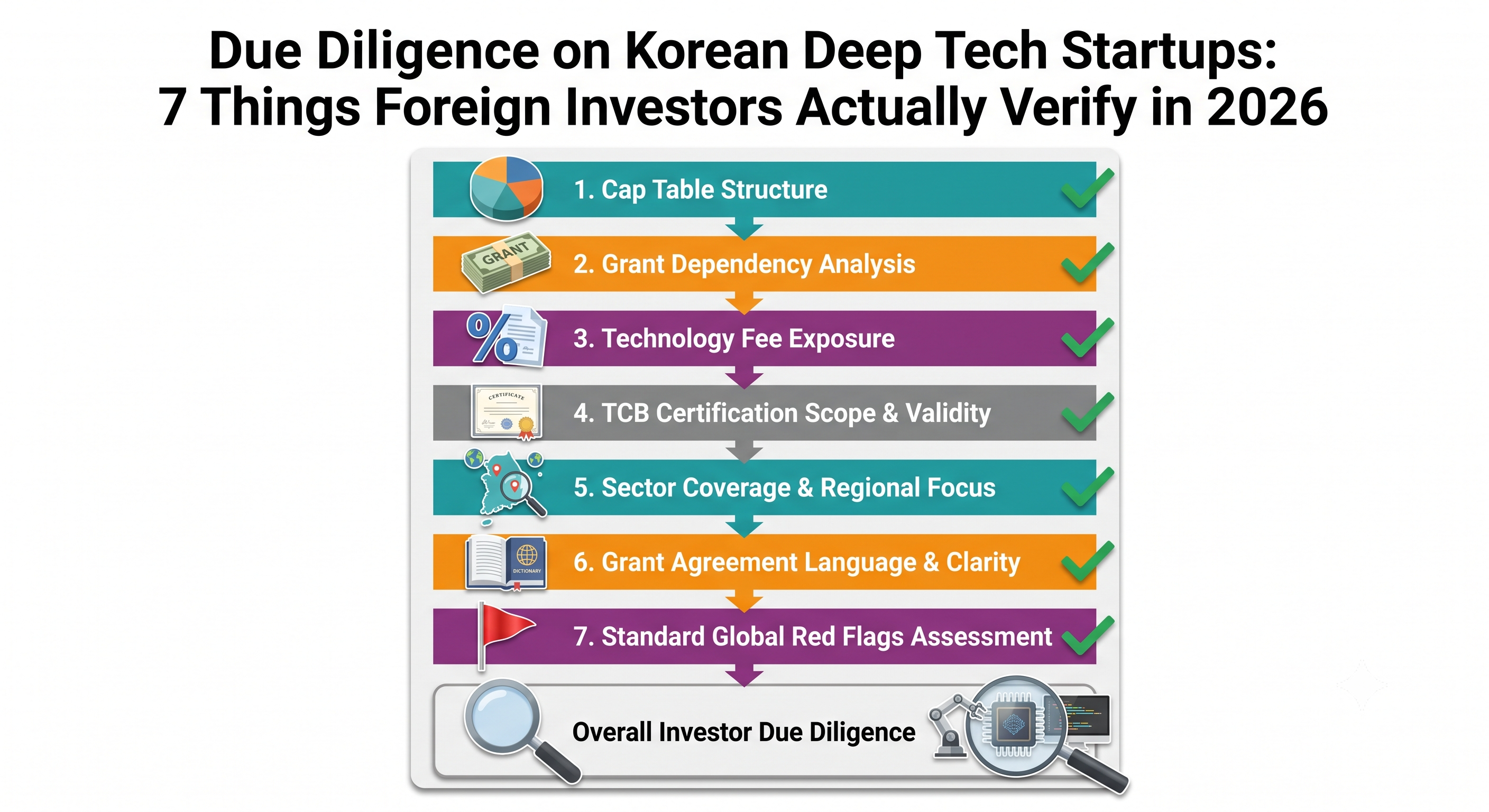
Foreign investors evaluating a Korean deep tech startup check seven things, roughly in this order: cap table and related-party structure, government-grant dependency ratio, technology-fee exposure, what TCB certification actually validates, how deep the real target pool is in the startup's specific frontier sector, whether grant agreements exist only in Korean, and the standard global red flags every VC checks regardless of geography. Four of those seven — grant dependency, technology-fee status, TCB scope, and the Korean-language documentation gap — rarely appear in a due-diligence checklist built for a US or European deal, which is exactly where foreign investors get caught out on a Korean target. The rest of this article walks through each check in the order it typically surfaces, before a term sheet gets signed.
Quick Facts
| Question | Answer |
|---|---|
| How many of the 7 checks below are Korea-specific vs. global-standard? | 4 are Korea-specific (grant dependency, technology fee, TCB scope, language gap); the other 3 are standard global VC diligence items applied to a Korean target |
| Is TCB certification the same thing as investor due diligence? | No — TCB (기술신용평가) certifies technology value for financing purposes; it doesn't substitute for cap-table, IP, or grant-history diligence |
| What triggers the technology-fee red flag investors should ask about? | Whether a startup's grant-funded technology has been successfully commercialized — that's what triggers Korea's tiered technology-fee repayment obligation |
| Where does Korea's sector-coverage gap actually show up? | Frontier sectors like quantum computing have a far thinner real target pool (4 companies, per Reddal) than headline sectors like AI/big data (78 companies) — same taxonomy, very different depth |
Why a Generic VC Checklist Isn't Enough for a Korean Target
Search "VC due diligence checklist" and you'll find solid, well-structured frameworks — cap table sanity, financial statement integrity, customer concentration, IP ownership, legal and regulatory exposure. None of it is wrong, and none of it should be skipped on a Korean deal either. But none of the generic checklists we reviewed for this article (including widely-cited ones from qubit.capital and 4Degrees) address the four things that are specific to how Korean deep tech companies actually get funded and structured: how much of the company's capital came from non-dilutive government grants rather than equity, whether a technology-fee obligation is sitting on the books, what a TCB certification badge on a pitch deck actually proves, and whether the frontier sector a company claims to compete in has a real population of comparable companies behind it — or just a government target-sector label.
This article is deliberately connective tissue rather than a full re-explanation of programs already covered elsewhere in this cluster. For the funding landscape itself, see Korea's deep tech VC ecosystem; for the technology-fee mechanics in full, see who owns the IP from a Korean government R&D grant; for how a founder should prepare to be evaluated on the funding-history slide, see how to structure a Series A pitch deck for deep tech hardware. This piece is the fourth angle in that set — what an investor actually checks, not what a founder presents or what programs exist.
The 7 Things Foreign Investors Actually Verify, In Order
| # | Check | What to Request | Korea-Specific or Global Standard |
|---|---|---|---|
| 1 | Cap table & related-party structure | Full cap table, UBO chain, disclosure of any chaebol-affiliated or related-party investors | Global standard — but Korea's concentrated corporate ecosystem raises the odds of an undisclosed related-party link |
| 2 | Government-grant dependency ratio | Total non-dilutive grant funding received to date vs. total capital raised | Korea-specific |
| 3 | Technology-fee exposure | Confirmation of whether any grant-funded technology has been commercialized, and whether a technology fee is paid, pending, or not yet triggered | Korea-specific |
| 4 | TCB certification scope | The underlying TCB report itself, not just the certification headline | Korea-specific (myth-busting) |
| 5 | Sector-coverage depth | A realistic count of the actual comparable-company population in the startup's specific frontier sector | Korea-specific |
| 6 | Grant-agreement language | English translation or bilingual counsel review of every signed research/grant agreement | Korea-specific |
| 7 | Standard global red flags | Customer concentration >30%, restated financials, cap-table inconsistencies, undisclosed related-party transactions | Global standard |
1. Cap Table and Related-Party Structure
This is the one item on the list that any VC due-diligence checklist, anywhere, would include — but it's worth flagging what's different about running it on a Korean target. Korea's corporate ecosystem is unusually concentrated around a small number of large conglomerate groups (재벌, chaebol) and their affiliated venture arms, corporate VC funds, and supplier networks. A related-party investment isn't inherently a problem — plenty of legitimate strategic capital in Korean deep tech comes from corporate VC arms tied to Samsung, LG, Hyundai, and similar groups. The diligence point is disclosure, not prohibition: request the full cap table with beneficial-ownership chains resolved down to natural persons or transparent institutional entities, and separately confirm whether any customer, supplier, or board member has an undisclosed equity or commercial relationship with the company. An opaque UBO chain running through an unrelated jurisdiction is a red flag in any market; in Korea, the additional question is whether an "independent" investor or customer is actually a related party inside the same corporate group the startup depends on for commercial traction.
2. Government-Grant Dependency Ratio
Korea's public sector funds deep tech at a scale most foreign investors underestimate going in. Korea's 2026 startup support budget is confirmed at KRW 3.4645 trillion — the largest such budget on record, spread across a stated 12 government target sectors including quantum, next-generation nuclear, and defense alongside AI and semiconductors. At exchange rates prevailing around publication (roughly ₩1,410–1,440/$1), that converts to approximately $2.4 billion; a $2.6 billion conversion would require a materially stronger won (~₩1,330/$1) that hasn't applied since mid-2025, so treat $2.4B as the applicable figure. The flagship Super-Gap Startup Project has backed 604 startups since its 2023 launch and produced 3 unicorns, including FuriosaAI, and 14 KOSDAQ-listed companies including Nota — figures confirmed via the Ministry of SMEs and Startups' December 2025 program-expansion announcement covering 2026 selection. Per-company funding under Super-Gap is grant-scale, not venture-scale: up to KRW 1.2 billion (~$830,000) in direct support over up to five years — up to ₩600 million in commercialization funding over three years, plus up to ₩600 million in additional R&D funding over up to two more years, contingent on evaluation.
For a diligence process, the useful number isn't the headline government budget — it's the ratio of non-dilutive grant funding to total capital raised inside the specific target company. A startup that has layered TIPS selection and Super-Gap-scale grants into early prototyping before a Series A is a normal, capital-efficient Korean deep tech funding pattern, not a red flag on its own (as covered in more depth in our VC ecosystem guide). What's worth flagging is a company whose reported "traction" is almost entirely grant milestones with little to no private capital validation behind it — that's a different risk profile than a company using grants to extend runway alongside a credible private round.
Separately, Korean startup investment overall reached KRW 7.8005 trillion across 540 deals in H1 2026, with AI/robotics absorbing roughly KRW 2.685 trillion — about a third of the total. That figure traces to Q2 2026 Korea startup investment data compiled by The VC (더브이씨), a Korean startup-investment database provider, as reported by Seoul Economic Daily. The Startup Korea Fund's 2025 vintage — the first to include overseas investor participation alongside 27 private domestic investors — is sized at roughly $475 million, per Startup Genome's Seoul ecosystem report; this reflects that specific named tranche rather than a single running AUM figure, since Korea has layered additional annual tranches into the program in both 2024 and 2025. Both figures are useful context for sizing how much dry powder is actually chasing Korean deep tech deals, but neither substitutes for company-level diligence.
3. Technology-Fee Exposure
This is the item most likely to be missed entirely by a diligence team unfamiliar with Korea's R&D grant system, and it's fully mapped in our companion spoke on IP ownership from Korean government R&D grants — the summary here is intentionally brief so the two articles' figures stay in sync.
Under Korea's National R&D Innovation Act, a company that successfully commercializes a grant-funded technology owes a technology fee (기술료) back to the funding ministry — a royalty-style obligation, tiered by company size under the Act's Article 18 and current ministry notices (e.g., MOTIE Notice No. 2025-50): roughly 2.5% of the fee collected for small/medium enterprises, 5% for mid-sized companies, and up to 10% for large enterprises. It is not owed if a project fails to reach commercialization in good faith — but under the Act's Article 32, willful non-performance or research misconduct can trigger a separate clawback of disbursed R&D funds and sanctions, distinct from the technology fee itself.
The diligence request here is straightforward: for each government R&D grant a target company has received, ask whether the funded technology has been commercialized, and if so, whether the corresponding technology fee has been paid, is pending, or hasn't yet been formally triggered. An unpaid or unassessed technology-fee liability sitting on a commercialized product line is exactly the kind of contingent obligation that should surface before a term sheet, not after a wire transfer.
4. What TCB Certification Actually Proves — And What It Doesn't
TCB (기술신용평가, Technology Credit Bureau) certification shows up constantly on Korean deep tech pitch decks and cap tables, and it's genuinely useful — but it's frequently misread by foreign investors as a substitute for their own diligence. It isn't. As our pillar article on Korea's TCB and R&D grant system covers, TCB certification is a technology valuation used to support financing decisions — it lets a company's technology value stand in for the financial track record an early-stage hardware or semiconductor startup doesn't have yet. That's a financing signal aimed at banks and domestic lenders, not an investor-grade diligence product built to answer the questions a Series A investor actually needs answered: cap table cleanliness, IP ownership chain, customer concentration, or technology-fee exposure.
The practical diligence move is to request the underlying TCB report itself, not just the certification outcome. A TCB certification confirms that a third party assessed the company's technology as having a certain credit-worthy value at a point in time — it says nothing about who actually owns the resulting IP, whether related-party transactions exist, or whether the company's grant history creates a pending technology-fee liability. Treating a TCB badge as "already done diligence" is the single most common misconception foreign investors bring into a Korean deep tech deal.
5. The Sector-Coverage Gap: Why "Korea's Deep Tech Boom" Numbers Can Mislead
Korea's government names quantum computing, next-generation nuclear energy, defense, and other frontier categories among its 12 target sectors for 2026 startup funding. The headline framing can make it sound like Korea has a deep, broad bench of companies across all of these categories. The actual company population tells a different story. Per Reddal's Korean Deep Tech Study, a single sector taxonomy counted 78 Korean deep tech firms in AI/big data, 14 in system semiconductors, only 4 in quantum technologies, and 0 in next-generation nuclear energy. These are four separate sector headcounts from the same taxonomy — not a ratio or a diligence-coverage fraction of one combined pool — but read together, they show a real ambition-vs-reality gap: government sector targets and actual company depth in frontier categories don't move at the same pace.
For a foreign investor sourcing a deal specifically in quantum computing or nuclear technology, the practical takeaway is to size expectations accordingly: the realistic universe of comparable Korean targets in those categories is a fraction of what the AI/robotics headline numbers suggest, which affects everything from competitive-landscape analysis to how much weight to put on "first mover in Korea" claims in a pitch deck. A company claiming to be a category leader in a sector where the entire national company population is in the single digits deserves a different kind of scrutiny — sometimes that claim is simply true given how thin the field is, and sometimes it's a sign the company is defining its category too narrowly to make the claim work.
6. The Korean-Language-Only Grant Agreement Problem
Research agreements, TCB reports, and government grant documentation in Korea are frequently executed only in Korean, with no official English translation prepared unless a company specifically commissions one. For a foreign investor's legal counsel reviewing IP ownership clauses, technology-fee triggers, or compliance obligations tied to a specific grant, working from a machine translation or a company-provided informal summary is a real diligence gap — the kind of clause language that determines whether ownership defaults to the lead research institution or splits with a university co-applicant (see the IP-ownership spoke for how that split works) is exactly the kind of legal nuance that doesn't survive an informal translation intact.
The practical fix is unglamorous: budget for a certified translation or a bilingual Korean counsel review of every material grant and research agreement before closing, rather than relying on the target company's own summary of its terms. This is also where a virtual data room built for cross-border deals, or an advisory relationship with bilingual legal counsel familiar with Korean grant documentation, earns its keep — not as a hard requirement of this checklist, but as a practical way to close the language gap rather than skip it.
7. The Standard Global Red Flags You Still Shouldn't Skip
Everything covered above is additive to, not a replacement for, the diligence checks that apply to any startup investment regardless of geography: customer concentration above roughly 30% of revenue, restated financials, cap-table inconsistencies between what a company presents and what its actual filings show, and undisclosed related-party transactions beyond the Korea-specific chaebol-affiliation angle covered in check #1. None of this is Korea-specific — it's standard VC diligence practice — but it's worth stating plainly precisely because the Korea-specific items above are genuinely new information for most foreign investors, and it would be a mistake to let the novelty of the Korea-specific checks crowd out the basics.
FAQ
Q: What do foreign investors actually check before investing in a Korean deep tech startup?
A: Seven things, in roughly this order: cap table and related-party structure, government-grant dependency ratio, technology-fee exposure, what TCB certification actually validates, how deep the real target pool is in the startup's frontier sector, whether grant agreements exist only in Korean, and the standard global red flags every VC checks regardless of geography.
Q: Is TCB certification a substitute for investor due diligence in Korea?
A: No. TCB (기술신용평가) certification is a technology valuation used to support financing decisions — a financing signal for banks and lenders — not an investor-grade diligence product. It says nothing about IP ownership, related-party transactions, or technology-fee exposure, which a foreign investor still needs to check separately.
Q: What is the Korea government R&D grant technology fee, and does it affect an investment?
A: The technology fee (기술료) is a royalty-style payment a company owes back to the government, but only if a grant-funded technology is successfully commercialized — tiered roughly 2.5% for small/medium enterprises up to 10% for large enterprises under Korea's National R&D Innovation Act. An unpaid or unassessed technology-fee liability on a commercialized product line is a contingent obligation investors should confirm before closing, not a reason on its own to avoid an otherwise strong deal.
Q: How do I check a Korean startup's cap table as a foreign investor?
A: Request the full cap table with beneficial-ownership chains resolved to natural persons or transparent institutional entities, and separately confirm whether any customer, supplier, or board member has an undisclosed equity or commercial relationship with the company — Korea's concentrated chaebol-affiliated corporate ecosystem raises the odds of an undisclosed related-party link more than in less concentrated markets.
Q: How do I evaluate a Korean startup investment if I'm new to the market?
A: Start with the standard global VC diligence basics — customer concentration, financial statement integrity, IP ownership — then layer in the Korea-specific checks that generic checklists miss: grant dependency ratio, technology-fee exposure, what a TCB certification badge actually proves, and whether the company's claimed frontier-sector position reflects a genuinely deep target pool or a thin one.
Sources
- Reddal, "Korean Deep Tech Study" (primary report PDF) — primary source for the sector-count statistic (78 AI/big data, 14 system semiconductors, 4 quantum, 0 next-gen nuclear)
- Reddal, "Innovative Korea: Deep Tech Ecosystem Growth..." (insights page)
- Seoulz, "Korea Deep Tech 2026: Inside the $2.4B Startup Bet" (2026-07-13) — 2026 startup budget, Super-Gap program figures, H1 2026 investment totals; corroborates the $475M Startup Korea Fund total (does not itself specify the 27-private-investor or first-overseas-participation detail)
- Seoulz, "Korea Startup Ecosystem 2026: The Foreign Founder's Survival Guide" — Korean-language grant-documentation gap
- Startup Genome, Seoul Ecosystem Report — primary source for the Startup Korea Fund 2025 vintage detail: $475M total, 27 private domestic investors, first-ever overseas investor participation
- KoreaTechDesk, "Super-Gap Startups 2026: Korea Expands Deep-Tech Frontier Across 12 Future Industries" — corroborates Super-Gap cohort (604), unicorn (3, incl. FuriosaAI), KOSDAQ-listed (14), and per-company funding (up to ₩1.2B) figures, citing the Ministry of SMEs and Startups' December 2025 program-expansion announcement
- Seoul Economic Daily, "Korea Startup Funding Skews to Mega Deals and AI" (2026-07-03) — primary trace for H1 2026 investment totals (₩7.8005T, 540 deals, ₩2.685T AI/robotics), citing Q2 2026 data from The VC (더브이씨)
- 국가연구개발혁신법 원문 — 국가법령정보센터 — primary statute for the technology fee mechanism (reused from our IP-ownership spoke; not re-derived here)
- qubit.capital, "VC Due Diligence Checklist" — generic VC diligence scaffolding referenced for comparison
- 4Degrees, "2026 Venture Capital Due Diligence Checklist" — generic VC diligence scaffolding referenced for comparison
- Who Owns the IP From a Korean Government R&D Grant? Ownership Rules and the Technology Fee Explained — our own spoke, full technology-fee mechanics
- How South Korea Funds Deep Tech Startups: TCB Certification & Government R&D Grants Explained — our own pillar article, TCB certification scope
Author Bio
The Whitepaper Skeptic has sat on both sides of Korean deep tech due diligence — preparing TCB certification materials and government R&D grant documentation for companies under investor review, and separately assessing a target company's grant-dependency ratio, cap table structure, and technology-fee exposure as part of Series A and IPO readiness work. This checklist is built from that dual vantage point: knowing what a company prepares to show investors, and what a diligence process actually needs to ask for.
Related Posts
- How South Korea Funds Deep Tech Startups: TCB Certification & Government R&D Grants Explained
- Korea's Deep Tech VC Ecosystem: Who's Funding Semiconductors, Robotics, and Advanced Materials Startups in 2026
- Who Owns the IP From a Korean Government R&D Grant? Ownership Rules and the Technology Fee Explained
- How to Structure a Series A Pitch Deck for Deep Tech Hardware Startups


Comments
Post a Comment