RCPS vs SAFE: How Korean Startup Equity Financing Actually Works in 2026
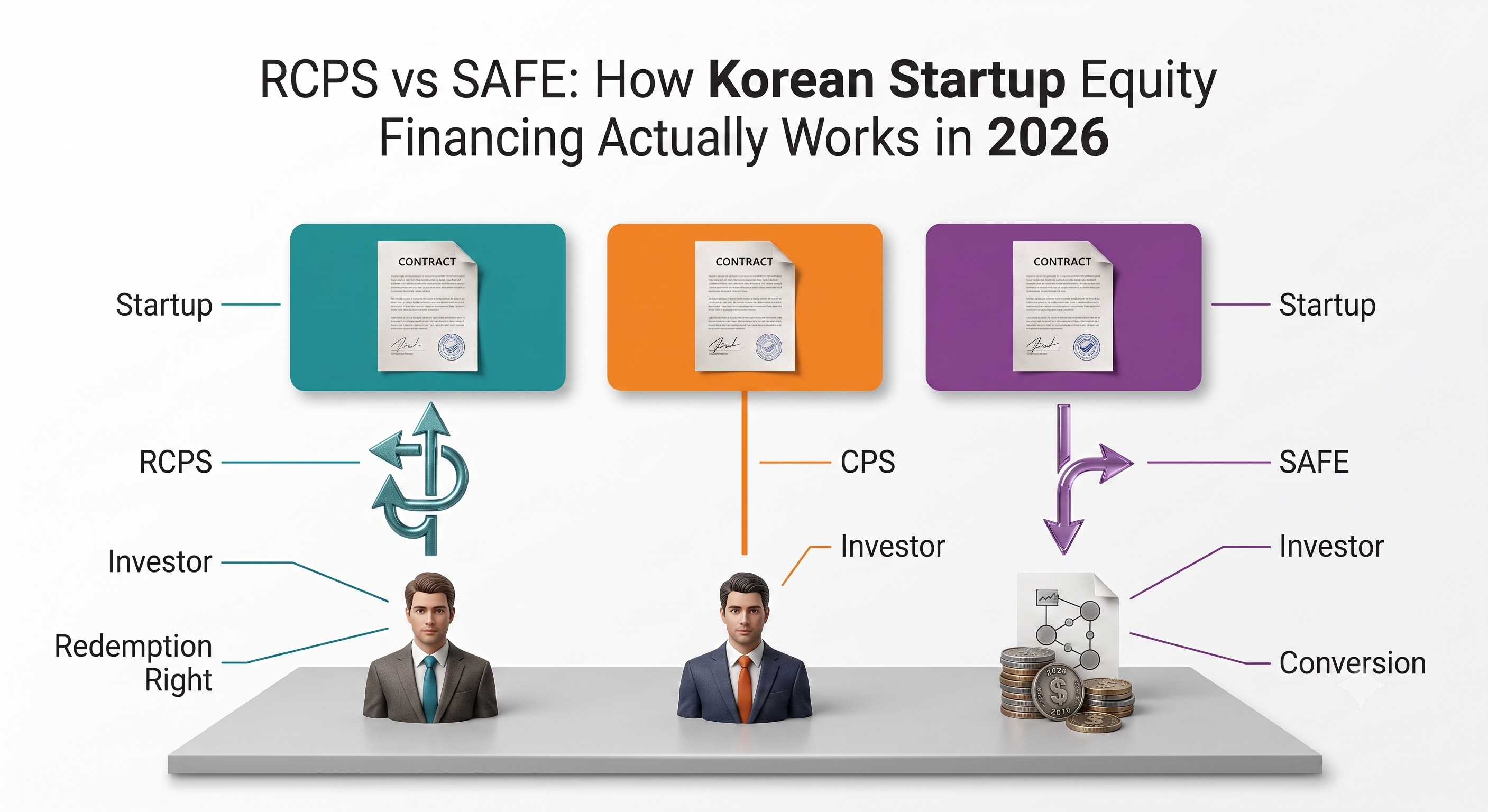
Korea's default startup equity instrument is RCPS (redeemable convertible preferred stock, 상환전환우선주), not the SAFE (Simple Agreement for Future Equity) that most US and international investors expect. The "R" in RCPS gives the investor a redemption right — the ability to demand the company buy back its shares, usually with interest, if an IPO or acquisition doesn't happen within an agreed window. A SAFE-equivalent instrument has been legal in Korea since 2020, and a June 2026 government reform pushed the market toward a redemption-free alternative called CPS — but RCPS still dominates early-stage priced deals, and understanding why matters before you sign a Korean term sheet.
Quick Facts
| Question | Answer |
|---|---|
| Is RCPS or SAFE Korea's default instrument? | RCPS (redeemable convertible preferred stock) — Korea's standard early-stage instrument for roughly 25 years, tracing to ~2001 after the 1999–2000 venture bubble collapse |
| Is a SAFE legally usable in Korea? | Yes — a SAFE-equivalent ("조건부지분인수계약," conditional equity purchase agreement) has been legal since the 2020 Venture Investment Act (혁신벤처투자촉진법), but adoption remains far behind RCPS |
| What changed on June 30, 2026? | Ministry of SMEs and Startups + Korea Venture Investment Corp. revised standard contract: 32 contract variants condensed to 5, CPS (no redemption right) recommended over RCPS, weighted-average anti-dilution replaces lowest-price refixing, IPO obligation downgraded from "result obligation" to "best-effort obligation" |
| Core structural difference | RCPS gives the investor a redemption right (can force a share buyback); a standard US-style SAFE has no redemption right and simply converts at the next priced round |
What Is RCPS, and Why Does It Show Up in Every Korean Term Sheet?
RCPS bundles two investor protections into one preferred share: a conversion right (the standard convertible-preferred feature familiar from US financing) and a redemption right, which lets the investor require the company to repurchase the shares — typically at cost plus a fixed interest rate — if a triggering event (most often, no IPO within a set number of years) doesn't happen.
That redemption right is the mechanical difference that matters most for a cap table. A conversion-only instrument (a standard SAFE, or CPS without redemption) behaves like equity all the way through: dilution happens, ownership percentages shift, and that's the end of the investor's leverage. RCPS instead creates a contingent liability that sits alongside equity — if the company hasn't exited or hit its milestones by the redemption date, the investor can demand cash back, out of a balance sheet that may not have the cash to give. For a hardware or deep-tech startup burning capital on long R&D cycles, that redemption clock can force a founder into an unplanned bridge round, a distressed sale, or renegotiation, years before a normal equity investor would have any comparable claim.
RCPS became Korea's default not by accident. The instrument dates to roughly 2001, in the aftermath of the 1999–2000 dot-com/venture bubble collapse, when Korean VCs — many of them structured as funds with government (모태펀드-adjacent) capital and strict audit obligations — needed a way to protect committed capital in a market with far fewer successful exits than the US. Twenty-five years later, RCPS is still the reflexive term-sheet default for most Korean VCs, even though the market conditions that originally justified it have changed considerably.
Does Korea Use SAFE Notes? What "조건부지분인수계약" Actually Is
Foreign VCs and foreign-founder readers researching Korean deal terms often assume a SAFE — no interest, no maturity date, converts automatically at the next priced round — is available the same way it is in the US or most of Europe. It technically is: Korea's 2020 Venture Investment Act (혁신벤처투자촉진법) formally legalized a SAFE-equivalent instrument called 조건부지분인수계약 (conditional equity purchase agreement). Like a US SAFE, it carries no interest and no maturity date, and it requires written notice and all-shareholder consent for any change that affects capital structure.
In practice, adoption has stayed low relative to RCPS. Two structural frictions get cited repeatedly by Korean legal and VC-industry sources: first, RCPS is what most institutional Korean LPs and fund auditors are comfortable underwriting, so switching instruments means renegotiating internal comfort, not just a term sheet; second — and this is the more technical point — a pure US-style SAFE's "automatic conversion" clause faces real enforceability friction under Korean corporate law. Korea's Venture Investment Act defines the SAFE-equivalent instrument as an investment type but does not separately regulate new-share-issuance procedures, so when the triggering event occurs, the company must still independently complete the Commercial Act's formal share-issuance steps (board resolution, shareholder or third-party share allocation) rather than converting purely by contract — and Korean legal commentary warns that skipping those steps can render the resulting share issuance itself invalid. Korea Capital Market Institute's 2018 legal-issues report on introducing a Korean-style SAFE flagged this same structural gap ahead of the 2020 law, noting that Commercial Act procedures for comparable instruments (stock options, convertible bonds) "strictly require special shareholder resolutions and related charter provisions" — a requirement that sits in tension with a purely contract-based automatic conversion.
RCPS vs SAFE (and CPS): Side-by-Side
| Feature | RCPS (Korea default) | CPS (June 2026 recommended alternative) | US-style SAFE |
|---|---|---|---|
| Redemption right (forced buyback) | Yes | No | No |
| Conversion mechanism | Requires board resolution / formal share-issuance procedure | Same corporate-law formalities as RCPS, minus redemption | Contract-based automatic conversion (still requires a separate Commercial Act share-issuance step in Korea — board resolution, share allocation — creating friction with a purely automatic conversion) |
| Interest / maturity date | Often carries interest tied to the redemption trigger | No interest, no maturity | No interest, no maturity |
| Anti-dilution (post-June 2026 standard contract) | Weighted-average (replacing lowest-price refixing) | Weighted-average | Not applicable — SAFEs don't carry a priced anti-dilution mechanism until conversion |
| Legal basis in Korea | Long-standing market practice, ~25 years | Same 2026 standard contract framework as RCPS | 2020 Venture Investment Act (혁신벤처투자촉진법), as 조건부지분인수계약 |
| Current market share of early-stage Korean deals | Estimated 70–80% of priced early-stage deals, per industry commentary (not an official government statistic) | Recommended by regulators since June 2026, but adoption still early | Legal since 2020, adoption low relative to RCPS |
Why Korean VCs Still Default to RCPS Despite the June 2026 Reform
The June 30, 2026 revision from the Ministry of SMEs and Startups and Korea Venture Investment Corp. — the first update to the standard venture-investment contract since 2023 — consolidated 32 separate contract variants into 5, explicitly recommends CPS (conversion rights without the redemption right) over RCPS to bring Korean terms closer to global norms, replaces "lowest-price" refixing with a weighted-average anti-dilution method that's less punitive to founders in a down round, and downgrades the IPO obligation from a binding "result obligation" to a softer "best-effort obligation."
None of that makes RCPS disappear overnight. Industry sources estimate the full transition from RCPS to CPS will take "at least two to three years" — this is an estimate/opinion from industry commentary, not a fixed regulatory timeline, and should be read as directional rather than a hard deadline. The reasons cited for the lag track closely with why RCPS took hold in the first place: LP-side conservatism (institutional limited partners built their return models around redemption rights as a downside protection, and don't change that overnight just because a standard contract template changed), and audit-liability comfort (Korean VC fund managers and their auditors are more familiar defending an RCPS structure than a newer CPS one, and switching creates internal compliance work that isn't required just because the government recommends it).
For comparison, Cooley LLP's own quarterly Venture Financing Reports put US redemption-rights clauses at a low single-digit-to-mid-single-digit share of deals — 1.8% of deals in Q4 2025, rising to 6.1% in Q1 2026, after fluctuating in roughly the 2.7%–6.4% range through 2025. That gap is the clearest evidence of how structurally different a "standard" Korean term sheet still is from a "standard" US one, reform or no reform.
What This Means for Foreign Investors and Founders
If you're a foreign investor running due diligence on a Korean deep tech startup, RCPS/CPS terms are exactly the kind of fine print a standard checklist should flag — redemption triggers, interest terms, and the specific anti-dilution mechanism in force are all easy to miss if you're reading the term sheet through a US-market lens. The same cap table structure a startup locks in at seed or Series A carries forward directly into how you'd structure a Series A pitch deck — investors will ask about outstanding redemption obligations the same way they ask about any other contingent liability.
It also connects to two other pieces of "read the fine print before you sign" territory in Korean deep-tech financing: who owns the IP from a Korean government R&D grant, and how a startup's cap table structure at Series A carries forward into KOSDAQ technology special listing readiness later. Neither RCPS nor CPS is inherently "wrong" for a founder to accept — but a founder who doesn't understand the redemption clock is negotiating from a weaker position than one who does.
FAQ
Q: Does Korea use SAFE notes for startup funding?
A: Yes, technically — a SAFE-equivalent instrument (조건부지분인수계약, conditional equity purchase agreement) has been legal in Korea since the 2020 Venture Investment Act. But it's used far less often than RCPS, which remains the market default for most early-stage priced deals.
Q: What is RCPS (redeemable convertible preferred stock) in Korea?
A: RCPS is Korea's standard early-stage venture financing instrument. It combines a conversion right (like a normal convertible preferred share) with a redemption right, which lets the investor demand the company buy back its shares — usually with interest — if the company hasn't gone public or been acquired within an agreed timeframe.
Q: Why do Korean VCs require redemption rights?
A: Redemption rights emerged after the 1999–2000 venture bubble collapse as a downside protection for investors in a market with fewer reliable exits than the US. Institutional LPs and fund auditors have built their comfort around this protection for roughly 25 years, which is a major reason it persists even after regulators started recommending redemption-free CPS in 2026.
Q: What did Korea's June 2026 venture investment contract reform actually change?
A: The Ministry of SMEs and Startups and Korea Venture Investment Corp. consolidated 32 contract variants into 5, recommended CPS (no redemption right) over RCPS, replaced "lowest-price" refixing with weighted-average anti-dilution, and downgraded the IPO obligation from a binding "result obligation" to a "best-effort obligation." It's a recommendation and new standard template, not a ban on RCPS.
Q: Is CPS the same thing as a US-style SAFE?
A: No. CPS is a preferred-stock instrument without a redemption right, but it's still priced at the time of investment and follows Korea's formal share-issuance procedures. A SAFE is a pre-money contractual right to future shares with no interest or maturity date that converts automatically at a later priced round — closer in spirit to Korea's separate 조건부지분인수계약 instrument than to CPS.
Sources
- MoneyToday — "A 25-Year-Old RCPS Investment Practice… Can the 'R' Be Removed?" (2026-07-29)
- MoneyToday — "From joint guarantees to RCPS... The bare face of K-risk capital" (2026-07-29)
- Seoul Economic Daily (English) — "Korea Revises Venture Investment Standard Contract to Ease Founder Burdens" (2026-06-30)
- KoreaTechDesk — "RCPS Investment Practices in Korea Put Startups at Risk, Driving Momentum for Change"
- KBLN (Korea Business Law Network) — introduction to US-style SAFE for Korean readers
- National Law Information Center (law.go.kr) — 벤처투자 촉진에 관한 법률 (Venture Investment Promotion Act), official statute text
- Cooley LLP — Q1 2026 Venture Financing Report (redemption provisions: 1.8% of deals in Q4 2025, rising to 6.1% in Q1 2026)
- Lawtalk — Korean attorney-authored explainer on 조건부지분인수계약 (SAFE) share-issuance procedure under the Commercial Act
- Korea Capital Market Institute (자본시장연구원) — "한국형 SAFE 도입의 경제적 의의와 법적 쟁점," Issue Report 18-10 (2018)
Author Bio
The Whitepaper Skeptic has direct experience preparing TCB certification materials and government R&D grant applications as part of Series A investment and IPO roadmap work — including reviewing how RCPS redemption clauses and anti-dilution terms actually get structured into a Korean startup's cap table before a priced round.
Related Posts
- How South Korea Funds Deep Tech Startups: TCB Certification & Government R&D Grants Explained
- Due Diligence on Korean Deep Tech Startups: 7 Things Foreign Investors Actually Verify in 2026
- How to Structure a Series A Pitch Deck for Deep Tech Hardware Startups
- Who Owns the IP From a Korean Government R&D Grant? Ownership Rules and the 기술료 Technology Fee Explained
- Korea's Deep Tech VC Ecosystem: Who's Funding Semiconductors, Robotics, and Advanced Materials Startups in 2026
- KOSDAQ Technology Special Listing Explained: How Deep Tech Startups Exit Without Profit in 2026


Comments
Post a Comment