Gen 8.6 OLED Explained: Why Samsung, BOE, and LG Are Racing to Build IT Panel Capacity in 2026
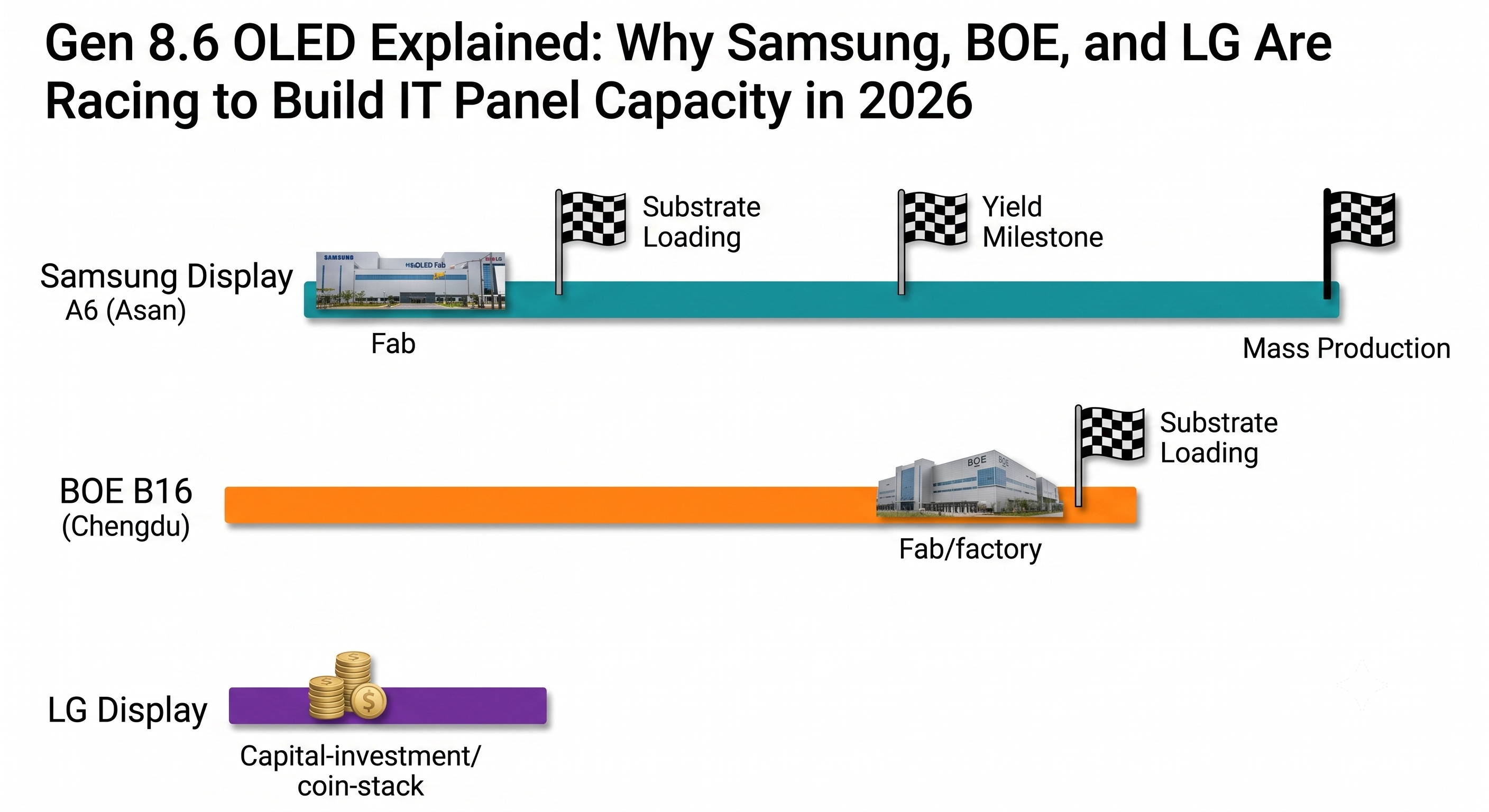
Gen 8.6 OLED refers to a new generation of larger glass-substrate OLED fabs built specifically for IT panels — laptops and tablets — rather than smartphones, and 2026 is the first year any of them reached real production. Samsung Display's A6 line in Asan and BOE's B16 line in Chengdu both began loading substrates in May 2026, racing to reach the yield levels needed to supply this new panel category at scale; LG Display, notably, has not announced a competing line. The race matters commercially because whoever gets there first with usable yield locks in supply contracts — Samsung reportedly reached full mass production on an exclusive Apple MacBook Pro contract on July 2, 2026 — and the capital being committed industry-wide (Counterpoint Research puts 2026 OLED equipment spending up 74% year-over-year, which is driving total display-equipment capex — OLED and LCD combined — up 57% for the year) is itself a signal of how much is riding on this generation shift.
By The Whitepaper Skeptic — display manufacturing project with a global materials supplier, plus packaging yield-economics analysis
Quick Facts
| Question | Answer |
|---|---|
| What is Gen 8.6 OLED? | A larger OLED glass-substrate generation size purpose-built for IT panels (laptops/tablets) rather than phones — bigger substrates cut more panels per sheet |
| Who's building it in 2026? | Samsung Display (A6 line, Asan) and BOE (B16 line, Chengdu) both began substrate-loading in May 2026; LG Display has not disclosed a competing line |
| Samsung's reported yield ramp | OLED-Info's reporting of industry sources (not a Samsung disclosure) describes ~70% (March 2026) → ~80% (April 2026) → ~90% "golden yield" (late May 2026) |
| Is it "Gen 8.6" or "Gen 8.7"? | TrendForce, TechTimes, and OLED-Info call the Samsung A6 and BOE B16 lines "Gen 8.6"; Counterpoint Research's capex report calls the identical two lines "Gen.8.7," citing the same ~2,290mm x 2,620mm substrate — confirmed to be the same physical lines, just different generation-numbering conventions between outlets |
| Why capex is surging | Counterpoint Research reports 2026 OLED equipment spending up 74% year-over-year, which is driving total display-equipment capex (OLED + LCD) up 57% for the year |
What Is Gen 8.6 OLED, and Why Build a Whole New Generation for Laptops?
OLED fabs are categorized by "generation," a label that refers to the size of the mother glass substrate that gets diced into individual panels. Larger substrates from a newer generation fit more panels per sheet, which is the core economic lever a fab uses to bring down per-panel cost as it moves into a larger screen-size category. Samsung's and BOE's existing smartphone OLED fabs mostly run on Gen 6 substrates, sized efficiently for phone-sized panels. Gen 8.6 substrates are considerably larger — built for a size range Gen 6 handles inefficiently: laptop and tablet panels, which are much bigger than a phone screen but still need OLED's per-pixel contrast, thinness, and power-efficiency advantages over LCD.
TechTimes' coverage of BOE's B16 line reports a Gen 8.6 substrate yields roughly 1,000 panels for a 14-inch laptop panel, against roughly 450 panels from a Gen 6 substrate for the same 14-inch panel size — a same-source, same-panel-size comparison, not a mismatch of panel sizes on each side. That gain traces directly to substrate area: Gen 8.6 substrates measure roughly 2,290mm x 2,620mm, more than double the roughly 1,500mm x 1,850mm area of a Gen 6 substrate. The 1,000-vs-450 figure should still be read as representative of this specific 14-inch cut plan rather than a fixed multiplier every fab or panel size will realize identically.
Is It "Gen 8.6" or "Gen 8.7"? The Naming Isn't Consistent
Not every outlet covering this shift uses the same name for it. TrendForce, TechTimes, and OLED-Info all describe the Samsung A6 and BOE B16 lines as "Gen 8.6." Counterpoint Research's capex analysis names the identical two lines at the identical two companies "Gen.8.7," and specifies the substrate size as 2,250mm x 2,620mm — within rounding distance of the ~2,290mm x 2,620mm figure other trade press attaches to "Gen 8.6." This confirms the discrepancy is a generation-numbering convention difference between outlets describing the same substrate class, not evidence of two distinct specifications. This article uses "Gen 8.6" throughout as the primary term because it is the more common label in trade coverage of these specific lines, and treats "Gen 8.7" as a synonym used specifically by Counterpoint Research.
Samsung Display's A6 Line: A Yield Ramp That Reads Like a Semiconductor Story
Samsung Display's A6 line in Asan began loading substrates in May 2026. According to OLED-Info's reporting of industry sources — not an official Samsung Display statement — the line's yield reportedly climbed from roughly 70% in March 2026 to about 80% in April 2026, crossing the industry's informal "golden yield" threshold of around 90% by late May 2026. These figures are trade-press-sourced, not a Samsung Display disclosure, and should be read with that caveat. Samsung reportedly reached full mass production on July 2, 2026, tied to an exclusive supply contract for Apple's 14-inch and 16-inch MacBook Pro OLED panels (TechTimes, MacRumors).
If that roughly two-month climb from unusable to commercially viable yield sounds familiar, it should — it's conceptually the same known-good-die logic covered in our HBM burn-in and known-good-die testing explainer: screen output against a hard threshold before committing further cost downstream, because a defect (or a low-yield batch) caught late is far more expensive than one caught early. The mechanics are different — display substrate yield ramps versus individual memory die screening — but the underlying economics are the same story told in a different material: the yield percentage on any given day determines whether the fab is losing money or making it on every unit that comes off the line.
Separately, OLED-Info has also published reporting headlined "Is Samsung Display slowing down its 8.6-Gen IT AMOLED line ramp up?" citing technical challenges combined with softer-than-expected demand, even as other OLED-Info reporting in the same window describes the line as on or ahead of schedule for mass production. Both threads of reporting exist in trade press as of this writing. This article does not attempt to resolve which framing is more accurate and flags both rather than presenting only the more dramatic one.
Samsung's broader OLED investment commitment — reported at KRW 67 trillion (about $46.5 billion) — is a long-horizon plan for Samsung Display's Asan and Cheonan campuses (specifically the Display City Campus 2 expansion, including the previously stalled A7 line), running through 2040 and covering laptop, tablet, foldable-smartphone, and XR microdisplay production broadly, not a capex figure specific to the A6 line alone. It should not be read as "what the A6 line cost to build" — A6 sits within this same Asan campus buildout, but the KRW 67 trillion figure is not an A6-specific number, and this article does not present it that way.
BOE's Chengdu B16 Line: First to Substrate-Loading, Not Yet First to Scale
BOE beat Samsung Display to the substrate-loading milestone at its B16 line in Chengdu, also in May 2026 (TechTimes, TrendForce). BOE has stated a target of 32,000 substrates per month at full buildout — but that figure describes the line's planned capacity once fully built out by 2029, not what B16 is actually producing in 2026. Being first to substrate-loading is a meaningful execution-speed signal, but it is a different claim from being first to commercial-scale output, and this article does not conflate the two.
LG Display's Different Bet: No Competing Line, a Smaller Investment
LG Display has not disclosed a competing Gen 8.6 (or "Gen 8.7") IT-panel line as of this writing. Instead, the company approved a considerably smaller OLED technology investment — KRW 1.1 trillion — running through June 2028 (DigiTimes, TrendForce). That is a meaningfully different capital bet than Samsung's or BOE's generation-size expansion, and DigiTimes has itself framed the open question this raises directly: whether LG Display can keep its share of the IT OLED market as its two largest rivals build purpose-built capacity for the category while LG spends at a fraction of the scale.
Samsung vs. BOE vs. LG: The 2026 Capacity Race at a Glance
| Category | Samsung Display | BOE | LG Display |
|---|---|---|---|
| Line | A6 (Asan, South Korea) | B16 (Chengdu, China) | No disclosed competing line |
| First substrate-loading | May 2026 | May 2026 (reportedly ahead of Samsung) | N/A |
| Reported 2026 yield | ~70% (Mar) → ~80% (Apr) → ~90% "golden yield" (late May) (OLED-Info, trade-press sourced, not Samsung-confirmed) | Not disclosed in available reporting | N/A |
| Capacity target | Not publicly disclosed at A6-line-specific granularity | 32,000 substrates/month at full buildout — a 2029 target, not current 2026 output | N/A |
| Anchor customer / milestone | Apple MacBook Pro (14"/16") exclusive supply; full mass production reported July 2, 2026 | Not disclosed | N/A |
| Capital commitment | KRW 67 trillion ($46.5B), Asan/Cheonan campus (Display City Campus 2) through 2040 — not A6-line-specific | Not disclosed at B16-line-specific granularity | KRW 1.1 trillion OLED technology investment through June 2028 |
On a display manufacturing project run with a global materials supplier, the number that actually moved budget was never the headline capacity figure — it was whether anyone could put a dated yield curve next to it. That is what this table quietly exposes: Samsung's ~70% (Mar) → ~80% (Apr) → ~90% (late May) trajectory is the only column with a yield history at all, while BOE's 32,000 substrates/month is a 2029 buildout target with no disclosed yield behind it. Those two numbers are not comparable as an investment signal, and reading them side by side as though they were is the mistake this race invites.
Why This Race Matters Beyond Display Engineers
This "who's winning the capacity race" framing is the display-cluster counterpart to our advanced packaging market share comparison of TSMC, Samsung, and Intel in the HBM/chiplet cluster — same underlying question (who controls the capacity downstream buyers actually depend on), applied here to displays instead of chip packaging. For supply-chain and procurement readers, the practical takeaway is sourcing risk: if you're specifying OLED panels for a laptop or tablet product shipping in 2027 or later, where that supply comes from — Korea or China — may end up depending less on today's quoted price and more on which company's 2026 yield curve actually held up. For investors, the capex surge itself (Counterpoint Research: OLED equipment spending up 74% year-over-year in 2026, lifting total display-equipment capex 57% for the year) is the leading indicator worth tracking, since it represents an industry-wide bet that this generation size becomes the new standard for IT-panel OLED for the rest of the decade.
Readers focused on the manufacturing and inspection side of this story may also want our pillar guide to OLED and LCD display manufacturing, which covers the fabrication and inspection process this capacity race is being built on top of, and our machine vision defect inspection explainer, which covers how fabs actually catch the defects that a yield percentage like "90%" is measuring in the first place.
FAQ
Q: What is Gen 8.6 OLED?
A: Gen 8.6 OLED is a new, larger glass-substrate OLED fab generation built specifically for IT panels — laptop and tablet screens — rather than the smaller substrates most smartphone OLED lines use. Larger substrates cut more panels per sheet, lowering per-panel manufacturing cost for this bigger screen category. Samsung Display and BOE both began building Gen 8.6 lines that started production in 2026.
Q: Is it called Gen 8.6 or Gen 8.7 OLED?
A: Both terms appear in industry coverage of the same 2026 capacity buildout, and they refer to the same physical lines. TrendForce, TechTimes, and OLED-Info describe Samsung's and BOE's new lines as "Gen 8.6," while Counterpoint Research's capex analysis calls the identical Samsung A6 and BOE B16 lines "Gen.8.7," citing a matching substrate size (~2,250-2,290mm x 2,620mm) to what other outlets attach to "Gen 8.6." The two labels are a generation-numbering convention difference between sources, not evidence of two different production lines or specs.
Q: Is Samsung's Gen 8.6 OLED line in mass production yet?
A: Samsung Display's A6 line reportedly reached full mass production on July 2, 2026, tied to an exclusive supply agreement to produce OLED panels for Apple's 14-inch and 16-inch MacBook Pro. Trade press (OLED-Info, citing industry sources) reports the line's yield climbed from roughly 70% in March 2026 to about 90% by late May 2026 — though these yield figures are trade-press-sourced, not an official Samsung Display disclosure, and some reporting has also flagged conflicting signals about ramp delays.
Q: Who's ahead in the Gen 8.6 OLED race, Samsung or BOE?
A: It depends on the metric. BOE reportedly began loading substrates at its Chengdu B16 line before Samsung's A6 line in May 2026, making BOE first to that specific milestone. But BOE's headline capacity figure — 32,000 substrates per month — is a target for full buildout by 2029, not current 2026 output, while Samsung has reported reaching a specific yield milestone (~90% "golden yield") and an anchor customer contract (Apple) already in 2026. Neither company has disclosed enough comparable, verified detail to declare a clear overall leader.
Q: Will my next laptop have a Gen 8.6 OLED screen?
A: Possibly, if it's a premium laptop shipping in 2026 or later — Apple's MacBook Pro (14-inch and 16-inch) is the first confirmed anchor customer for Samsung's Gen 8.6 line. Broader adoption across other laptop brands depends on how quickly Samsung, BOE, and any other entrants can sustain high yield at scale; LG Display, notably, has not committed to a competing Gen 8.6 line as of this writing.
Sources
- BOE Begins Gen 8.6 OLED Production This Month, Beating Rival Samsung Display to Market — TechTimes
- World's First Gen-8.6 OLED Production Line Enters Mass Production and Begins Shipments — TrendForce
- Samsung reaches commercial-level 90% yields at its A6 8.6-Gen line — OLED-Info
- As Samsung, BOE expand 8.6G OLED capacity, can LGD keep its edge in the IT OLED market? — DigiTimes
- Gen.8.7 OLED Push Lifts Display Equipment CAPEX 57% as BOE and Samsung Display Begin Production — Counterpoint Research
- MacBook Pro OLED Display Production Clears Major Manufacturing Hurdle — MacRumors
- Samsung Display achieved over 70% yield at its 8.6-Gen A6 fab, is on track for mass production by end of May — OLED-Info, March 2026
- Samsung Display reportedly achieve 80% yields at its A6 8.6-Gen production line, on track for mass production in June — OLED-Info, April 9, 2026
- Samsung reaches commercial-level 90% yields at its A6 8.6-Gen line, on track to begin full scale production in June 2026 — OLED-Info, May 22, 2026
- Is Samsung Display slowing down its 8.6-Gen IT AMOLED line ramp up? — OLED-Info
- Samsung Display Revives Asan OLED Expansion Plan with KRW 67 Trillion — TrendForce
Author Bio
The Whitepaper Skeptic has direct project experience working with a global materials supplier on a display-related manufacturing project, and separately has tracked semiconductor packaging yield economics — including known-good-die test and screening trends — as part of ongoing AI hardware analysis. Both lenses inform this article's read on why a yield curve, not a headline capacity number, is the number actually worth watching in this race.
Related Posts
- How Are OLED and LCD Displays Manufactured? A Guide to Panel Fabrication and Inspection — pillar guide (mandatory pillar link for this spoke)
- Machine Vision for Display Defect Inspection: How AOI and Deep Learning Catch Sub-Pixel Defects — cluster-mate on how the defects behind a yield percentage actually get caught in production
- OLED Thin-Film Encapsulation Explained: How Barrier Films Keep Flexible Displays From Dying in Days — cluster-mate covering a different OLED manufacturing-yield lever (barrier-film defects) for comparison
- Who's Winning Advanced Packaging? TSMC, Samsung, and Intel's CoWoS-Class Capacity Compared — cross-cluster structural counterpart in hbm-chiplet: the same "who controls the capacity" framing applied to chip packaging instead of displays
- HBM Burn-In and Known-Good-Die Testing Explained: Why Memory Testing Moved Left — cross-cluster: the same yield-ramp/known-good-unit screening economics described here for OLED substrates, applied to HBM die testing
Tags
Gen 8.6 OLED, OLED IT panel, Samsung Display A6, BOE Gen 8.6, display fab capacity


Comments
Post a Comment