ANSI/ITSDF B56.5 Explained: The AMR Safety Standard Every Warehouse Buyer Should Know
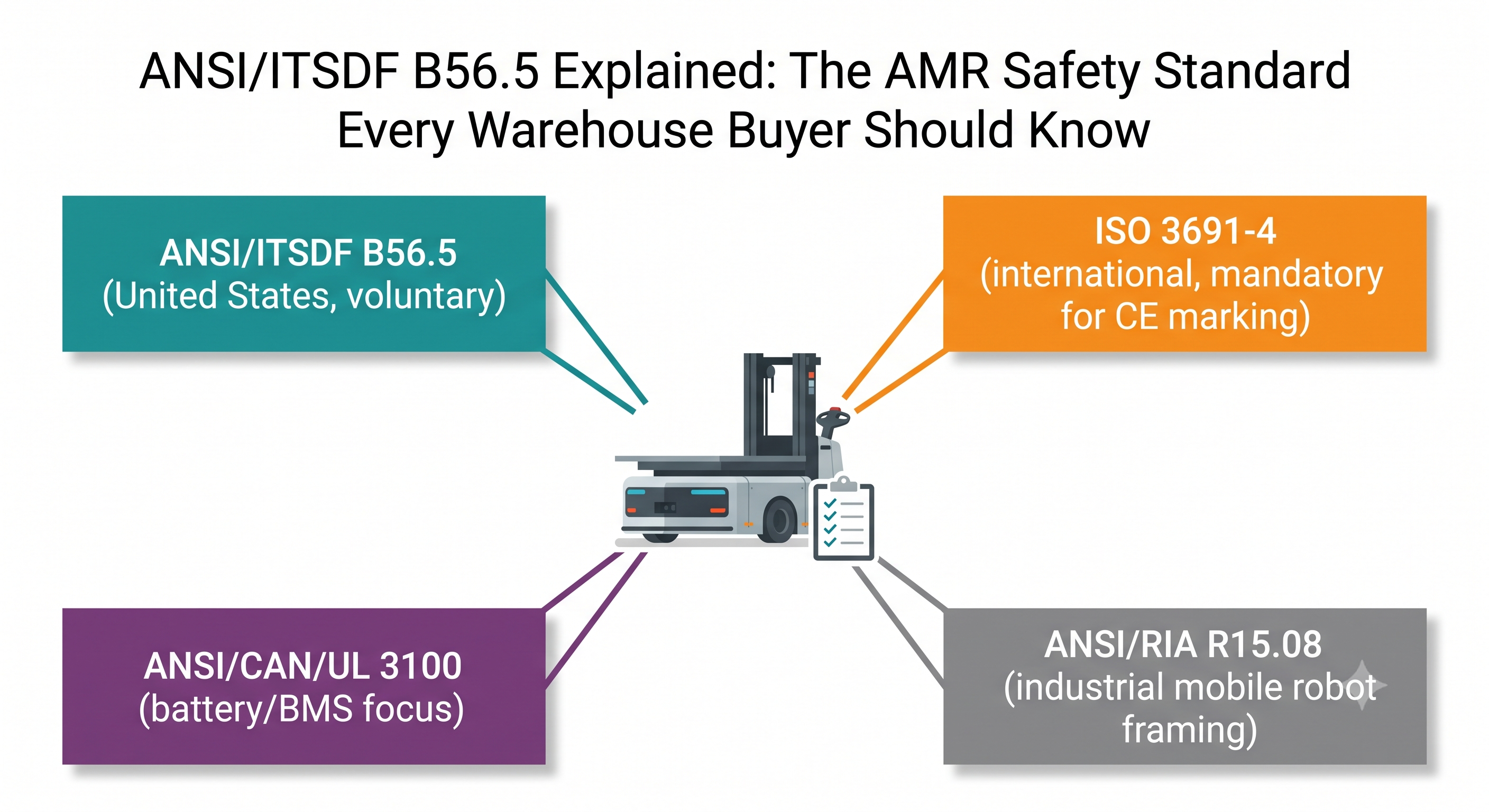
ANSI/ITSDF B56.5-2024 is the U.S. safety standard for driverless, automatically guided industrial vehicles and the automated functions added to manned industrial vehicles — the standard that covers most warehouse AMRs and AGVs. It's a voluntary consensus standard, not an OSHA regulation, but OSHA and courts routinely treat it as the reference point for what a "reasonably safe" industrial vehicle looks like under OSHA's General Duty Clause when no vehicle-specific OSHA rule exists. It's also only one of at least four standards that can apply to the same vehicle — alongside ISO 3691-4, UL 3100, and ANSI/RIA R15.08 — and a vendor's spec sheet claiming "B56.5 compliant" doesn't tell you which of the other three you might still need to check.
Quick Facts
| Question | Answer |
|---|---|
| Current edition | ANSI/ITSDF B56.5-2024, effective December 16, 2025, superseding the B56.5-2019 edition |
| Legal status | Voluntary consensus standard — not an OSHA regulation itself, but referenced under OSHA's General Duty Clause when no vehicle-specific OSHA rule applies |
| Publisher | Industrial Truck Standards Development Foundation (ITSDF), accredited by ANSI |
| Scope | Driverless/automatically guided industrial vehicles, plus automated functions retrofitted onto manned industrial vehicles (e.g., forklifts) |
| Related but distinct standards | ISO 3691-4 (mandatory for EU CE marking), UL 3100 (AMR-specific, battery/BMS focus), ANSI/RIA R15.08 (industrial mobile robots) |
What ANSI/ITSDF B56.5 Actually Covers
B56.5's own title frames its scope precisely: "Safety Standard for Driverless, Automatic Guided Industrial Vehicles and Automated Functions of Manned Industrial Vehicles." That title matters more than it looks, because it defines B56.5 around the vehicle category ITSDF calls a "guided industrial vehicle" — which includes both fully driverless AGVs/AMRs and manned equipment (a standard forklift, for example) that has had automated or autonomous functions added to it. It sits within ITSDF's broader B56 family of powered-industrial-truck safety standards, most of which cover traditional operator-driven forklifts; B56.5 is the piece of that family specifically written for the driverless and automated-function cases.
Because it's a voluntary consensus standard developed through ANSI's accredited standards-development process, B56.5 itself doesn't carry the force of federal law. What gives it practical teeth is how OSHA and the courts use it: when there's no OSHA regulation written specifically for AMRs or AGVs, OSHA's General Duty Clause requires employers to provide a workplace "free from recognized hazards," and a widely-adopted industry consensus standard like B56.5 becomes the evidentiary benchmark for what "recognized" and "reasonably safe" mean in that context. A facility that ignores B56.5 entirely isn't automatically breaking a specific law, but it's giving up the strongest available defense if an incident is later scrutinized under the General Duty Clause.
Which Standard Actually Governs Your Vehicle? B56.5 vs ISO 3691-4 vs UL 3100 vs R15.08
This is the question vendor-authored "compliance checklist" content tends to skip. Most of it lists B56.5, ISO 3691-4, and UL 3100 side by side as if a buyer could pick whichever one sounds most official — but they aren't interchangeable, they aren't all mandatory, and a single deployment can genuinely need to satisfy more than one at once.
| Standard | Governing body | Where it applies | Mandatory or voluntary | Vehicle framing | Distinguishing focus |
|---|---|---|---|---|---|
| ANSI/ITSDF B56.5-2024 | ITSDF, under ANSI accreditation | United States | Voluntary consensus standard; referenced under OSHA's General Duty Clause | "Guided industrial vehicle" (driverless + automated functions on manned trucks) | General safety requirements for AGV/AMR-class guided industrial vehicles |
| ISO 3691-4:2023 | ISO | International; mandatory for CE marking in the EU | Mandatory for EU market placement | Driverless industrial trucks | Requires an explicit Performance Level (PLr) rating aligned to ISO 13849-1, plus a full technical file and Declaration of Conformity |
| ANSI/CAN/UL 3100:2025 | UL Standards & Engagement | United States / Canada | Voluntary (product-safety certification standard) | Automated Mobile Platforms (AMR-class) | The newest of the three; strong emphasis on battery/BMS thermal-runaway safety, which neither B56.5 nor ISO 3691-4 emphasizes to the same degree |
| ANSI/RIA R15.08 | RIA, under ANSI accreditation | United States | Voluntary; sold by ANSI bundled with B56.5 and R15.06 | "Industrial mobile robot" | Robotics-industry framing of mobile-robot safety, with real scope overlap against B56.5's guided-industrial-vehicle framing (see below) |
The practical read: ISO 3691-4's PLr requirement under ISO 13849-1 is a structured reliability-engineering framework — it forces a vendor to state a quantified performance level for each safety function and back it with a technical file — in a way B56.5 doesn't use the same way. UL 3100 is the newest entrant (published September 15, 2025) and leans hardest into the AMR-specific battery/BMS risk that older powered-industrial-truck standards weren't originally written around. A vendor selling into both the US and EU markets may reasonably need to demonstrate compliance with more than one of these at the same time — "B56.5 compliant" on a US spec sheet says nothing about whether the same vehicle also carries a CE-mandatory ISO 3691-4 Declaration of Conformity, and vice versa.
On adoption scale: ISO doesn't publish a per-standard "adopted in X countries" figure, so a specific country count for ISO 3691-4 isn't something this article treats as confirmed (a vendor compliance-guide blog states "160+ countries," but no independent source corroborates that specific number). What is verifiable directly from ISO: as of ISO's own 2025 membership figures, ISO counts 175 national standards bodies as members, each the sole standards body for its country, and those bodies are the ones who can choose to adopt an ISO standard like 3691-4 as an identical national standard. The underlying point — that ISO 3691-4 functions as the dominant international reference standard, while B56.5 is a US-specific standard — holds regardless of the exact adoption count.
The Fourth Standard No One Mentions: ANSI/RIA R15.08
Buyer-facing compliance content almost universally stops at three standards. It misses a fourth: ANSI/RIA R15.08, the Robotic Industries Association's standard for industrial mobile robots. ANSI sells R15.08 bundled together with B56.5 and ANSI/RIA R15.06 (industrial robot safety) as a package — a strong signal, on its own, that the standards bodies themselves recognize meaningful scope overlap between "guided industrial vehicle" (B56.5's frame) and "industrial mobile robot" (R15.08's frame).
That overlap is a real, unresolved point of confusion for buyers rather than a settled division of labor. Beyond the fact that ANSI packages the two together, the specific boundaries of where B56.5's scope ends and R15.08's begins aren't something this research could confirm from an explanatory primary source — so treat R15.08 as a related standard worth asking your vendor about directly, not as a standard with a specific, independently-verified scope claim in this article. The actionable takeaway for a buyer: if a vendor's platform reads more like a robotics product than a guided industrial truck (multi-purpose manipulation, non-material-handling tasks, etc.), ask explicitly whether R15.08 applies in addition to — or instead of — B56.5, rather than assuming one covers the other.
What Changed in the 2024 Edition vs 2019
B56.5-2024 became effective December 16, 2025, superseding the B56.5-2019 edition. The standard's title and structure already covered "automated functions of manned industrial vehicles" as of the 2019 edition (that's Part IV of the standard), so that category itself is not new to 2024. ITSDF marks every specific 2024 change with a margin note "(24)" throughout the purchased standard text, but this article could not independently confirm the precise scope language of those changes: the ANSI blog post summarizing the 2024 edition returned an HTTP 403 error on every fetch attempt during research, including alternate access paths, and a more specific claim — that the revision added a distinct new category for aftermarket "retrofit kits" that convert a manual forklift into a semi-automated guided vehicle — could not be corroborated against any primary clause text, so it has been left out rather than asserted here. Buyers who need the exact edition-to-edition delta should pull the purchased standard or ask ITSDF directly rather than rely on a secondary summary.
Separately — and true regardless of what the 2024 revision specifically changed — converting an existing manual forklift fleet into semi-automated vehicles via aftermarket retrofit kits has become a common lower-cost alternative to buying purpose-built AMRs outright. If a vendor is selling that kind of retrofit, ask directly which edition of B56.5 they're certifying against and which part of the standard applies (it already separates unmanned AGVs from automated functions added to manned vehicles), rather than assuming the 2024 edition changed something specific to your use case.
Is "B56.5 Compliant" on a Spec Sheet Actually Enforceable?
Here's the gap most vendor compliance checklists gloss over: B56.5 being a voluntary consensus standard means there's no government body auditing every AMR manufacturer's claim of compliance before it ships. A "B56.5 compliant" line on a spec sheet can mean anything from a rigorous third-party test report to an unverified self-declaration written by the vendor's own marketing team — and from the outside, those two things look identical on paper.
Before treating a compliance claim as verified, a buyer evaluating an AMR vendor should ask for specifics rather than accepting the checkbox:
- Which edition, specifically? A 2019-edition compliance claim is not the same as a 2024-edition one — ITSDF marks every specific requirement that changed in the 2024 text with a margin note, so a vendor citing the older edition may not reflect current requirements.
- Self-declaration or third-party test report? Ask whether an independent testing lab evaluated the vehicle against B56.5's requirements, or whether the vendor is self-certifying based on internal engineering review alone.
- Does the claim cover the specific vehicle configuration you're buying? A base platform and a customized or retrofit-kit variant of the same product line may not carry identical compliance status.
- Which of the other three standards (if any) also apply? If the vehicle is sold internationally, ask separately about ISO 3691-4's CE requirements; if battery/thermal safety is a concern for your facility, ask about UL 3100 specifically, since B56.5 doesn't carry the same battery-safety emphasis.
- Is the "detects small objects reliably" claim backed by a specific, cited clause? Some buyer guides cite a "200mm" object-detection figure as something B56.5 and ISO 3691-4 converge on, but that specific number could not be corroborated against any primary standard text during research and appears to trace back to an AI-generated search summary rather than a cited clause. The figure that does show up consistently in verifiable technical documentation is different: IEC 61496-3 Type 3 — the certification standard that safety-rated laser scanners must meet to be used for the area-protection functions ISO 3691-4 and B56.5 both call for — specifies reliable detection of a minimum 70mm-diameter test object (at a defined rated range and minimum reflectance). If a vendor cites an object-size detection threshold, ask them to name the specific clause and standard edition it comes from — including whether they mean the sensor's IEC 61496-3 rating or a separate vehicle-level requirement — rather than accepting a round number like "200mm" at face value.
VDA 5050 vs B56.5: Two Different Kinds of "Compliant"
A separate but related confusion worth flagging directly: VDA 5050 compliance and B56.5 (or any physical safety standard) compliance are two entirely different claims, and vendors sometimes let buyers conflate them. As our VDA 5050 explainer covers in more depth, VDA 5050 is a communication/interoperability standard — it governs how a fleet-management system exchanges order and status messages with robots from different vendors over MQTT. It says nothing about the vehicle's physical safety systems, sensor-based hazard detection, or structural design. A robot can be fully VDA 5050-compliant with zero relevant safety certification, and a fully B56.5-compliant robot may not support VDA 5050 at all. If a vendor's RFP response leans on "our robots are fully standards-compliant" without specifying which standard covers which claim, that's a prompt to ask them to separate the two explicitly.
What to Ask a Vendor Before You Sign
Bringing the checklist together: a warehouse buyer evaluating AMR vendors on safety compliance should ask for the specific edition of each applicable standard, whether the compliance claim rests on third-party testing or self-declaration, which of the four standards above actually apply to the vehicle class and deployment geography in question, and — separately — whether any interoperability standard (like VDA 5050) the vendor also cites is being presented as if it were a safety claim. None of that documentation review shows up as a line item in most vendor ROI pitches, but it belongs in the same due-diligence conversation as the cost lines covered in our warehouse AMR ROI guide — verifying a safety-compliance claim, and possibly commissioning independent testing if a vendor can't produce one, is a real cost and timeline item, not a formality.
FAQ
Q: Is ANSI/ITSDF B56.5 mandatory or voluntary?
A: It's a voluntary consensus standard — no federal law requires an AMR or AGV manufacturer to comply with it. In practice it carries real weight anyway: when no OSHA regulation exists specifically for AMRs or AGVs, OSHA's General Duty Clause requires a workplace free from recognized hazards, and a widely-adopted standard like B56.5 becomes the reference point for what "reasonably safe" means in that context.
Q: ANSI B56.5 vs ISO 3691-4 vs UL 3100 — which AMR safety standard applies?
A: It depends on where the vehicle is deployed and its vehicle class. B56.5 is the US voluntary standard for guided industrial vehicles; ISO 3691-4 is mandatory for CE marking if the vehicle is placed on the EU market and requires a formal Performance Level (PLr) rating under ISO 13849-1; UL 3100 (ANSI/CAN/UL 3100:2025) is the newest and specifically targets AMR-class platforms with a stronger battery/BMS thermal-runaway focus. They aren't interchangeable substitutes, and a vehicle sold in multiple regions may need to satisfy more than one at once.
Q: What changed in ANSI/ITSDF B56.5-2024 vs the 2019 edition?
A: The 2024 edition became effective December 16, 2025, superseding the 2019 edition. Both editions already cover automated functions on manned industrial vehicles — that category isn't new to 2024 — and ITSDF marks the specific 2024 changes with a margin note "(24)" throughout the standard text. The precise scope language of those individual changes couldn't be independently confirmed against a primary source during research, so buyers who need the exact edition-to-edition delta should consult the purchased standard or ITSDF directly rather than a summary.
Q: Does VDA 5050 compliance mean an AMR is safety-certified?
A: No. VDA 5050 is a communication/interoperability standard that governs how a fleet-management system exchanges messages with robots from different vendors — it says nothing about physical safety, hazard detection, or structural design. A robot can be fully VDA 5050-compliant with no relevant safety certification at all, and vice versa; they're two separate compliance claims that shouldn't be conflated.
Q: What is ANSI/RIA R15.08 and does it apply to my AMR too?
A: ANSI/RIA R15.08 is a separate standard for industrial mobile robots, sold by ANSI bundled together with B56.5 and ANSI/RIA R15.06 — a strong signal that B56.5's "guided industrial vehicle" framing and R15.08's "industrial mobile robot" framing have real scope overlap. Ask your vendor directly which of the two frameworks (or both) their compliance testing actually addresses, rather than assuming one automatically covers the other.
Sources
- ANSI webstore, ANSI/ITSDF B56.5-2024 listing
- ANSI webstore, ANSI/ITSDF B56.5-2019 listing (superseded edition, comparison basis)
- ANSI Blog, "ANSI/ITSDF B56.5-2024: Guided Industrial Vehicles" (the source page returned an HTTP 403 error to automated fetch on every access attempt during research, including alternate access paths; general structural facts about the standard — effective date, Part I-IV structure — corroborated via search-indexed snippets, but the specific "new retrofit-kit category" characterization could not be corroborated against primary clause text and was removed from the body rather than asserted)
- ITSDF, B56 Standards page
- ANSI Blog, "ISO 3691-4:2023 — Driverless Industrial Trucks"
- ANSI webstore, ANSI/CAN/UL 3100:2025 listing
- ANSI webstore, "ANSI/RIA R15.08-1 / ANSI/ITSDF B56.5 / ANSI/RIA R15.06 — Industrial Mobile Robots Package" bundle listing
- OSHA General Duty Clause reference / Federal Register, "Powered Industrial Trucks Design Standard Update"
- Reeman Robotics, "AGV Safety Standards: A Complete Compliance Guide to ANSI B56.5 and ISO 3691-4" (secondary vendor source; used for general PLr/CE comparison framing only. This source does state "160+ Countries Where ISO 3691-4 Is Adopted," but no independent corroborating source for that specific figure could be found during research — ISO does not publish per-standard adoption-by-country counts — so that number is not used in the body text above)
- ISO, "ISO in Figures 2025" (member-body count)
- GlobalSpec, "IEC 61496-3 — Safety of Machinery, Electro-Sensitive Protective Equipment, Part 3" (Type 3 AOPDDR minimum detectable object spec)
- Keyence, "Safety Laser Scanners" (product documentation corroborating the IEC 61496-3 Type 3 70mm minimum detectable object figure used by AGV/AMR-class safety scanners)
- Our own pillar: AMR vs AGV: What's the Real Difference in Warehouse and Outdoor Robotics?
- Our own cluster mates: Warehouse AMR ROI: How to Calculate Payback Period Before You Buy and VDA 5050 Explained: How Multi-Vendor AMR Fleets Actually Talk to Each Other
Author Bio
The Whitepaper Skeptic led AMR strategy and vendor evaluation work at The Won, including reviewing vendor safety-compliance documentation as part of due diligence before deployment approval — the same gap between a spec-sheet compliance claim and a verifiable third-party test report this article walks through.


Comments
Post a Comment