Display Inspection AI Vendor Comparison 2026: Cognex, Mirtec, ViTrox vs. AI-Native Challengers
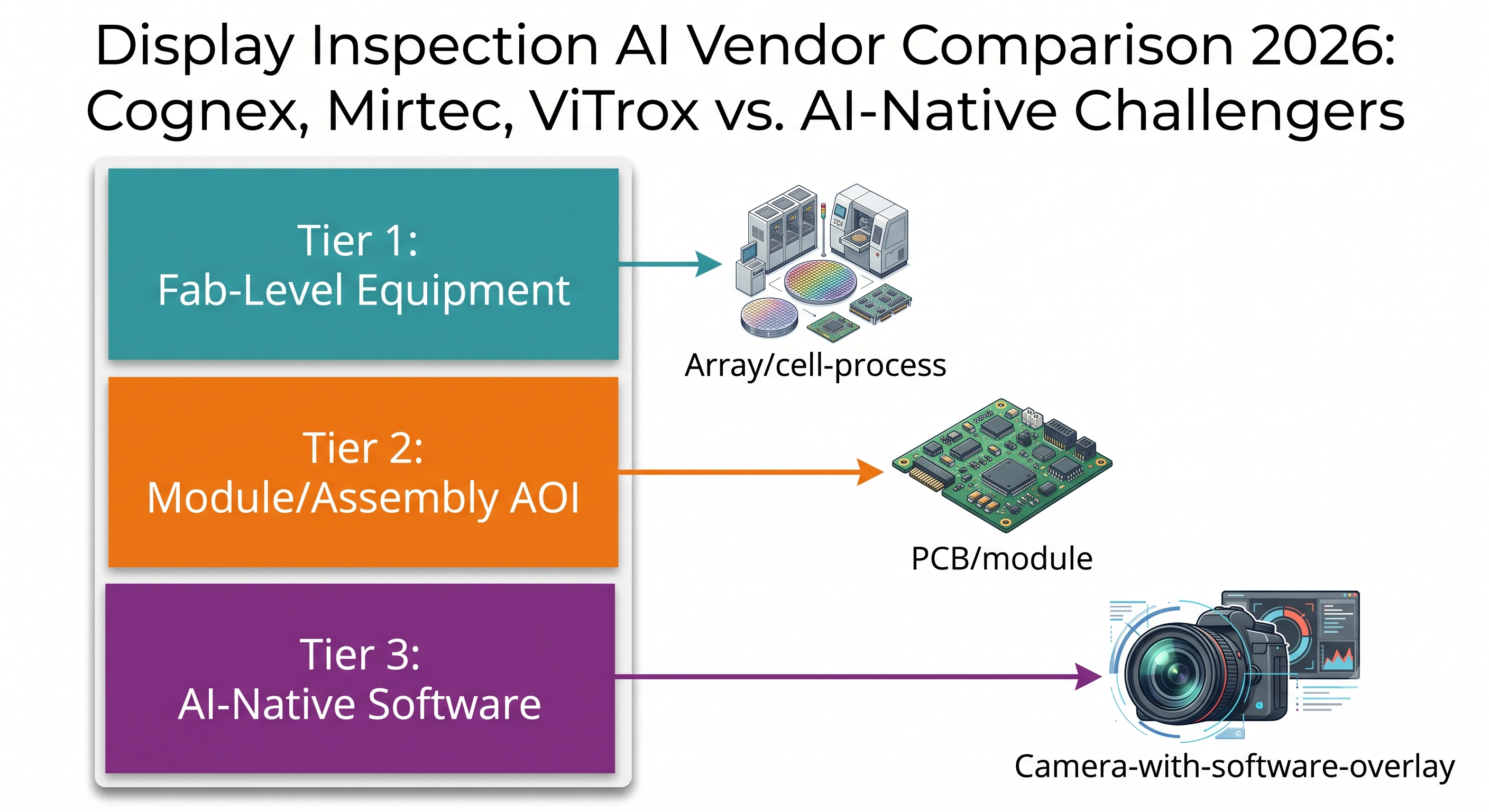
If you're evaluating display inspection AI vendors, the first thing to know is that most "AOI vendor" content blurs together three structurally different tiers: fab-level equipment makers (KLA/Orbotech, Applied Materials, SCREEN Holdings, Hitachi High-Tech) who inspect panels inside the array/cell fabrication process; module/assembly-level AOI vendors (Cognex, Mirtec, ViTrox) who inspect at the PCB, module, and back-end assembly stage; and a newer wave of AI-native software challengers (Delvitech, DaoAI, Landing AI, Averroes.ai, Instrumental) selling camera- or software-based inspection layered on top of an existing line. Of the three vendors most often named together in search results like this one, only Cognex has clearly documented display-panel-specific product lines — Mirtec and ViTrox are predominantly SMT/PCB and semiconductor back-end AOI vendors whose display relevance sits at module assembly, not inside the fab. Which tier you should actually evaluate depends on which line stage has the defect problem, not on which vendor name shows up most often in generic "top AOI vendors" listicles.
For how the underlying inspection technology itself works — manual vs. rule-based vs. deep-learning AOI — see Machine Vision for Display Defect Inspection. This article treats that mechanism as settled background and focuses entirely on the buyer's-guide question that comes next: which vendor, for which stage of the line.
Quick Facts
| Question | Answer |
|---|---|
| How many vendor tiers actually exist in display inspection? | Three — fab-level equipment makers (KLA/Orbotech, Applied Materials, SCREEN Holdings, Hitachi High-Tech), module/assembly AOI vendors (Cognex, Mirtec, ViTrox), and AI-native software challengers (Delvitech, DaoAI, Landing AI, Averroes.ai, Instrumental) |
| Do Cognex, Mirtec, and ViTrox compete head-to-head for display work? | Not really — only Cognex has named display-panel-specific product lines (OLED Gauging, MicroLED Panel Inspection); Mirtec and ViTrox's public product pages are predominantly SMT/PCB and semiconductor back-end AOI, with display-module inspection as an adjacent use case |
| What does fab-level panel inspection equipment cost? | No verifiable public per-unit price was found — it's widely understood to be capital-equipment tier, orders of magnitude above module-level AOI hardware, but that's a qualitative description, not a citable number |
| What does module-level AOI hardware cost? | One AI-inspection vendor's own published estimate (Averroes.ai) puts PCB/module AOI hardware at roughly $30K–$200K+ per unit plus $20K–$150K in integration/NRE — vendor-sourced, not an independently verified industry figure |
| Which tier should you evaluate first? | Depends on where the defect problem lives — array/cell process defects need fab-level equipment vendors, module/back-end assembly defects fit AOI vendors, and new software-only inspection use cases fit AI-native challengers |
The Three-Tier Vendor Map
The core mistake in most vendor-comparison content on this topic is treating "AOI vendor" as one competitive set. In practice, a panel maker's fab-level array/cell inspection budget, a module assembler's AOI line-item budget, and a plant's software-license budget for an AI inspection overlay are usually different purchase decisions made by different buyers inside the same company — sometimes years apart, and rarely evaluated against each other.
| Tier | Line Stage | Representative Vendors | What They Actually Sell | Typical Buyer |
|---|---|---|---|---|
| 1 — Fab-level equipment | Array/cell process, inside the panel fab | KLA (via Orbotech), Applied Materials, SCREEN Holdings, Hitachi High-Tech | Capital equipment — inspection systems integrated into or alongside the array/cell production line itself | Panel fab process/equipment engineering teams |
| 2 — Module/assembly AOI | PCB, module, and back-end assembly | Cognex, Mirtec, ViTrox | Camera-based AOI hardware and software for module assembly and back-end lines; only Cognex has named display-panel product lines | Module assembly and back-end quality engineering teams |
| 3 — AI-native challengers | Overlay on existing lines, any stage | Delvitech, DaoAI, Landing AI, Averroes.ai, Instrumental | AI/software-first inspection platforms, often positioned as an upgrade layer on top of existing camera hardware rather than a full hardware replacement | Quality/process teams evaluating a software or retrofit upgrade |
Self-select before reading vendor detail: if your defect problem is inside the array/cell process, Tier 1 is the only relevant conversation. If it's at module or back-end assembly, Tier 2 is your baseline and Tier 3 is worth evaluating as a potential upgrade or complement to what you already run.
Tier 1: Fab-Level Panel Inspection Equipment Makers
KLA, Applied Materials, SCREEN Holdings, and Hitachi High-Tech make up the fab-level tier — the equipment that inspects panels inside the array and cell fabrication process itself, not after the panel has left the fab. KLA's presence in this market is largely built on its acquisition of Orbotech, which closed on February 20, 2019 for total consideration of approximately $3.26 billion — Orbotech shareholders received $38.86 per share in cash plus 0.25 of a share of KLA common stock per Orbotech ordinary share, for total consideration of $65.93 per share (per KLA's official acquisition-completion announcement; see Sources) — which brought Orbotech's flat-panel-display inspection and metrology systems under KLA's umbrella; KLA continues to market and support this line through an "Orbotech Innovation" channel rather than folding it into a generic KLA product name (see Sources). Applied Materials, SCREEN Holdings, and Hitachi High-Tech round out this tier with their own process-integrated inspection and metrology offerings for panel fabrication.
Market-research aggregator sites (VerifiedMarketReports, dataintelo, and pmarketresearch among them, per this research pass) put the flat-panel-display inspection equipment market at roughly $3.8 billion in 2025, growing to around $3.99 billion in 2026, with KLA and Applied Materials together holding more than 22% combined share and the top five vendors holding roughly 51.3% of the market. These figures should be read as market-research estimates, not verified fact — they weren't traceable back to a primary source (a vendor 10-K, investor-relations segment disclosure, or comparable filing) reliable enough to cite as confirmed, and this article isn't upgrading their confidence level just because they support the narrative that this tier is concentrated among a handful of large players.
No verifiable public per-unit price exists for fab-level panel inspection tools from any of these four vendors. This is capital equipment purchased through direct vendor negotiation, not list-priced hardware — it's reasonable to describe it qualitatively as orders of magnitude above module-level AOI pricing, but no specific number should be treated as citable until a primary source discloses one.
Tier 2: Module/Assembly AOI Vendors — Where Cognex, Mirtec, and ViTrox Actually Differ
This is the tier that gets conflated with Tier 1 most often in generic vendor listicles, and it's also the tier where the three vendors named in most searches for this topic aren't actually direct competitors with each other on display work specifically.
| Vendor | Documented Display-Specific Products | Core Business | Display Relevance |
|---|---|---|---|
| Cognex | OLED Gauging, MicroLED Panel Inspection (named product/industry pages, see Sources) | Machine vision hardware and software across multiple industries, including electronics | Direct — Cognex publishes display-panel-specific product pages for OLED and MicroLED inspection |
| Mirtec | None found as a named display-panel product category | SMT/PCB and semiconductor back-end AOI (e.g., MV-6 OMNI, ART 3D AOI product lines — see Sources) | Adjacent/overlapping — display-panel-module inspection is a possible use case for its general AOI hardware, not a marketed product category |
| ViTrox | None found as a named display-panel product category | Semiconductor back-end and SMT/PCB AOI/AXI | Adjacent/overlapping — same pattern as Mirtec: general-purpose AOI hardware that could touch display module assembly, not a dedicated display product line |
Cognex is the only one of the three with a documented display-specific product angle, built specifically around OLED Gauging and MicroLED Panel Inspection use cases (see Sources for both product pages). Mirtec and ViTrox's public product catalogs are built around SMT/PCB assembly and semiconductor back-end inspection — their relevance to display manufacturing is at the module-assembly level (inspecting the boards and modules that go into a display product), not inside the panel fabrication process, and neither markets a named "display panel inspection" product category the way Cognex does.
ViTrox's own site states that its V510i DST AOI system was honored with the 2025 New Product Introduction (NPI) Award from Circuits Assembly, in the "Test and Inspection – AOI" category, on March 10, 2025 (see Sources). This is a trade-publication-administered industry award recognizing product innovation, not an independent third-party performance benchmark — it should be read as "won a named industry award from a trade publication" rather than as validated superiority over competing AOI systems.
Tier 3: AI-Native Challengers
The third tier — Delvitech, DaoAI, Landing AI, Averroes.ai, and Instrumental — is made up of newer, AI-software-first companies that generally position themselves as an upgrade layer for existing inspection hardware rather than as a replacement for either Tier 1 or Tier 2 equipment. None of these companies are capital-equipment-priced at the fab-equipment level; they're closer to SaaS or software-plus-integration pricing, which is also why this tier is the one worth checking for referral or partner programs if there's ever a monetization angle worth revisiting.
| Vendor | Positioning | Notable Claim (Hedged) |
|---|---|---|
| Delvitech | AI-native AOI platform (ATON/HORUS) | Showcased at APEX EXPO 2026 per I-Connect007's coverage (see Sources) — verify against that article directly rather than a search-summary paraphrase |
| DaoAI | "Feature Cognition Inspection," described as agentic AI layered onto AOI | Per DigiTimes coverage of DaoAI's own announcement (see Sources), corroborated by DaoAI's own About page, which lists Siemens and BASF among its partners (see Sources): the Siemens partnership centers on electronics-manufacturing automation-platform integration, and the BASF partnership centers on vision-analysis applications in chemicals — neither is display-panel-specific, and both should be read as DaoAI-reported partnership scope rather than an independently audited case study |
| Landing AI | Founded by Andrew Ng; product is LandingLens | Low-risk claim, but confirm current company positioning and product naming are still accurate at publish time |
| Averroes.ai | AI-based visual inspection software | Self-reports ">99% accuracy" — a vendor marketing figure, not independently verified; treat as vendor-reported if referenced at all |
| Instrumental | AI-based manufacturing quality/inspection platform | General electronics manufacturing focus; display-panel-specific relevance is not clearly documented and shouldn't be assumed |
None of these five companies' claims above should be read as confirmed third-party benchmarks — each is a vendor's own reported figure or a trade-press paraphrase of one, and they're presented here exactly that way rather than as verified performance data.
What This Actually Costs (and What Nobody Will Confirm)
Pricing transparency drops off sharply as you move up the tiers. For module/PCB-level AOI hardware, the only concrete figures found during research came from Averroes.ai's own blog — a vendor in this exact market, not a neutral source — which estimates roughly $30,000 to $200,000+ per unit for AOI hardware, plus another $20,000 to $150,000 for integration and non-recurring engineering costs. Those numbers are worth knowing as a directional range, but they should be attributed explicitly as one AI-inspection vendor's own published estimate, not presented as an independently verified industry-wide figure.
For fab-level equipment from KLA, Applied Materials, SCREEN Holdings, or Hitachi High-Tech, no verifiable public per-unit price exists. These are capital-equipment-tier purchases negotiated directly with the vendor — industry understanding places them far above module-level AOI pricing, but that's a qualitative statement, not a number this article is willing to invent. Anyone budgeting for this tier should treat a specific dollar figure sourced anywhere online as unverified until a vendor quote confirms it.
Which Tier Should You Actually Evaluate First?
Start with where the defect actually shows up on your line, not with which vendor name is most familiar:
- Array/cell-process defects inside the panel fab — this is a Tier 1 conversation. Only KLA (Orbotech), Applied Materials, SCREEN Holdings, and Hitachi High-Tech are realistic vendors here; Cognex, Mirtec, ViTrox, and the AI-native challengers don't operate at this stage.
- Module or back-end assembly defects — this is a Tier 2 conversation, with Cognex as the vendor with an actual display-specific product angle (OLED Gauging, MicroLED Panel Inspection). Mirtec and ViTrox are worth evaluating if your defect profile overlaps with general SMT/PCB assembly issues rather than display-specific optical defects.
- A software upgrade to existing camera hardware, or a new inspection use case that doesn't justify a full hardware purchase — this is where Tier 3 fits. Delvitech, DaoAI, Landing AI, Averroes.ai, and Instrumental are worth evaluating as a layer on top of what you already run, with every performance claim treated as vendor-reported until you validate it against your own defect population.
The practical mistake this three-tier map is meant to prevent: requesting a quote from a Tier 2 or Tier 3 vendor for a problem that actually requires Tier 1 equipment, or vice versa, because a listicle presented all of them as competing for the same purchase decision.
FAQ
Q: What's the difference between fab-level and module-level display inspection equipment?
A: Fab-level equipment (KLA/Orbotech, Applied Materials, SCREEN Holdings, Hitachi High-Tech) inspects panels inside the array/cell fabrication process, before the panel leaves the fab. Module-level AOI (Cognex, Mirtec, ViTrox) inspects at the PCB, module, and back-end assembly stage, after fab-level processing is complete. They're different purchase decisions serving different line stages, not competing options for the same budget.
Q: Is Cognex a display inspection company?
A: Cognex has documented display-panel-specific product lines — OLED Gauging and MicroLED Panel Inspection — making it the clearest fit among the three module/assembly AOI vendors commonly named for display work. It's a machine vision company serving multiple industries, with display inspection as one named category rather than its sole focus.
Q: Do Mirtec and ViTrox make display inspection equipment?
A: Not as a named product category. Both companies are predominantly SMT/PCB and semiconductor back-end AOI vendors; their relevance to display manufacturing is at the module-assembly level as an adjacent or overlapping use case for their general-purpose AOI hardware, not a dedicated display-panel product line the way Cognex offers.
Q: How much does a display panel inspection system cost?
A: It depends entirely on the tier. No verifiable public price exists for fab-level equipment from KLA, Applied Materials, SCREEN Holdings, or Hitachi High-Tech — it's capital-equipment-tier pricing negotiated per deal. For module/PCB-level AOI hardware, one vendor's own published estimate (Averroes.ai) suggests roughly $30,000–$200,000+ per unit plus $20,000–$150,000 in integration costs — a vendor-sourced figure, not an independently verified industry number.
Q: What is AI-native AOI, and how is it different from traditional machine vision vendors?
A: AI-native challengers like Delvitech, DaoAI, Landing AI, Averroes.ai, and Instrumental build their inspection products around AI/software as the core offering, often positioned as an upgrade layer on top of existing camera hardware rather than a full hardware replacement. Traditional AOI vendors like Cognex, Mirtec, and ViTrox sell integrated camera-and-software hardware systems, with AI/deep-learning models increasingly built into those systems as well rather than sold as a separate software-only layer.
Sources
- Cognex — OLED Gauging
- Cognex — MicroLED Panel Inspection
- KLA — Orbotech Innovation Channel
- KLA Investor Relations — "KLA Completes Acquisition of Orbotech Ltd."
- I-Connect007 — "Smarter AOI: Delvitech Brings Native AI to AOI" (APEX EXPO)
- DigiTimes — "DaoAI Brings Agentic AI to AOI with Feature Cognition Inspection"
- DaoAI — About page (lists Siemens and BASF among its partners)
- MIRTEC — MV-6 OMNI product page
- MIRTEC — ART 3D AOI product page
- ViTrox — company/product pages
- ViTrox — "ViTrox's V510i DST AOI Wins 2025 NPI Award: A Leap Forward in Innovation"
- LG Display Newsroom — "Revolutionizing OLED Manufacturing Processes with an 'AI Production System'" — cited here as the one disclosed example of what a panel maker's own internal AI inspection system looks like, in contrast to third-party vendor products
Market-share and market-size figures cited above (flat-panel-display inspection equipment market size, KLA/Applied Materials combined share, top-5 vendor share) came from market-research-aggregator sites (VerifiedMarketReports, dataintelo, pmarketresearch) rather than a primary source and are attributed as estimates in the body text rather than listed here as verified sources. AOI hardware/integration pricing bands came from Averroes.ai's own blog, a self-interested vendor source, and are likewise attributed as such in the body rather than cited as an independent figure.
Author Bio
The Whitepaper Skeptic's project experience working with a global materials supplier on a display-manufacturing initiative included sitting in on internal capex conversations that routinely conflated fab-level inspection equipment budgets with module-level AOI line items — the same tier confusion this article's three-tier vendor map is built to clear up before a reader requests a single quote.
Related Posts
- How Are OLED and LCD Displays Manufactured? A Guide to Panel Fabrication and Inspection — the pillar guide this vendor-selection piece builds on
- Machine Vision for Display Defect Inspection: How AOI and Deep Learning Catch Sub-Pixel Defects — for how the underlying rule-based-vs-deep-learning inspection technology actually works; this article covers vendor selection, not the mechanism
- OLED Thin-Film Encapsulation Explained: How Barrier Films Keep Flexible Displays From Dying in Days — the material/process choices that determine which defect types a vendor's inspection system actually needs to catch
Tags
AOI vendors, display inspection equipment, machine vision, vendor comparison, AI-native inspection


Comments
Post a Comment