Korea vs. Taiwan vs. Japan Deep Tech Funding: 2026 Comparison Guide
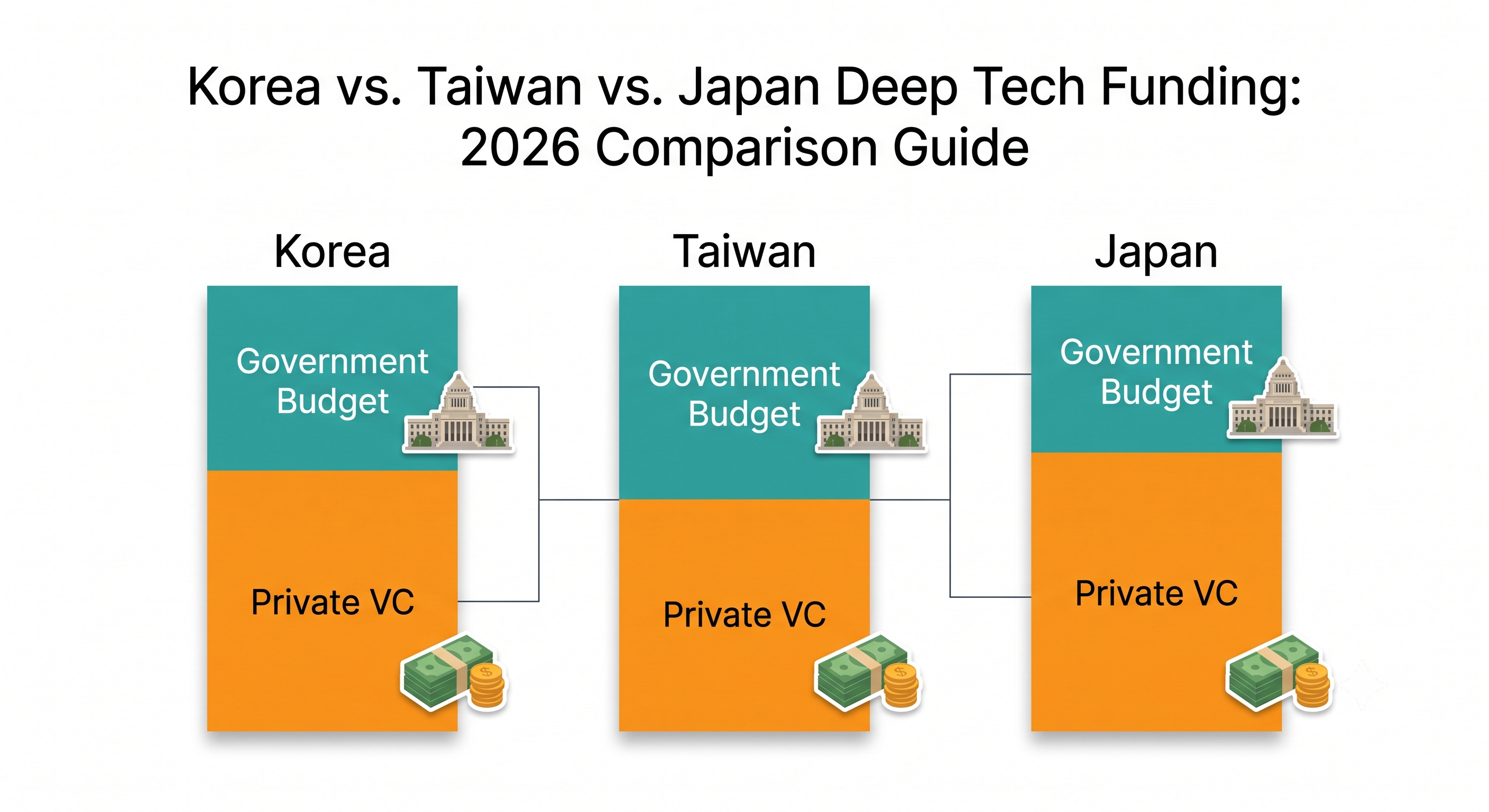
Korea, Taiwan, and Japan are each running large but structurally different deep tech funding stacks in 2026: Korea combines a ₩3.4645 trillion 2026 government startup budget with a fast-maturing private VC scene and a distinctive 기술료 (technology-fee) clawback model; Taiwan is channeling NT$100 billion+ into AI-infrastructure-linked VC activity under its Ten Major AI Infrastructure Projects; and Japan is executing a multi-year, trillion-yen-scale startup investment plan, alongside a newer, separate AI-specific investment commitment announced in December 2025. For a foreign founder or investor, the real difference isn't total dollars — it's how each country structures non-dilutive grants, typical check sizes, and IP/ownership terms, differences a first-ever July 2026 wave of cross-border cooperation between the three countries' VC associations is now actively working to bridge.
Quick Facts
| Question | Answer |
|---|---|
| Which country has the largest disclosed 2026 government deep-tech budget line? | Korea's 2026 startup support budget is ₩3.4645 trillion — the largest single disclosed figure among the three, though Japan's 5-year ¥10 trillion startup investment target is larger in total multi-year scope |
| What connects Korea, Taiwan, and Japan's funding ecosystems in 2026? | A first-ever joint stage appearance by the three countries' VC association heads at the Asia VC Summit (Taipei, July 7-8, 2026) — where KVCA also concluded its cross-border co-investment MOU with Taiwan's TVCA/TPEA — followed two days later by a second KVCA MOU with Vietnam's VPCA (Ho Chi Minh City, July 9, 2026); KVCA publicly announced both agreements on July 15, 2026 |
| Does Korea have a funding mechanism Taiwan and Japan don't? | Yes — Korea's 기술료 (technology fee) clawback model requires grant recipients to repay a share of government R&D funding, but only if the technology is later commercialized successfully |
| Which country currently has the most developed foreign-investor pathway? | Korea, via the K-Invest Hub and 2026 USD-direct LP contribution rules — though the July 2026 Taiwan-Korea-Vietnam MOUs signal Taiwan is actively building toward the same |
Korea's Deep Tech Funding Stack in 2026
Korea's model layers two distinct tracks. On the non-dilutive side, TCB (기술신용평가, technology credit bureau) certification and government R&D grants — the subject of our pillar guide to how South Korea funds deep tech startups — provide early-stage prototyping capital tied to a ₩3.4645 trillion 2026 startup support budget. That figure is confirmed directly by the Ministry of SMEs and Startups' (중소벤처기업부) integrated 2026 startup-support announcement (published December 19, 2025 via the government's official 정책브리핑 channel): 111 central and local institutions will run 508 startup-support projects on that combined budget, up 5.2% from 2025's ₩3.294 trillion.
On the private-capital side, Korea Investment Partners, Hashed, Kakao Ventures, Company K Partners, and a16z's new Seoul office anchor a VC scene increasingly co-funded by large government vehicles like the KDB National Growth Fund and KIC's strategic investment account — covered in full in our guide to Korea's deep tech VC ecosystem.
What genuinely differentiates Korea from Taiwan and Japan is the 기술료 (technology fee) clawback attached to many R&D grants: rather than treating grant funding as a pure subsidy, Korea structures it closer to a success-contingent, royalty-style repayment — the government recoups a share of the grant only once (and if) the funded technology is commercialized. Neither Taiwan's nor Japan's programs, as far as this research surfaced, use an equivalent contingent-repayment mechanism at this scale; most of their non-dilutive support functions as a straightforward grant or matching-fund model. Our deep dive on who owns the IP from a Korean government R&D grant covers exactly how the technology-fee trigger works.
Taiwan's Deep Tech Funding Stack in 2026
Taiwan's 2026 push centers on its Ten Major AI Infrastructure Projects (AI新十大建設), unveiled by the Executive Yuan's National Development Council (國家發展委員會). At a July 21, 2025 briefing, NDC Chairman Liu Jing-ching stated the government would provide roughly NT$100 billion (~US$3.2B) in venture capital funding as one pillar of the plan, alongside talent development and three planned international-grade AI labs — confirmed by Taiwan's Central News Agency (CNA), the island's official/semi-official newswire.
Structurally, Taiwan's advantage is proximity to its own semiconductor supply chain — VC activity there skews toward startups with a direct line into TSMC-adjacent manufacturing, packaging, and equipment ecosystems, a different center of gravity than Korea's broader mix of semiconductors, robotics, and AI software, or Japan's more diversified deep tech base. The Taiwan Venture Capital & Private Equity Association (TVCA) and Taipei-based TPEA are the two industry bodies most active in coordinating this activity, and both were on stage at the July 2026 Asia VC Summit described below.
Japan's Deep Tech Funding Stack in 2026
Japan's government set a 5-year, ¥10 trillion startup investment target (public and private capital combined, by March 2028) under its 2022 Startup Development Five-Year Plan, launched by the Cabinet Secretariat's New Form of Capitalism Realization Council in November 2022 with a baseline of roughly ¥820 billion in 2021 startup investment (JETRO Invest Japan Report 2023) — this is an aggregate public-and-private investment goal, not a direct government spending line. Subsequent industry reporting shows progress has lagged the original pace: 2024 startup investment came in at roughly ¥874.8 billion, little changed since the plan's 2022 launch, prompting VC-industry skepticism that the ¥10 trillion target is reachable (Nikkei xTECH).
Separately — and this is a genuinely distinct program, not a single-year slice of the ¥10 trillion figure — Japan's Cabinet approved the country's first-ever AI Basic Plan (人工知能基本計画) on December 23, 2025, committing roughly ¥1 trillion (~$6.4B) in government funding over five years (FY2026–FY2030) specifically to domestic AI development, including foundation models and "physical AI" applications; Jiji Press reported the ¥1 trillion figure directly from the government's December 19-21, 2025 announcement. For the concrete single-year FY2026 (April 2026–March 2027) number, Japan's Ministry of Economy, Trade and Industry (METI) budgeted ¥1.239 trillion (~$8B) specifically for semiconductors and AI combined — a 3.7x increase over FY2025, also confirmed via Jiji Press. A separately reported ¥350 billion figure refers to a narrower, unrelated program: AMED's (Japan Agency for Medical Research and Development) Drug Venture Ecosystem Strengthening fund for biopharma startups, established under a 2021 cabinet decision — it is not part of the general startup or AI investment totals above and should not be read as a competing or additive FY2026 figure.
On the deal-flow side, Tracxn's database counted 247 active Deep Tech companies in the Tokyo area as of January 2026 — a proprietary-database figure worth citing by name rather than treating as an official government statistic. The Japan Venture Capital Association (JVCA) is the industry body most directly comparable to Korea's KVCA and Taiwan's TVCA/TPEA, and its head joined both on stage at the July 2026 Asia VC Summit.
Head-to-Head Comparison
| Dimension | Korea | Taiwan | Japan |
|---|---|---|---|
| 2026 government commitment (disclosed) | ₩3.4645T startup support budget (~$2.6B) | NT$100B+ VC funding tied to Ten Major AI Infrastructure Projects (~$3.2B) | 5-yr ¥10T public+private startup target (by FY2027); separate AI Basic Plan adds ~¥1T over FY2026–30 (~$6.4B, Cabinet-approved Dec 2025); FY2026 METI AI+chip budget alone: ¥1.239T (~$8B) |
| Distinctive non-dilutive mechanism | 기술료 (technology fee) success-contingent clawback on R&D grants | Grant/matching-fund model tied to AI infrastructure priorities | Grant and public-support package model, less contingent-repayment structure |
| Private VC center of gravity | Broad mix: semiconductors, robotics, AI software, advanced materials | Semiconductor supply chain / TSMC-adjacent manufacturing and equipment | Diversified deep tech base; Tokyo counted at 247 active companies (Tracxn, Jan. 2026) |
| Lead VC industry association | KVCA (Korea Venture Capital Association) | TVCA / TPEA (Taiwan Venture Capital & Private Equity Association / Taipei) | JVCA (Japan Venture Capital Association) |
| Foreign-investor accessibility (2026) | Most developed: K-Invest Hub, USD-direct LP contribution rules, FIPA/D-8 visa pathway | Actively expanding via July 2026 cross-border MOUs | Less foreign-investor-specific infrastructure surfaced in this research pass |
The July 2026 Cross-Border Cooperation Wave
Three dated milestones across nine days in July 2026 mark a genuine inflection point in how Korea, Taiwan, and Japan's deep tech funding ecosystems relate to each other. They're closely spaced but distinct, and shouldn't be flattened into a single "MOU signing" event — the actual signings happened at and immediately after the Taipei summit, with the public announcement following nearly a week later.
July 7-8, 2026 — the Asia VC Summit and Taiwan MOU signing (Taipei). Hosted by Taiwan's TVCA/TPEA as the centerpiece of a broader two-day program, this was the first time the heads of Taiwan's, Japan's (JVCA), and Korea's (KVCA) national venture capital associations shared a stage together. AI, cross-border investment, digital assets, and deep tech were named as core agenda themes. During this same event, KVCA concluded a memorandum of understanding with Taiwan's TVCA/TPEA to jointly foster venture investment, including plans for a cross-border co-investment fund between Korea and Taiwan.
July 9, 2026 — KVCA's Vietnam MOU signing (Ho Chi Minh City). Days after the Taipei summit, KVCA held a separate agreement ceremony with Vietnam's VPCA, committing to similar cross-border investment cooperation.
July 15, 2026 — public announcement. KVCA publicly announced both already-concluded agreements via press release; this is the date most secondary coverage cites, but it is the announcement date, not a third signing event. KVCA Chairman Kim Hak-kyun described the move as a "practical expansion of our global investment territory."
Taken together, these three dates signal that the historically siloed funding ecosystems of Korea, Taiwan, and Japan (plus Vietnam, via the same MOU wave) are moving toward more active cross-border co-investment — which matters directly for a foreign founder or investor trying to decide which country's funding stack to plug into first, since a fund based in one country may increasingly have direct access to deal flow or co-investment capacity in another.
Which Ecosystem Fits Your Funding Stage?
- Very early-stage, prototyping-heavy deep tech — Korea's non-dilutive TCB/R&D grant system, paired with the technology-fee model, gives founders a lower-risk way to fund early technical validation before taking on dilution; see our pillar guide and Series A pitch deck guide for what comes after.
- Semiconductor supply-chain-adjacent hardware — Taiwan's proximity to TSMC-linked manufacturing and its Ten Major AI Infrastructure Projects funding make it a natural fit if the startup's value proposition is tightly coupled to advanced packaging, equipment, or fab-adjacent processes.
- Broader deep tech with an eye on Japan's domestic enterprise market — Japan's larger multi-year public commitment and growing Tokyo deep tech base suit startups prioritizing access to Japan's large domestic enterprise and industrial customer base alongside funding.
- Cross-border co-investment strategy — the July 2026 MOU wave means a startup or investor with ties to one of these three ecosystems (or Vietnam) should increasingly expect deal flow and co-investment paths to widen across all of them, rather than treating each market as fully separate.
FAQ
Q: Which Asian country offers the most deep tech startup funding in 2026?
A: It depends on what's being measured — Korea has the largest single disclosed 2026 government budget line (₩3.4645 trillion), but Japan's 5-year ¥10 trillion startup investment target is larger in total multi-year scope, and Taiwan's funding is more narrowly concentrated on AI-infrastructure and semiconductor-adjacent projects.
Q: How much does the Korean government spend on deep tech startups?
A: Korea's 2026 startup support budget is confirmed at ₩3.4645 trillion (roughly $2.6B) by the Ministry of SMEs and Startups' integrated 2026 announcement, layered under a separate private VC ecosystem that itself includes large government co-investment vehicles — see our Korea deep tech VC ecosystem guide for the full breakdown.
Q: What's the difference between Korea, Taiwan, and Japan's deep tech VC scenes?
A: Korea blends non-dilutive grants (with its distinctive technology-fee clawback) and a broad-sector private VC scene; Taiwan's VC activity concentrates around its semiconductor supply chain and AI infrastructure buildout; Japan runs a larger multi-year public investment target across a more diversified deep tech base, plus a newer, separate AI-specific government funding plan launched in December 2025.
Q: Can foreign founders access government deep tech funding in Taiwan or Japan the way they can in Korea?
A: Korea currently has the most developed foreign-investor infrastructure (K-Invest Hub, USD-direct LP contribution rules, FIPA/D-8 visa pathway); Taiwan and Japan's foreign-investor pathways were less prominent in this research pass, though the July 2026 cross-border MOUs between KVCA, TVCA/TPEA, and Vietnam's VPCA suggest that gap is starting to close.
Q: What happened at the Asia VC Summit in July 2026?
A: On July 7-8, 2026 in Taipei, the heads of Taiwan's TVCA/TPEA, Japan's JVCA, and Korea's KVCA shared a stage together for the first time, discussing AI, cross-border investment, digital assets, and deep tech. KVCA also concluded its cross-border co-investment MOU with TVCA/TPEA during that same event, signed a second MOU with Vietnam's VPCA on July 9 in Ho Chi Minh City, and then publicly announced both agreements on July 15, 2026 — the date most secondary coverage cites, though it marks the announcement, not the signings themselves.
Sources
- Digitimes — "Asia VC leaders call for deeper cross-border tech investment at inaugural regional summit" — Asia VC Summit dates, location, and participating associations
- Asia Business Daily (asiae.co.kr) — KVCA MOU announcement — confirms the Taiwan MOU was concluded during the July 7-8 Taipei summit and the Vietnam MOU on July 9, with July 15 as the public-announcement date (not a third signing event), plus the Chairman Kim Hak-kyun quote
- Businesskorea — "Korea Forms Venture Alliance With Taiwan, Vietnam" — corroborates the same sequence: Taiwan MOU signed July 7-8 at the summit, Vietnam MOU signed July 9 in Ho Chi Minh City, July 15 announcement
- KVCA official VC statistics portal — Korea-side VC association reference
- Korea.kr (대한민국 정책브리핑) — "내년 창업지원 예산 3조 4645억 원…정부·지자체 111개 기관 참여" — official government-channel confirmation of Korea's ₩3.4645 trillion 2026 startup-support budget, sourced from the Ministry of SMEs and Startups' integrated announcement (Dec. 19, 2025)
- CNA (Central News Agency, Taiwan) — "AI新十大建設 打造國際級實驗室、提供千億創投資金" — National Development Council Chairman Liu Jing-ching's July 21, 2025 announcement of the NT$100 billion+ venture capital fund under Taiwan's Ten Major AI Infrastructure Projects
- Jiji Press — government AI investment announcement — confirms Japan's ¥1 trillion, five-year (FY2026-FY2030) AI investment commitment, part of the AI Basic Plan approved by Cabinet decision on December 23, 2025
- Jiji Press — FY2026 METI budget — confirms METI's FY2026 single-year budget line of ¥1.239 trillion for semiconductors and AI combined (3.7x the FY2025 allocation)
- JETRO — Invest Japan Report 2023, Ch.3 Sec.10: "Startup Development Five-year Plan" — confirms the 2022 Startup Development Five-Year Plan's target of increasing startup investment to ¥10 trillion by March 2028, more than 10x the roughly ¥820 billion invested in 2021
- Nikkei xTECH — "そういえば、岸田政権のスタートアップ育成5カ年計画はどうなった?" — reports 2024 startup investment of ¥874.8 billion (roughly flat since the plan's 2022 launch) and VC-industry skepticism that the ¥10 trillion target is achievable
- AMED (Japan Agency for Medical Research and Development) — Drug Venture Ecosystem Strengthening program overview — confirms the program was established under a June 2021 cabinet decision (Vaccine Development and Production System Strengthening Strategy); cumulative budget of ¥350 billion (built from a ¥50B FY2021 supplementary budget to a ¥300B FY2022 supplementary budget) per Nikkei Biotech — this is a distinct, narrower biopharma-venture fund unrelated to the general startup/AI totals above and not a competing FY2026 figure
- Tracxn — Deep Tech Startups in Tokyo, Japan (explore database) — cited by name for the "247 active Deep Tech companies in Tokyo as of January 2026" figure (proprietary database claim, not a government statistic)
Author Bio
The Whitepaper Skeptic has advised on Series A investment readiness and TCB certification/government R&D grant preparation for Korean deep tech companies, including fielding funding-structure questions from foreign investors comparing Korea's non-dilutive grant model against other Asian markets.
Related Posts
- How South Korea Funds Deep Tech Startups: TCB Certification & Government R&D Grants Explained
- Korea's Deep Tech VC Ecosystem: Who's Funding Semiconductors, Robotics, and Advanced Materials Startups in 2026
- Who Owns the IP From a Korean Government R&D Grant? Ownership Rules and the 기술료 Technology Fee Explained


Comments
Post a Comment