Who Owns the IP From a Korean Government R&D Grant? Ownership Rules and the Technology Fee Explained
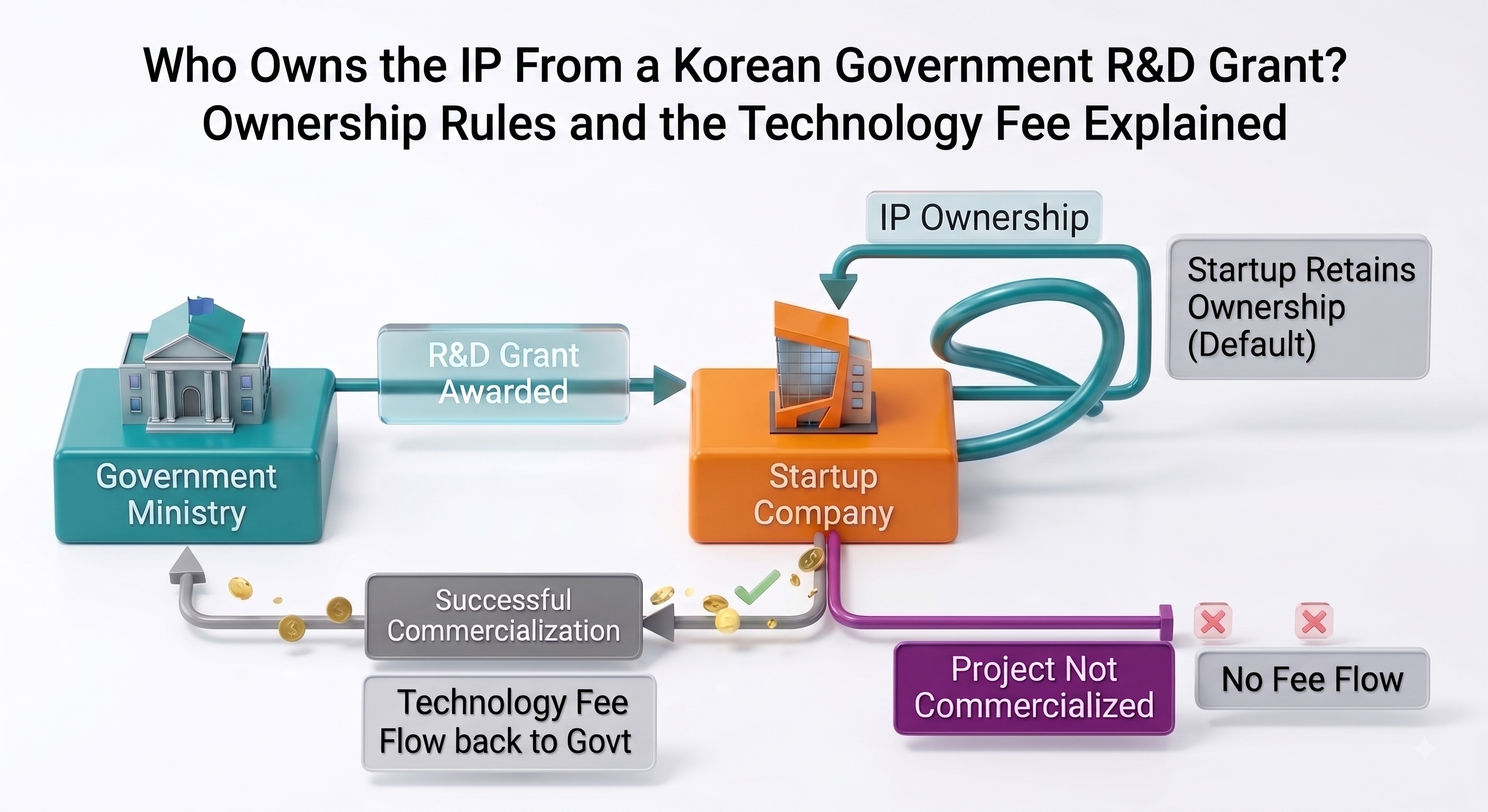
Under Korea's National R&D Innovation Act (국가연구개발혁신법), IP created through a government-funded R&D project belongs by default to the research-performing institution (원어: 연구개발기관) — for most startups acting as the lead research institution (원어: 주관연구개발기관), that means the company itself typically owns the resulting patents, not the funding ministry, unless the research agreement (원어: 연구협약서) says otherwise. That's the ownership half of the story. The other half is the technology fee (원어: 기술료): a royalty-style payment owed back to the government, but only if the funded technology is successfully commercialized — a structure genuinely different from either equity dilution or a loan. The nuances — how joint-research ownership splits, exactly what triggers the technology fee and at what rate, and whether foreign-invested companies are treated differently — are where founders and investors actually need to look closely, and that's what the rest of this article walks through.
Quick Facts
| Question | Answer |
|---|---|
| Who owns IP from a Korea gov R&D grant? | By default, the research-performing institution — a startup acting as the lead research institution typically owns it, subject to the research agreement |
| Governing law | the Act and its enforcement decree (원어: 시행령) — not a generic grant contract |
| What is the technology fee? | A royalty-style fee owed to the government only upon successful commercialization of the funded technology |
| Typical technology fee rate | Tiered by company size under the Act's enforcement decree and ministry notices (e.g., MOTIE Notice No. 2025-50): roughly 2.5% of the fee collected for small/medium enterprises, 5% for mid-sized companies, and 10% for large enterprises — most startups fall in the SME tier, so the flat "~10%" figure some aggregators cite overstates the typical case |
| What if the project fails? | No technology fee repayment is owed on a good-faith commercialization failure — but if the failure stems from willful non-performance or research misconduct, the government can separately claw back disbursed R&D funds and impose sanctions under the Act's Article 32, distinct from the technology fee |
Who Actually Owns the IP? The Default Rule Under Korean Law
This is the question most English-language coverage of Korean R&D grants skips entirely — and it's the one that actually matters once a company has a patent to defend or a cap table to explain to an investor.
IP arising from a Korean national R&D project isn't governed by whatever grant contract a ministry happens to hand a company. It's governed by the Act and its enforcement decree, a statute that applies uniformly across the government R&D grant system. The default principle under the Act is that ownership of research outputs — patents, know-how, and other IP — vests in the research-performing institution, the institution that actually performs the research.
For a startup that applies for and receives a grant as the lead research institution, that default principle works in the company's favor: the company itself typically owns the resulting IP by default, not the funding ministry or agency. This is a meaningfully different arrangement from what many foreign founders assume going in — some expect a government funder to retain a claim on the IP the way a corporate sponsor or licensor might.
The important qualifier is "by default." The research agreement signed at grant award can specify different terms, and in practice, the exact IP clause in that agreement — not just the general statutory default — is what a company should actually read closely before signing, and what a diligence counsel should ask to see before closing an investment.
Joint Research: How Ownership Splits When a Project Has Multiple Institutions
Many Korean government R&D grants are structured as joint research — a startup partnered with a university lab, a government-funded research institute (GRI), or a corporate co-applicant, each performing a defined portion of the work.
The Act's Article 16 sets the statutory basis directly: Article 16(1) establishes that research outputs are owned in principle by the research-performing institution that performed the work, succeeding to the rights from the individual researcher. Article 16(2) then carves out the joint-research case: "제1항에도 불구하고 연구개발성과의 유형, 연구개발과제에의 참여 유형과 비중에 따라 연구개발성과를 연구자가 소유하거나 여러 연구개발기관이 공동으로 소유할 수 있다" — notwithstanding the default rule, ownership can be held by the researcher individually or jointly by multiple research-performing institutions, based on the type of output and each institution's type and proportion of participation in the project. In practice, this means the actual ownership split a startup ends up with depends heavily on how the research agreement characterizes each party's participation and contribution at the outset — a term worth negotiating explicitly rather than assuming will default to something favorable.
For a startup, the practical takeaway is the same either way: if a grant-funded project involves a university or GRI co-applicant, don't assume the company will end up owning 100% of the resulting patent. Get the research agreement's IP clause reviewed before the project starts, not after a patent application is already filed.
What Is the Technology Fee and When Do You Actually Owe It?
The technology fee is where a lot of confusion sets in for foreign readers, because the closest English words — "royalty," "fee," "repayment" — don't map cleanly onto how the obligation actually works.
The technology fee is a payment a company owes back to the funding ministry or agency, but only if and when the grant-funded technology is successfully commercialized. It is not a loan that accrues regardless of outcome, and it is not equity — the government does not take a cap table position in exchange for the grant.
The technology fee is governed by the Act's Article 18 (기술료의 징수 및 사용), which requires the institution that owns the R&D outcome (원어: 연구개발성과소유기관) to collect a technology fee from anyone licensing or exploiting the funded output, then remit a portion of that fee to the government. The exact rate isn't a flat figure — it's tiered by company size and set out in ministry-level notices issued under the statute's implementing framework (e.g., the Ministry of Trade, Industry and Energy's Unified Guidelines for Technology Fee Collection and Management, currently MOTIE Notice No. 2025-50, effective April 2025). Across the notices reviewed for this article, the recurring pattern is roughly 2.5% of the fee collected for small/medium enterprises (원어: 중소기업), 5% for mid-sized companies (원어: 중견기업), and up to 10% for large enterprises (원어: 대기업), typically capped at a multiple of the government-funded portion of the R&D budget. Because most startups taking these grants qualify as SMEs, the rate that actually applies to a typical funded company is closer to the low single digits than the flat "~10%" figure that circulates in some English-language summaries — and because each funding ministry can issue its own version of the guidelines, founders should confirm the specific rate against the notice tied to their program rather than assume a single government-wide number.
The sequence below maps how IP ownership and the technology fee obligation move through a typical grant lifecycle:
| Stage | What happens to IP ownership | Is the technology fee triggered? |
|---|---|---|
| Grant awarded | No IP exists yet — ownership rules are set by the research agreement to be signed | No |
| Research agreement signed | IP ownership terms fixed for the project — default is the lead institution, subject to any joint-research split | No |
| R&D execution / IP created (patents filed, etc.) | Ownership vests per the research agreement as research outputs are generated | No |
| Project ends — commercialization fails or technology isn't adopted (good faith) | Company generally retains whatever IP it already owns; no clawback of ownership | No — but see the separate negligence/misconduct exception below |
| Project ends — technology is successfully commercialized | Ownership unchanged; company keeps the IP it already owns | Yes — the technology fee becomes due, at a rate tiered by company size (roughly 2.5%–10% of the fee collected, per current ministry notices) |
The main point this table is meant to make clear: the technology fee is a success-triggered obligation, not a background cost that accrues no matter what. A company that takes a grant, does the R&D, and never commercializes the resulting technology generally doesn't owe the technology fee on the amount received — which is a fundamentally different risk profile from venture debt.
What Happens If the Grant-Funded Project Fails?
For a founder deciding whether a government R&D grant is worth the reporting overhead, the failure case is usually the more important question than the success case.
The general rule is straightforward: no technology fee repayment is owed if the project fails to reach successful commercialization in good faith. The company doesn't lose ownership of whatever IP it already generated, either — a failed commercialization outcome on its own doesn't trigger a clawback of patents or know-how back to the government.
That "no repayment on failure" rule has a real exception, though it runs through a different statutory mechanism than the technology fee itself. Under the Act's Article 32 (부정행위 등에 대한 제재처분), if a project is discontinued or changed because the researcher or institution willfully failed to meet its obligations, if an evaluation finds the execution and results "극히 불량" (extremely poor), or if research misconduct occurred, the funding ministry can restrict that institution's or researcher's participation in national R&D activity for up to 10 years, claw back the government R&D funds already disbursed for the portion tied to the violation, and impose an additional penalty surcharge of up to five times the disbursed government funding. That's a separate track from the technology fee — it isn't triggered by ordinary, good-faith commercialization failure — but it means "the funded party owes nothing back on failure" isn't an unconditional statement. Fault-based non-performance carries real financial exposure.
This is the structural feature that makes government R&D grants attractive relative to venture debt in particular: a failed hardware R&D project doesn't leave the company owing money back on top of having burned the runway.
Do Foreign-Invested Companies Face Different IP-Ownership Rules?
This is worth stating plainly: the Act's Article 16, the article that sets the default ownership rule, does not carve out a different ownership default for foreign-invested or foreign-founded companies. The default — ownership vesting in the research-performing institution that performed the work, subject to the joint-research exception in Article 16(2) — applies on its face to any research-performing institution acting as the lead research institution, regardless of the nationality of its investors. Nothing in the research for this article turned up a separate IP-ownership provision specific to foreign-invested entities.
Where foreign investment status does matter is participation eligibility, not ownership: which grant programs a company can apply for, and under what investment-ratio conditions, is reviewed separately before a project is even selected — a distinct question from what happens to IP once a project is funded. As the pillar article on Korea's TCB and grant system establishes, foreign-invested companies incorporated in Korea can be eligible for specific grant programs depending on investment ratio and program terms. This article treats eligibility and IP-ownership defaults as the separate questions they are rather than collapsing them into one answer.
Why This Matters for Series A Due Diligence and Cap Tables
For a foreign investor or acquirer evaluating a Korean deep tech target, a company's government R&D grant history isn't a footnote — it's a set of specific documents worth requesting directly: the research agreement for each funded project, confirmation of which entity is listed as the lead research institution, and a clear accounting of whether any technology fee obligation has been triggered or is pending on a commercialized product line.
None of this should block a deal on its own — non-dilutive grant funding is, if anything, a point in a Korean startup's favor, since it means product development was subsidized without diluting the cap table the way an equivalent amount of venture debt or bridge equity would have. But a diligence process that treats "the company received a Korean government grant" as a single line item, without asking who actually owns the resulting IP and whether a technology fee payment is sitting on the books, is skipping a step that's specific to how Korean public R&D funding works. The same due-diligence lens applies to the pitching side of this: a startup preparing a Series A deck should be ready to answer the IP-ownership question cleanly on the same slide where it lists its grant and TCB history, rather than leaving investors to ask.
Founders and investors working through this for the first time in a live deal — reviewing a specific research agreement's IP clause, or confirming whether a technology fee obligation applies to a particular product line — are often better served by a targeted review than by trying to read the statute cold; that's a natural point where outside advisory support on Korean grant and TCB documentation earns its keep.
FAQ
Q: Who owns the IP created from a Korean government R&D grant?
A: By default, the research-performing institution that carried out the work — for a startup acting as the lead research institution, that typically means the company itself, subject to the terms of the research agreement signed at grant award.
Q: What is the technology fee and when do I have to pay it?
A: The technology fee is a royalty-style payment owed to the funding ministry or agency, but only if the grant-funded technology is successfully commercialized. Under the Act's Article 18 and current ministry notices, the rate is tiered by company size — roughly 2.5% of the fee collected for small/medium enterprises up to 10% for large enterprises — so the applicable rate for most startups is lower than the flat "~10%" some sources cite, and it doesn't apply if the project fails in good faith.
Q: Do I lose ownership of my IP if my grant-funded project fails?
A: Generally no — the general rule is no technology fee repayment and no clawback of already-generated IP if a project fails to reach commercialization in good faith. But if the failure stems from willful non-performance or research misconduct, the Act's Article 32 allows the government to claw back disbursed R&D funds and impose sanctions separately from the technology fee — that risk is real for fault-based failure, just not for an ordinary unsuccessful outcome.
Q: Can a foreign investor safely co-invest in a Korean startup that has government R&D grant history?
A: Grant history is generally a positive signal, not a red flag, but diligence should specifically request the research agreement for each funded project and confirm whether any technology fee obligation is pending. The statutory default ownership rule under the Act's Article 16 doesn't carve out a separate rule for foreign-invested companies — where foreign investment status matters is program eligibility, not the IP-ownership default itself.
Q: Does taking a government R&D grant affect how I present IP ownership in a Series A pitch deck?
A: Yes — investors evaluating a Korean deep tech company increasingly expect the IP-ownership and grant-history story to be addressed directly on the same slide, rather than left for due diligence to surface separately.
Sources
- 국가연구개발혁신법 원문 — 국가법령정보센터 — primary statute; Article 16 (연구개발성과의 소유 등) sets the default IP-ownership rule and the joint-research exception, Article 18 (기술료의 징수 및 사용) sets the technology fee mechanism, Article 32 (부정행위 등에 대한 제재처분) covers fault-based clawback/sanctions
- 국가연구개발혁신법 시행령 — 국가법령정보센터 — enforcement decree; Article 38 sets the technology fee remittance-rate framework referenced in this article
- 정부 R&D사업의 연구성과(특허 등) 소유권 및 관련정보 기재 안내 — 산학협력단 — plain-language institutional explainer of the ownership rule
- 기술료 징수 및 관리에 관한 통합요령 (산업통상자원부고시 제2025-50호, 2025년 4월 시행) — 관련 자료 — reference for the tiered technology fee rate structure by company size; since individual ministries issue their own version of this notice, confirm the specific notice tied to a given grant program before treating any single rate as universal
- TIPS (Tech Incubator Program for Startup) — official program site — TIPS-linked commercialization context for the technology fee
- How South Korea Funds Deep Tech Startups: TCB Certification & Government R&D Grants Explained — our own pillar article, background on the funding mechanisms this article builds on
Author Bio
The Whitepaper Skeptic has directly reviewed research agreement IP clauses and prepared technology fee commercialization reporting as part of government R&D grant applications and TCB certification work supporting Series A and IPO roadmap preparation for deep tech startups in Korea.
Related Posts
- How South Korea Funds Deep Tech Startups: TCB Certification & Government R&D Grants Explained
- Korea's Deep Tech VC Ecosystem: Who's Funding Semiconductors, Robotics, and Advanced Materials Startups in 2026
- How to Structure a Series A Pitch Deck for Deep Tech Hardware Startups
Tags
Korea R&D grant IP ownership, 기술료 technology fee, 국가연구개발혁신법, Korea startup funding


Comments
Post a Comment