Korea's Tech Guarantee Fund (KIBO) Explained: How Startups Borrow Without Collateral in 2026
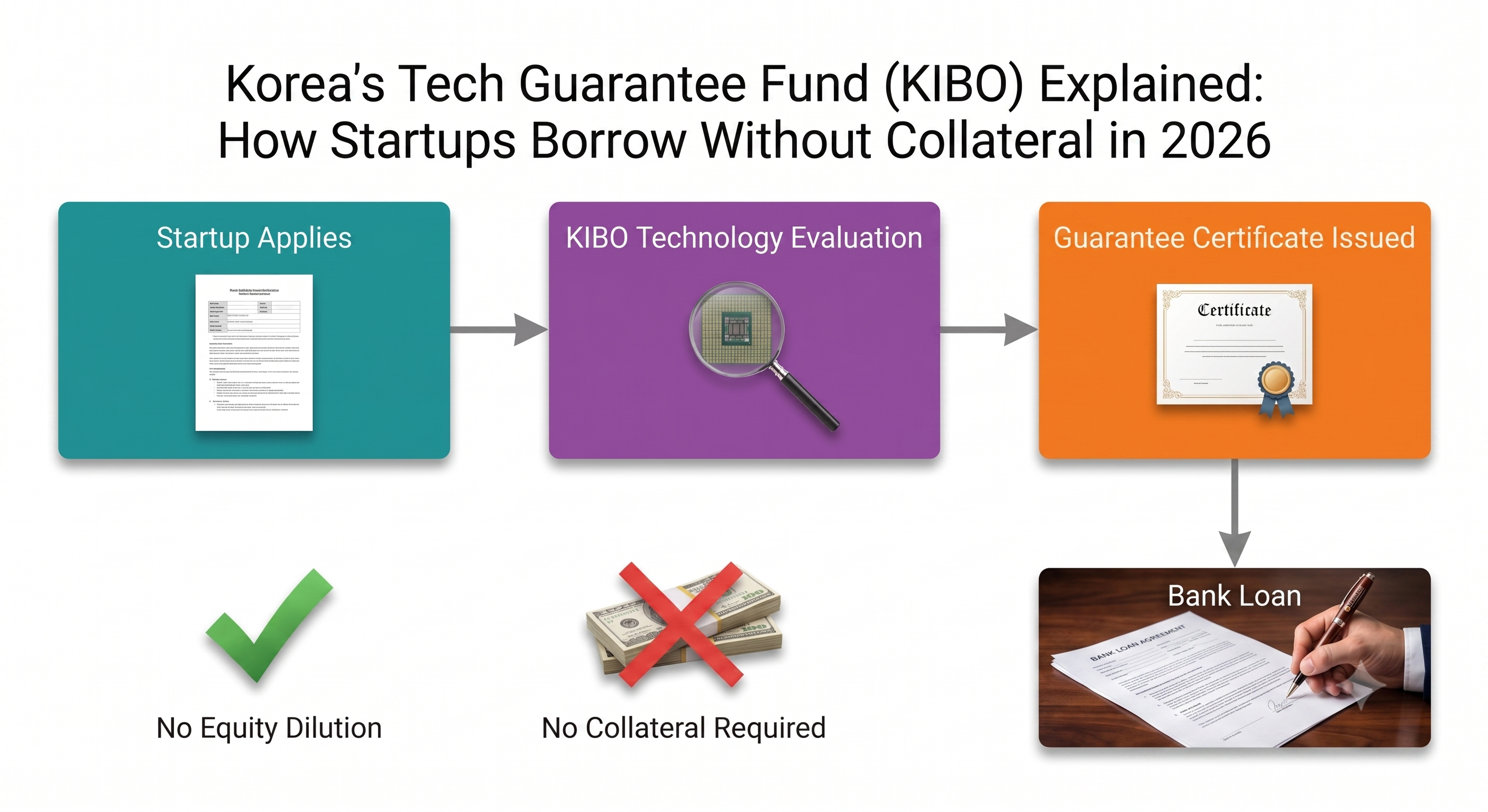
KIBO (기술보증기금, the Korea Technology Finance Corporation) is a government-backed institution that lets banks lend to technology SMEs without full collateral — not by lending the money itself, and not by handing out a grant, but by guaranteeing a share of the bank's loan against default. The company still borrows from a commercial bank, still pays interest, and still owes the principal back; KIBO just replaces some of the collateral a bank would normally require with a formal evaluation of the company's technology. That structure has no clean US or EU equivalent, which is exactly why foreign founders coming from a "venture debt" or SBA-loan mental model tend to misread it. Here's how the mechanism actually works, and what changed at KIBO in 2026.
By The Whitepaper Skeptic — prepared TCB certification technology-evaluation materials firsthand
Quick Facts
| Question | Answer |
|---|---|
| What is KIBO? | Government-backed guarantee institution (기술보증기금) — not a bank, not a grant agency, not a VC |
| Does it involve equity dilution? | No — it's debt. The company repays principal and interest to a partner bank, plus a guarantee fee to KIBO |
| How much of the loan does KIBO cover? | 85% is KIBO's standard ratio for a general new guarantee; select programs go higher — 90% partial coverage for non-startups and up to 100% full coverage for startups under KIBO's venture-linked and youth tech-star guarantee products |
| What changed in 2026? | KRW 238.9B in P-CBO issuance to 129 tech SMEs (H1), a new project-based R&D Commercialization Securitization Guarantee, and a record default (subrogation) rate that triggered a broker-fraud crackdown |
| Can foreign-invested companies apply? | Unclear — KIBO's public materials don't clearly state whether foreign-invested companies (외국인투자기업) qualify one way or the other; confirm directly with KIBO or Invest Korea before applying |
What KIBO Actually Is (and Isn't)
KIBO's Korean name, 기술보증기금, translates literally to "technology guarantee fund" — and that's a more accurate description of the institution than any English shorthand. KIBO doesn't originate loans. It doesn't write checks to startups the way a grant program or a government R&D fund does. It doesn't take an equity stake the way a VC or a mother fund's underlying GPs do. What it does is evaluate a company's technology and, based on that evaluation, issue a guarantee that a partner bank can rely on to extend a loan it wouldn't otherwise make on the company's balance sheet alone.
That last part is the whole point of the institution. Early-stage and growth-stage tech SMEs — semiconductor, robotics, biotech, defense-adjacent hardware companies — routinely have real technology value and close to nothing in the way of collateral or multi-year profit history a conventional bank underwriter would want to see. KIBO's guarantee is designed to close that specific gap, the same gap TCB (기술신용평가) certification closes on the grant and investment side of Korea's funding system.
How the Guarantee Mechanism Actually Works
The sequence, in practice, runs like this:
- The company applies to KIBO (directly or through a partner bank) and goes through KIBO's technology evaluation — a formal assessment of the underlying technology's commercial and technical merit, methodologically similar in spirit to the TCB evaluation used elsewhere in Korea's startup funding system.
- If approved, KIBO issues a guarantee certificate covering a defined share of a loan amount.
- A partner bank extends the loan against that guarantee rather than against full collateral, and the company pays the bank interest on the loan plus a separate guarantee fee to KIBO.
- If the company defaults, KIBO pays the guaranteed portion to the bank and then pursues recovery from the company through a legal process called subrogation — KIBO effectively steps into the bank's shoes as creditor for the guaranteed amount.
That fourth step matters more in 2026 than it usually would. KIBO's own credit stress has become part of the story this year, and it's worth understanding before assuming a guarantee is a free pass — see "What Changed at KIBO in 2026" below.
KIBO's Guarantee vs. Venture Debt vs. SBA Loan Guarantees
This is the comparison most foreign founders actually need, because "government-backed guarantee that helps a tech company borrow" sounds like it should map cleanly onto something they already know. It doesn't map onto venture debt at all, and it only partially maps onto an SBA-style guarantee.
| Aspect | KIBO Guarantee (Korea) | US Venture Debt | US SBA 7(a) Loan Guarantee |
|---|---|---|---|
| Who takes the primary credit risk | KIBO (government-backed institution) guarantees a share; the partner bank still underwrites the loan | The venture debt lender itself — no government backstop | The SBA guarantees a share; the lending bank still underwrites the loan |
| Basis for approval | Formal technology evaluation of the company, in place of collateral/financial history | Existing institutional VC backing and runway — lenders typically require the company already be VC-funded | Standard small-business underwriting (cash flow, some collateral, owner's personal guarantee) |
| Equity component | None — pure debt, no warrants | Usually includes warrant coverage as part of pricing (an equity kicker) | None — pure debt |
| Typical eligible company | Korean tech SME with evaluable proprietary technology | Already-funded, VC-backed startup, typically post-Series A/B | Small business meeting SBA size standards, largely US-domiciled |
| Structural closest match | — | Not this one | Closer structural cousin — both are third-party guarantees layered on a bank loan. The SBA's FY2026 7(a) schedule guarantees 85% of loans of $150,000 or less and 75% of larger loans (capped at a $3.75M maximum guaranteed amount), which is close to KIBO's 85% baseline but calculated and capped differently — and SBA loans typically also require a personal guarantee from any owner holding 20%+ equity, a requirement KIBO's technology-evaluation model doesn't have |
The mistake foreign founders make most often is reaching for "venture debt" as the mental model, because both terms involve "debt" and "tech company." But venture debt lenders bear their own credit risk and price for it with warrants; KIBO is a government institution absorbing part of the bank's risk based on a technology evaluation, with no equity attached at all. If anything, KIBO sits structurally closer to an SBA-style loan guarantee — a government backstop on a bank loan — but even that comparison breaks down on the details of what qualifies a company and how much of the loan is actually covered: KIBO's 85% baseline and the SBA's 85%/75% tiered schedule land in a similar range, but the two systems calculate, cap, and condition that coverage differently, so the ratios aren't a drop-in substitute for one another.
What Changed at KIBO in 2026
Two things are happening at KIBO at the same time this year, and they cut in opposite directions.
On the expansion side: KIBO issued KRW 238.9 billion in P-CBOs (primary collateralized bond obligations) to 129 tech SMEs in the first half of 2026. It also launched a new R&D Commercialization Securitization Guarantee this year, funded at roughly KRW 80 billion, which is structurally different from KIBO's standard company-based guarantee — it evaluates the commercialization project itself rather than the applicant company's overall technology profile. KIBO has also been signing fresh bank-partnership MOUs, including a KRW 50 billion agreement with Kyongnam Bank and a roughly $36 million partnership with KB Kookmin, both aimed at expanding guaranteed lending to AI, biotech, defense, energy, and advanced-manufacturing SMEs.
On the stress side: KIBO's net loan subrogation — the value of guarantees KIBO has had to pay out after borrower defaults — hit a record KRW 1.4258 trillion in 2025, and the subrogation rate has climbed to 4.76%, up sharply from 1.87% in 2021. That rise in defaults is part of what prompted the Ministry of SMEs and Startups to stand up a cross-agency task force, based at KIBO's headquarters, targeting fraud by "brokers" who help companies game policy-fund and guarantee programs.
Both halves of this story matter for a founder evaluating KIBO as an option in 2026: the guarantee programs are genuinely expanding and diversifying, but the underwriting environment is also visibly tightening in response to rising defaults and fraud enforcement — which is a reasonable thing to factor into how much friction to expect in the application and evaluation process this year.
Eligibility: Who Actually Qualifies (and the Open Question for Foreign-Invested Startups)
KIBO's evaluation methodology centers on the technology itself, not the company's balance sheet — the same underlying logic as TCB certification, which is why the two systems are easy to confuse even though they serve different purposes (TCB backs financing and investment decisions broadly; KIBO's guarantee specifically backs a bank loan). Having sat on the applicant side of a TCB-style technology evaluation, the pattern is familiar: reviewers are pricing the technology's commercial and technical merit, not just checking whether the company has three years of clean financial statements.
Beyond that general framework, two specific eligibility questions need direct verification before anyone treats them as settled:
- Which industries get enhanced guarantee access. KIBO's 2026 guarantee push consistently centers on six strategic sectors it refers to as its "6대 전략산업" — AI, bio, cultural content, defense, energy, and advanced manufacturing — a grouping that recurs across multiple 2026 KIBO program announcements (regional guarantee-supply drives and bank-partnership MOUs alike), not just one secondary report.
- Whether foreign-invested companies (외국인투자기업) qualify, and under what conditions. This remains genuinely unclear. KIBO's own English and Korean guarantee-overview pages don't spell out foreign-ownership eligibility either way, and independent research for this article didn't turn up a definitive public answer. Given how consequential this is for the exact audience most likely to be reading it — foreign founders and CFOs weighing a KIBO-guaranteed loan against grants or equity — don't take an assumption either way at face value. Confirm directly with KIBO or Invest Korea before relying on it for a real application.
Where a KIBO Guarantee Fits in the Funding Stack
Most explanations of Korea's deep tech funding stack — including our own TCB certification and government R&D grants overview — cover two instruments: non-dilutive grants and equity investment. A KIBO-guaranteed bank loan is a third instrument that sits alongside both, and it behaves differently from either one on the two dimensions founders actually care about: it doesn't dilute equity (unlike VC), and unlike a grant, it has to be repaid with interest regardless of whether the underlying R&D project succeeds. Our funding-sequence framework for grant vs. VC timing doesn't currently address where debt/guarantee financing fits into that sequence — in practice, a KIBO guarantee is most useful as a working-capital or bridge tool once a company has revenue or a near-term contract to service the loan against, rather than as a substitute for early derisking capital the way a grant is.
It's also worth pairing this with the rest of Korea's non-dilutive toolkit: our guide to Korea's R&D tax credit and our breakdown of Korea's startup stock option tax exemption cover two other pieces of the same "what doesn't cost you equity" picture — tax credits reduce your R&D spend after the fact, KIBO reduces your cost of capital to fund the spend in the first place, and neither one touches your cap table.
FAQ
Q: Is KIBO a government grant program?
A: No. KIBO guarantees bank loans — the company still borrows money from a commercial bank and repays principal and interest, plus a guarantee fee to KIBO. A grant, by contrast, doesn't need to be repaid at all.
Q: Does getting a KIBO guarantee mean giving up equity?
A: No. A KIBO-backed loan is pure debt financing. There's no equity stake, no warrants, and no dilution involved — that's the main structural difference from venture debt, which typically prices in warrant coverage.
Q: How is KIBO different from a US SBA-guaranteed loan?
A: They're structurally closer to each other than either is to venture debt — both are third-party guarantees layered on top of a bank loan. But the eligibility basis differs (KIBO centers on a formal technology evaluation rather than standard small-business underwriting), and the guarantee percentages aren't identical: KIBO's baseline is 85% (up to 90–100% under startup and venture-linked programs), while the SBA's FY2026 7(a) schedule guarantees 85% of loans of $150,000 or less but only 75% of larger loans, and typically also requires a personal guarantee from owners holding 20%+ equity.
Q: Can a foreign-owned startup in Korea get a KIBO guarantee?
A: This remains genuinely unclear — KIBO's public materials don't spell out foreign-ownership eligibility one way or the other, and research for this article didn't surface a definitive public answer either. Foreign-invested companies (외국인투자기업) considering this route should confirm eligibility directly with KIBO or Invest Korea before assuming either way.
Q: What happens if a company can't repay a KIBO-guaranteed loan?
A: KIBO pays the guaranteed portion to the bank and then pursues recovery from the company through subrogation — the company still owes the debt, just to KIBO instead of the bank. This isn't a forgiveness mechanism; it's a repayment-risk transfer between the bank and KIBO. KIBO's own subrogation rate has been climbing (4.76% in 2025, up from 1.87% in 2021), which is part of why underwriting scrutiny has tightened in 2026.
Sources
- KIBO (Korea Technology Finance Corporation), official English portal — Technology Valuation — KIBO's own description of the technology evaluation methodology its guarantee decisions are based on
- KIBO — 벤처투자연계보증 (venture-investment-linked guarantee) product page — KIBO's own listing of guarantee ratios (100% full guarantee for startups, 90% partial guarantee for other companies under this program), corroborating the 85% baseline ratio cited for KIBO's general new guarantees
- KoreaTechDesk (koreatechdesk.com) — 2026 reporting on KIBO's rising loan subrogation rate, new bank-partnership MOUs (Kyongnam Bank, KB Kookmin), and the Ministry of SMEs and Startups' cross-agency broker-fraud task force
- The Asia Business Daily (asiae.co.kr) — 2026 reporting on KIBO's H1 P-CBO issuance (KRW 238.9B to 129 tech SMEs) and the launch of the R&D Commercialization Securitization Guarantee
- The Herald Business (mbiz.heraldcorp.com) — 2026 reporting on the KIBO/Kyongnam Bank MOU and the Hyundai Motor/Kia/IBK enhanced guarantee-ratio partner program
- Maeil Ilbo (m-i.kr) — 2026 reporting on KIBO's regional guarantee supply confirming KIBO's "6대 전략산업" (six strategic industries): AI, bio, cultural content, defense, energy, and advanced manufacturing
- U.S. Small Business Administration (sba.gov) — 7(a) Loan Program terms, conditions, and eligibility — official FY2026 guarantee percentage schedule (85% for loans of $150,000 or less, 75% for larger loans, $3.75M maximum guaranteed amount)
- Korea Policy Briefing / Ministry of SMEs and Startups (korea.kr) — official 2026 startup-support budget announcement: KRW 3.4645 trillion across 111 central/local institutions and 508 programs, up 5.2% (KRW 170.5B) year-over-year from 2025's KRW 3.294 trillion (announced December 19, 2025)
Author Bio
The Whitepaper Skeptic has direct experience preparing TCB certification materials as part of Series A investment and IPO roadmap work — the same technology-evaluation methodology KIBO's guarantee underwriting is built on, seen from the applicant's side of the table.
Related Posts
- How South Korea Funds Deep Tech Startups: TCB Certification & Government R&D Grants Explained
- Government Grant vs. Venture Capital: A 3-Stage Funding Sequence for Deep Tech Hardware Startups (2026)
- Korea's Deep Tech VC Ecosystem: Who's Funding Semiconductors, Robotics, and Advanced Materials Startups in 2026
- Korea R&D Tax Credit for Startups Explained: Up to 50% Rates and the 2026 Eligibility Changes
- Korea Startup Stock Options Explained: How the ₩200M Tax Exemption Works for Deep Tech Employees in 2026


Comments
Post a Comment